

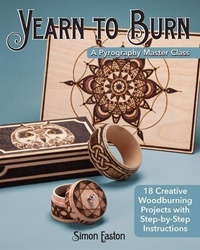
Yearn to Burn: A Pyrography Master Class
30 Creative Woodburning Projects with Step-by-Step Instructions
Published on 9. July 2019
Book
Paperback/Softback
128 pages
978-1-56523-986-9 (ISBN)
Description
Take your woodburning art to the next level by taking a masterclass with award-winning pyrographer Simon Easton! This inspired sequel to the bestselling book Learn to Burn offers the opportunity to advance your skills with guidance from a master craftsman. Yearn to Burn is organized by the life attributes that lend themselves to creativity--Live, Laugh, Love, Learn, and Life. Themed projects within each section are designed to build your skills while you create an array of handsome household items, gifts, home d cor and more. Thirty new projects with clear instructions and step-by-step photographs fit a wide variety of occasions and decors. Burn beautiful and memorable items like Christmas tree decorations, mirrored box frames, a child's wood pencil case, a hanging leather map, and more.
More details
Language
English
Place of publication
East Petersberg
United States
Product notice
Paperback (trade)
Dimensions
Height: 206 mm
Width: 255 mm
Thickness: 8 mm
Weight
548 gr
ISBN-13
978-1-56523-986-9 (9781565239869)
Copyright in bibliographic data and cover images is held by Nielsen Book Services Limited or by the publishers or by their respective licensors: all rights reserved.
Schweitzer Classification
Other editions
Additional editions
Simon Easton
Yearn to Burn: A Pyrography Master Class
18 Creative Woodburning Projects with Step-by-Step Instructions
E-Book
02/2021
Fox Chapel Publishing
€17.03
Available for download
Person
Simon Easton studied a BA (Hons) degree at Manchester Metropolitan University where he studied woodturning, silversmithing and pewterware. His pewter napkin ring set was one of the MMU winners of the Pewter Live 1999 competition, and was displayed at Pewterers' Hall in London. He has won both a Precious Metals Bursary and a Grant from the Worshipful Company of Goldsmiths in order to produce design concepts that he had developed. The common theme in Simon's work was a decorative and textural feel, often rich in embellishment or pattern.