

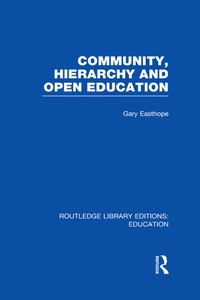
Community, Hierarchy and Open Education (RLE Edu L)
Volume 10: Community, Hierarchy and Open Education
1st Edition
Published on 8. December 2011
Book
Hardback
154 pages
978-0-415-50586-4 (ISBN)
Description
The book describes the English school, especially the secondary school, as a hierarchical community in which the head-teacher (principal) is an autocratic ruler. After explaining how that particular organisation of the school developed historically from the market situation faced by the English public (i.e. private) schools in the developing industrial society of the nineteenth century it provides empirical evidence demonstrating that the hierarchies of knowledge, teachers and students that developed then were still in place when the book was published in 1975. They are still present today.
It also looks at the challenges to the school as a hierarchical community presented by the ideologies of deschooling, progressive education and open education. Finally, it provides an explanation of why these ideologies were never put into practice in English schools despite some pioneering exemplars.
Although first published over thirty-five years ago the issues examined in it raise questions that are still central to education today:
Does size of school affect the commitment of teachers to the school, their colleagues and their students?
How can the teaching staff be organised in a school? Do all need to work to the same ends? What is the role of leadership from the head-teacher (principal) in this?
Is it possible to have a curriculum that is open without losing rigour? What should be the relationship between using local community knowledge and the educational wish to extend students' horizons?
The result is a short, nuanced, and densely argued text that demands thought and reflection from any contemporary educator.
It also looks at the challenges to the school as a hierarchical community presented by the ideologies of deschooling, progressive education and open education. Finally, it provides an explanation of why these ideologies were never put into practice in English schools despite some pioneering exemplars.
Although first published over thirty-five years ago the issues examined in it raise questions that are still central to education today:
Does size of school affect the commitment of teachers to the school, their colleagues and their students?
How can the teaching staff be organised in a school? Do all need to work to the same ends? What is the role of leadership from the head-teacher (principal) in this?
Is it possible to have a curriculum that is open without losing rigour? What should be the relationship between using local community knowledge and the educational wish to extend students' horizons?
The result is a short, nuanced, and densely argued text that demands thought and reflection from any contemporary educator.
More details
Series
Language
English
Place of publication
London
United Kingdom
Publishing group
Taylor & Francis Ltd
Target group
College/higher education
Professional and scholarly
General, Postgraduate, Professional, and Undergraduate
Dimensions
Height: 234 mm
Width: 156 mm
Weight
460 gr
ISBN-13
978-0-415-50586-4 (9780415505864)
Copyright in bibliographic data and cover images is held by Nielsen Book Services Limited or by the publishers or by their respective licensors: all rights reserved.
Schweitzer Classification
Other editions
Additional editions
Gary Easthope
Community, Hierarchy and Open Education (RLE Edu L)
Book
04/2014
1st Edition
Routledge
€81.89
Shipment within 15-20 days
Gary Easthope
Community, Hierarchy and Open Education (RLE Edu L)
E-Book
05/2012
1st Edition
Routledge
€69.99
Available for download
Gary Easthope
Community, Hierarchy and Open Education (RLE Edu L)
E-Book
05/2012
1st Edition
Routledge
€69.99
Available for download
Person
Gary Easthope
Content
Preface. Acknowledgements. Part 1: Community. 1. Three Conceptions of Community. 2. The School as a 'Hierarchical Community'. 3. The Sovereign Head. Part 2: Hierarchy. 4. Four ideologies Against Hierarchy. 5. The Reality of Hierarchy. Part 3: Open Education. 6. Open Education. 7. The Open School. Bibliography.