

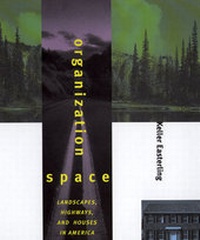
Organization Space
Landscapes, Houses and Highways in America
Published on 10. December 1999
Book
Hardback
215 pages
978-0-262-05061-6 (ISBN)
Description
The dominant architectures in our culture of development consist of generic protocols for building offices, airports, houses, and highways. For Keller Easterling these organizational formats are not merely the context of design efforts -- they are the design. Bridging the gap between architecture and infrastructure, Easterling views architecture as part of an ecology of interrelationships and linkages, and she treats the expression of organizational character as part of the architectural endeavor.
Easterling also makes the case that these organizational formats are improvisational and responsive to circumstantial change, to mistakes, anomalies, and seemingly illogical market forces. By treating these irregularities opportunistically, she offers architects working within the customary development protocols new sites for making and altering space.
By showing the reciprocal relations between systems of thinking and modes of designing, Easterling establishes unexpected congruencies between natural and built environments, virtual and physical systems, highway and communication networks, and corporate and spatial organizations. She frames her unconventional notion of site not in terms of singular entities, but in terms of relationships between multiple sites that are both individually and collectively adjustable.
Review text:
'In its innovations of form, its depth of research, its acute analysis, and its enormous relevance, this is a remarkable work. Keller Easterling has written one of the most original works about the American environment I've ever read.'
-- Michael Sorkin, architect, Institute for Urbanism, Vienna
Easterling also makes the case that these organizational formats are improvisational and responsive to circumstantial change, to mistakes, anomalies, and seemingly illogical market forces. By treating these irregularities opportunistically, she offers architects working within the customary development protocols new sites for making and altering space.
By showing the reciprocal relations between systems of thinking and modes of designing, Easterling establishes unexpected congruencies between natural and built environments, virtual and physical systems, highway and communication networks, and corporate and spatial organizations. She frames her unconventional notion of site not in terms of singular entities, but in terms of relationships between multiple sites that are both individually and collectively adjustable.
Review text:
'In its innovations of form, its depth of research, its acute analysis, and its enormous relevance, this is a remarkable work. Keller Easterling has written one of the most original works about the American environment I've ever read.'
-- Michael Sorkin, architect, Institute for Urbanism, Vienna
More details
Language
English
Place of publication
Cambridge, Mass.
United States
Publishing group
MIT Press Ltd
Target group
College/higher education
Professional and scholarly
Illustrations
37
Dimensions
Height: 234 mm
Width: 182 mm
Thickness: 20 mm
Weight
658 gr
ISBN-13
978-0-262-05061-6 (9780262050616)
Copyright in bibliographic data and cover images is held by Nielsen Book Services Limited or by the publishers or by their respective licensors: all rights reserved.
Schweitzer Classification
Person
Keller Easterling is Associate Professor, Yale University School of Architecture. She is the author of Organization Space (MIT Press, 1999).