

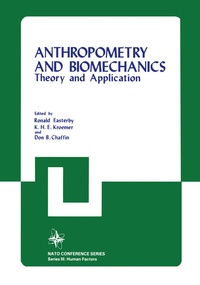
Anthropometry and Biomechanics
Theory and Application
Published on 18. February 2012
Book
Paperback/Softback
X, 328 pages
978-1-4684-1100-3 (ISBN)
Description
Assessment of the physical dimensions of the human body and application of this knowledge to the design of tools, equip ment, and work are certainly among the oldest arts and sciences. It would be an easy task if all anthropometric dimensions, of all people, would follow a general rule. Thus, philosophers and artists embedded their ideas about the most aesthetic proportions into ideal schemes of perfect proportions. "Golden sections" were developed in ancient India, China, Egypt, and Greece, and more recently by Leonardo DaVinci, or Albrecht Durer. However, such canons are fictive since actual human dimensions and proportions vary greatly among individuals. The different physical appearances often have been associated with mental, physiological and behavioral characteristics of the individuals. Hypocrates (about 460-377 BC) taught that there are four temperaments (actually, body fluids) represented by four body types. The psychiatrist Ernst Kretchmer (1888-1964) proposed that three typical somatotypes (pyknic, athletic, aesthenic) could reflect human character traits. Since the 1940's, W. H. Sheldon and his coworkers devised a system of three body physiques (endo-, meso-, ectomorphic). The classification was originally qualitative, and only recently has been developed to include actual measurements.
More details
Series
Edition
Softcover reprint of the original 1st ed. 1982
Language
English
Place of publication
New York
United States
Target group
Professional and scholarly
Research
Illustrations
X, 328 p.
Dimensions
Height: 254 mm
Width: 178 mm
Thickness: 19 mm
Weight
641 gr
ISBN-13
978-1-4684-1100-3 (9781468411003)
DOI
10.1007/978-1-4684-1098-3
Schweitzer Classification
Other editions
Additional editions
E-Book
12/2012
1st Edition
Springer
€96.29
Available for download

Book
05/1982
Kluwer Academic / Plenum Publishers
€109.28
Article exhausted; check different version
Content
Opening Address.- Postural Research - The Next Challenge to Anthropometrics and Biomechanics.- Session I: Data Acquisition Methods.- Fundamentals of Anthropometric Survey Measurement Techniques.- Evolution of the Techniques of Data Collecting and Processing in Biometry.- Results of Large-Scale Anthropometrie Surveys.- The Human Machine in Three Dimensions: Implications for Measurement and Analysis.- An Anthropometric Data Bank: Its Hidden Dimensions.- Session II: Anthropometric Data Bases.- Present and Future Needs for Anthropometric Data Bases.- Anthropometric and Biomechanical Data Acquisition and Application to Rehabilitation Engineering.- Anthropometry of Mentally and Physically Handicapped Persons Employed in Productive Occupations.- Progress and Prospects in Human Biometry; Evolution of the Measurement Techniques and Data Handling Methods.- Session III: Models of Anthropometric Data.- Biomechanical Computer Modeling for the Design and Evaluation of Work Stations.- User Needs in Computerised Man Models.- Some Computational Problems in Developing Computerized Man-Models.- Empirical Models of Individuals and Population Maximum Reach Capability.- Issues in the Statistical Modeling of Anthropometric Data for Workplace Design.- Session IV: Maximum Voluntary Exertion Data.- Overview of Methods to Assess Voluntary Exertions.- Postural Considerations in Maximum Voluntary Exertion.- Standardized Strength Testing Methods for Population Descriptions.- Evaluation of Controlled Static Exertions in Various Muscle Groups.- On-Site Maximum Voluntary Exertion Measurements and Job Evaluation.- Session V: Models of Biomechanical Data.- New Perspectives and Needs in Biomechanical Modelling.- The Development and Use of Biomechanical Strength Models.- The Validity of BiomechanicalModels of Volitional Activities.- Development of a Biomechanical Hand Model for Study of Manual Activities.- Factor Analytic Approach to Biomechanical Modeling.- Session VI: Applications I.- Workspace Evaluation and Design: USAF Drawing Board Manikins and the Development of Cockpit Geometry Design Guides.- Somatography in Workspace Design.- A Systems Approach to Long Term Task Seating Design.- Evaluation of Chairs Used by Air Traffic Controllers of the U.S. Federal Aviation Administration-Implications for Design.- Biomechanical and Engineering Anthropometry Considerations for the Assessment of Amputees' Work Performance.- Session VII: Applications II.- Anthropometric and Strength Data in Tool Design.- Container and Handle Design for Manual Handling.- Application of Dynamic Testing and Anthropometic Computer Modeling in Design of an Aircraft/ Ejection Escape System.- The Collection and Application of Anthropometric Data for Domestic and Industrial Standards.- Computer Aided Crew Station Design for the NASA Space Shuttle.- Session VIII: Future Needs and Perspectives.- Postural Considerations in Workspace Design.- Anthropometric and Biomechanical Considerations in Government Regulations.- Extending the State of the Art in Anthropometry and Biomechanics.