

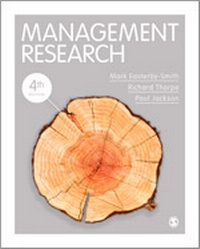
Management Research
4th Edition
Published on 12. April 2012
Book
Paperback/Softback
392 pages
978-0-85702-117-5 (ISBN)
Description
Electronic Inspection Copy available for instructors here
Now in its Fourth Edition, this much loved text offers theoretical and philosophical depth without sacrificing what you need to know in practical terms. With an impressive suite of in-text features and online materials, as well as the authors' ability to tackle complex issues in a clear and accessible way, this textbook makes the whole scope of management research methods approachable.
Inside you will find painless coverage of the entire research process as well as a critical, thoughtful treatment of important issues like ethics and politics, making this an invaluable companion to any student or researcher who needs to know about business and management research methods.
New to the Fourth Edition:
- Expanded coverage of mixed methods
- Further guidance on choosing a research question and writing a research proposal
- More visual material and an improved, full-colour layout
The book's companion website has been fully updated to include:
- An instructor's manual
- Lecture slides
- Links to further reading
- More full-text articles from SAGE Journals Online
- An online glossary
- An author podcast
Visit the Companion Webiste at www.sagepub.co.uk/easterbysmith
Now in its Fourth Edition, this much loved text offers theoretical and philosophical depth without sacrificing what you need to know in practical terms. With an impressive suite of in-text features and online materials, as well as the authors' ability to tackle complex issues in a clear and accessible way, this textbook makes the whole scope of management research methods approachable.
Inside you will find painless coverage of the entire research process as well as a critical, thoughtful treatment of important issues like ethics and politics, making this an invaluable companion to any student or researcher who needs to know about business and management research methods.
New to the Fourth Edition:
- Expanded coverage of mixed methods
- Further guidance on choosing a research question and writing a research proposal
- More visual material and an improved, full-colour layout
The book's companion website has been fully updated to include:
- An instructor's manual
- Lecture slides
- Links to further reading
- More full-text articles from SAGE Journals Online
- An online glossary
- An author podcast
Visit the Companion Webiste at www.sagepub.co.uk/easterbysmith
Reviews / Votes
This is an excellent book that covers a variety of management research related topics relevant to undergraduate, postgraduate, and research students as well as to research professionals. Furthermore, the book offers numerous useful practical activities through which readers can apply and advance their understanding in relation to management researchThomas Matheus
Senior Lecturer and Programme Leader, Logistics and Supply Chain Management, Northumbria University
This book has everything that the new and established management researcher needs to know, it is both informative and comprehensive. An excellent introduction
Catherine Cassell
Professor of Organizational Psychology, Manchester Business School, University of Manchester
More details
Edition
4th Revised edition
Language
English
Place of publication
London
United Kingdom
Target group
College/higher education
Edition type
Revised edition
Dimensions
Height: 232 mm
Width: 186 mm
Weight
754 gr
ISBN-13
978-0-85702-117-5 (9780857021175)
Copyright in bibliographic data and cover images is held by Nielsen Book Services Limited or by the publishers or by their respective licensors: all rights reserved.
Schweitzer Classification
Other editions
Previous edition
Book
03/2008
3rd Edition
SAGE Publications Ltd
€60.84
Article exhausted; check for reprint
Persons
Mark Easterby-Smith passed away in 2020. He was an Emeritus Professor at the University of Lancaster. His field was organizational learning. He had a first degree in Engineering Science and a PhD in Organizational Behaviour from Durham University and was an active researcher for over 30 years with primary interests in methodology and learning processes. He carried out evaluation studies in many European companies, and led research projects on management development, organizational learning, dynamic capabilities and knowledge transfer across international organizations in the UK, India and China.
Mark published numerous academic papers and over ten books including: Auditing Management Development (Gower, 1980); The Challenge to Western Management Development (Routledge, 1989); Evaluation of Management Education, Training and Development (Gower, 1994); Organizational Learning and the Learning Organization (Sage, 1998); The Handbook of Organizational Learning and Knowledge Management, 2nd edn (Wiley, 2011).
At Lancaster he was, variously, Director of the School's Doctoral Programme, Director of the Graduate Management School and Head of Department. Externally he spent several years as a visiting faculty member on the International Teachers' Programme, acting as Director when it was held at the London Business School in 1984. During the early 1990s he was national co-ordinator of the Management Teaching Fellowship Scheme funded by the UK's Economic and Social Research Council (ESRC), which was responsible for training 180 new faculty members across UK management schools. He was a former member of the ESRC Post-graduate Training Board and was President of the British Academy of Management in 2006 and Dean of Fellows in 2008.
Richard Thorpe is an Emeritus Professor at the University of Leeds where he was latterly Professor of Management Development and Pro Dean for Research at Leeds University Business School. His early industrial experience informed the way his ethos has developed. Common themes are a strong commitment to process methodologies and a focus on action in all its forms; an interest in and commitment to the development of doctoral students and the development of capacity within the sector; and a commitment to collaborative working on projects of mutual interest. Following a number of years in industry, he joined Strathclyde University as a researcher studying incentive payment schemes. This led to collaboration on Payment Schemes and Productivity (Macmillan, 1986). In 1980 he joined Glasgow University where he widened his research interests to include small firm growth and development as well as making regular contributions to the Scottish Business School's doctoral programme. In 1983 he attended the International Teachers' Programme in Sweden where he met Mark and embarked on a PhD under Mark's supervision. Collaboration continued through the 1990s with the ESRC Teaching Fellowship Scheme. In 1996 he was instrumental in establishing the Graduate Business School at Manchester Metropolitan University and in 2003 joined the ESRC Training and Development Board. There, he was involved in establishing the training guidelines for both doctorate and professional doctorate provision and more recently in initiatives to address capacity building in management and business. In 2003 he contributed to the ESRC's Evolution of Business Knowledge programme. His research interests have included: performance, remuneration and entrepreneurship, management learning and development and leadership, and he has published (with others) a number of books including: Remuneration Systems (Financial Times/Prentice Hall, 2000); Management and Language: The Manager as Practical Author (Sage, 2003); The SAGE Dictionary of Qualitative Management Research (Sage, 2008); Performance Management: Multidisciplinary Perspectives (Palgrave, 2008); Gower Handbook of Leadership and Management Development (Gower, 2010) ) and more recently, two research methods books, Management Research, in the Sage 'A very Short, Fairly Interesting and reasonably Cheap Book About' series and A Guide to Professional Doctorates in Business and Management (Sage, 2015). He was a past Present of the British Academy of Management in 2007, Dean of Fellows in 2012 and in 2009-2015 he was Chair of the Society for the Advancement of Management Studies. In this latter role he initiated the ESRC/SAMS/UKCES Management and Business Fellowship Scheme.
Paul R. Jackson is Professor of Corporate Communications and member of the Business Economics and Strategy group at the Alliance Manchester Business School, University of Manchester. Over the years he has undertaken various roles including Director of Doctoral Programmes at the University of Sheffield and, at UMIST, Head of the Division of Marketing, International Business and Strategy as well as designing the doctoral training programme at MBS. He has been teaching research methods to undergraduate, Masters and doctoral students since 1975 and has contributed to books on research methods teaching as well as workshops for students and teachers on behalf of the British Academy of Management.
Mark published numerous academic papers and over ten books including: Auditing Management Development (Gower, 1980); The Challenge to Western Management Development (Routledge, 1989); Evaluation of Management Education, Training and Development (Gower, 1994); Organizational Learning and the Learning Organization (Sage, 1998); The Handbook of Organizational Learning and Knowledge Management, 2nd edn (Wiley, 2011).
At Lancaster he was, variously, Director of the School's Doctoral Programme, Director of the Graduate Management School and Head of Department. Externally he spent several years as a visiting faculty member on the International Teachers' Programme, acting as Director when it was held at the London Business School in 1984. During the early 1990s he was national co-ordinator of the Management Teaching Fellowship Scheme funded by the UK's Economic and Social Research Council (ESRC), which was responsible for training 180 new faculty members across UK management schools. He was a former member of the ESRC Post-graduate Training Board and was President of the British Academy of Management in 2006 and Dean of Fellows in 2008.
Richard Thorpe is an Emeritus Professor at the University of Leeds where he was latterly Professor of Management Development and Pro Dean for Research at Leeds University Business School. His early industrial experience informed the way his ethos has developed. Common themes are a strong commitment to process methodologies and a focus on action in all its forms; an interest in and commitment to the development of doctoral students and the development of capacity within the sector; and a commitment to collaborative working on projects of mutual interest. Following a number of years in industry, he joined Strathclyde University as a researcher studying incentive payment schemes. This led to collaboration on Payment Schemes and Productivity (Macmillan, 1986). In 1980 he joined Glasgow University where he widened his research interests to include small firm growth and development as well as making regular contributions to the Scottish Business School's doctoral programme. In 1983 he attended the International Teachers' Programme in Sweden where he met Mark and embarked on a PhD under Mark's supervision. Collaboration continued through the 1990s with the ESRC Teaching Fellowship Scheme. In 1996 he was instrumental in establishing the Graduate Business School at Manchester Metropolitan University and in 2003 joined the ESRC Training and Development Board. There, he was involved in establishing the training guidelines for both doctorate and professional doctorate provision and more recently in initiatives to address capacity building in management and business. In 2003 he contributed to the ESRC's Evolution of Business Knowledge programme. His research interests have included: performance, remuneration and entrepreneurship, management learning and development and leadership, and he has published (with others) a number of books including: Remuneration Systems (Financial Times/Prentice Hall, 2000); Management and Language: The Manager as Practical Author (Sage, 2003); The SAGE Dictionary of Qualitative Management Research (Sage, 2008); Performance Management: Multidisciplinary Perspectives (Palgrave, 2008); Gower Handbook of Leadership and Management Development (Gower, 2010) ) and more recently, two research methods books, Management Research, in the Sage 'A very Short, Fairly Interesting and reasonably Cheap Book About' series and A Guide to Professional Doctorates in Business and Management (Sage, 2015). He was a past Present of the British Academy of Management in 2007, Dean of Fellows in 2012 and in 2009-2015 he was Chair of the Society for the Advancement of Management Studies. In this latter role he initiated the ESRC/SAMS/UKCES Management and Business Fellowship Scheme.
Paul R. Jackson is Professor of Corporate Communications and member of the Business Economics and Strategy group at the Alliance Manchester Business School, University of Manchester. Over the years he has undertaken various roles including Director of Doctoral Programmes at the University of Sheffield and, at UMIST, Head of the Division of Marketing, International Business and Strategy as well as designing the doctoral training programme at MBS. He has been teaching research methods to undergraduate, Masters and doctoral students since 1975 and has contributed to books on research methods teaching as well as workshops for students and teachers on behalf of the British Academy of Management.
Content
Introducing Management and Business Research
Introduction
The Nature of Management and Business Research
What Is Management?
Skills and Resources for Management and Business Research
Levels and Outcomes of Management Research
Is Management Research Distinctive?
Conclusion
Further Reading
The Philosophy of Management Research
Introduction
The Philosophical Debates
Ontology: From Realism to Nominalism
Epistemology: Positivism versus Social Constructionism
Linking Ontology, Epistemology and Methodology
Strengths and Weaknesses of the Main Traditions
Overviews of Other Philosophies
Conclusion
Further Reading
Designing Management Research
Introduction
Epistemology and Researcher Engagement
Positivist Research Designs
Constructionist Research Designs
Case method and Grounded Theory
Mixed Methods
Common Design Dilemmas
Contributing to Theory
Contrasting Views on Validity and Reliability
Research Design Template
Conclusion
Further Reading
The Politics and Ethics of Management Research
Introduction
Political Influences on the Research Questions
Politics of Access
Ethics
Utilization of Research
Conclusion
Further Reading
Reviewing the Literature
Introduction
What Is a Literature Review and What Is Its Purpose?
Preparation for the Literature Review
Elements of Literature Review
Alignment with Study Context and Approach
Sources of Information
Conclusion
Further Reading
Creating Qualitative Data
Methods for qualitative data collection
Collecting data through language
Collecting data through observation
Understanding data through interaction
General concerns related to the collection of qualitative methods
Conclusion
Further reading
Framing Qualitative Data
Introduction
Analysing natural language data
Content analysis and grounded analysis
Computer aided analysis
Social network analysis
Discourse analysis
Narrative analysis
Conversation analysis
Argument analysis
Gaining knowledge through interaction
Conclusion
Further reading
Creating Quantitative Data
Introduction
Sampling design
Sources of quantitative data
Questionnaire design
Conclusion
Further reading
Summarising and Making Inferences from Quantitative Data
Introduction
Summarizing and describing data
Going beyond a sample
Conclusion
Further reading
Multivariate Analysis
Introduction
Multivariate analysis of measurement models
Multivariate analysis of causal models
Conclusion
Further reading
Writing Management and Business Research
The skills of writing
The content of reports and dissertations
Writing up the literature review
Outputs and evaluation
Plagiarism
Dissemination strategies
Conclusion
Further reading
Answers to exercises
Glossary
Bibliography
Index
Introduction
The Nature of Management and Business Research
What Is Management?
Skills and Resources for Management and Business Research
Levels and Outcomes of Management Research
Is Management Research Distinctive?
Conclusion
Further Reading
The Philosophy of Management Research
Introduction
The Philosophical Debates
Ontology: From Realism to Nominalism
Epistemology: Positivism versus Social Constructionism
Linking Ontology, Epistemology and Methodology
Strengths and Weaknesses of the Main Traditions
Overviews of Other Philosophies
Conclusion
Further Reading
Designing Management Research
Introduction
Epistemology and Researcher Engagement
Positivist Research Designs
Constructionist Research Designs
Case method and Grounded Theory
Mixed Methods
Common Design Dilemmas
Contributing to Theory
Contrasting Views on Validity and Reliability
Research Design Template
Conclusion
Further Reading
The Politics and Ethics of Management Research
Introduction
Political Influences on the Research Questions
Politics of Access
Ethics
Utilization of Research
Conclusion
Further Reading
Reviewing the Literature
Introduction
What Is a Literature Review and What Is Its Purpose?
Preparation for the Literature Review
Elements of Literature Review
Alignment with Study Context and Approach
Sources of Information
Conclusion
Further Reading
Creating Qualitative Data
Methods for qualitative data collection
Collecting data through language
Collecting data through observation
Understanding data through interaction
General concerns related to the collection of qualitative methods
Conclusion
Further reading
Framing Qualitative Data
Introduction
Analysing natural language data
Content analysis and grounded analysis
Computer aided analysis
Social network analysis
Discourse analysis
Narrative analysis
Conversation analysis
Argument analysis
Gaining knowledge through interaction
Conclusion
Further reading
Creating Quantitative Data
Introduction
Sampling design
Sources of quantitative data
Questionnaire design
Conclusion
Further reading
Summarising and Making Inferences from Quantitative Data
Introduction
Summarizing and describing data
Going beyond a sample
Conclusion
Further reading
Multivariate Analysis
Introduction
Multivariate analysis of measurement models
Multivariate analysis of causal models
Conclusion
Further reading
Writing Management and Business Research
The skills of writing
The content of reports and dissertations
Writing up the literature review
Outputs and evaluation
Plagiarism
Dissemination strategies
Conclusion
Further reading
Answers to exercises
Glossary
Bibliography
Index