

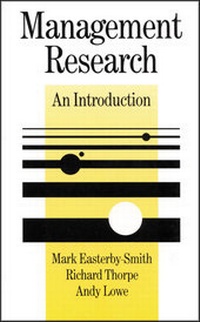
Management Research
An Introduction
1st Edition
Published on 22. May 1991
Book
Paperback/Softback
182 pages
978-0-8039-8393-9 (ISBN)
Description
Written specifically for management students and others wishing to do research in management, this textbook is a highly accessible introduction to the practice and principles of management research.
The authors consider the particular characteristics of research in management and the factors likely to lead to successful research outcomes, including the personal qualities of the researcher. They examine the philosophical assumptions underpinning research design and the choice of different methodologies, and address the political and ethical dimensions of management research. The book also takes the reader through the `basic' practicalities of undertaking a research project, from planning through to presentation of findings. A wide range of research methods and techniques is discussed. Throughout, the authors provide illustrative examples from their own research.
The authors consider the particular characteristics of research in management and the factors likely to lead to successful research outcomes, including the personal qualities of the researcher. They examine the philosophical assumptions underpinning research design and the choice of different methodologies, and address the political and ethical dimensions of management research. The book also takes the reader through the `basic' practicalities of undertaking a research project, from planning through to presentation of findings. A wide range of research methods and techniques is discussed. Throughout, the authors provide illustrative examples from their own research.
Reviews / Votes
`A central feature of the book is an excellent resume of the most appropriate philosophical position from which methods should be derived' - Management Centre Doctoral Journal`I will be recommending the book to graduate researchers at master's and doctoral level. It is a book which deserves to succeed for its honesty, clarity, and common sense' - Leadership and Organizational Development Journal
`Quantitative methods are reviewed in a way which even the non-numerative could understand; the chapter on finishing and writing up research contains several ideas, including mind-mapping, worthy of a more extended treatment. An accessible relaxed style enables the authors to deal with issues that are intellectually demanding and at times controversial, encouraging the researcher to develop a self-reflexive capacity to manage research as both personal and public learning' - Management Education and Development Journal
More details
Series
Edition
First Edition
Language
English
Place of publication
London
United Kingdom
Target group
College/higher education
Dimensions
Height: 216 mm
Width: 138 mm
Weight
235 gr
ISBN-13
978-0-8039-8393-9 (9780803983939)
Copyright in bibliographic data and cover images is held by Nielsen Book Services Limited or by the publishers or by their respective licensors: all rights reserved.
Schweitzer Classification
Other editions
New editions
Book
12/2001
2nd Edition
SAGE Publications Inc
€53.41
Article is exhausted; no reprint
Persons
Mark Easterby-Smith passed away in 2020. He was an Emeritus Professor at the University of Lancaster. His field was organizational learning. He had a first degree in Engineering Science and a PhD in Organizational Behaviour from Durham University and was an active researcher for over 30 years with primary interests in methodology and learning processes. He carried out evaluation studies in many European companies, and led research projects on management development, organizational learning, dynamic capabilities and knowledge transfer across international organizations in the UK, India and China.
Mark published numerous academic papers and over ten books including: Auditing Management Development (Gower, 1980); The Challenge to Western Management Development (Routledge, 1989); Evaluation of Management Education, Training and Development (Gower, 1994); Organizational Learning and the Learning Organization (Sage, 1998); The Handbook of Organizational Learning and Knowledge Management, 2nd edn (Wiley, 2011).
At Lancaster he was, variously, Director of the School's Doctoral Programme, Director of the Graduate Management School and Head of Department. Externally he spent several years as a visiting faculty member on the International Teachers' Programme, acting as Director when it was held at the London Business School in 1984. During the early 1990s he was national co-ordinator of the Management Teaching Fellowship Scheme funded by the UK's Economic and Social Research Council (ESRC), which was responsible for training 180 new faculty members across UK management schools. He was a former member of the ESRC Post-graduate Training Board and was President of the British Academy of Management in 2006 and Dean of Fellows in 2008.
Richard Thorpe is an Emeritus Professor at the University of Leeds where he was latterly Professor of Management Development and Pro Dean for Research at Leeds University Business School. His early industrial experience informed the way his ethos has developed. Common themes are a strong commitment to process methodologies and a focus on action in all its forms; an interest in and commitment to the development of doctoral students and the development of capacity within the sector; and a commitment to collaborative working on projects of mutual interest. Following a number of years in industry, he joined Strathclyde University as a researcher studying incentive payment schemes. This led to collaboration on Payment Schemes and Productivity (Macmillan, 1986). In 1980 he joined Glasgow University where he widened his research interests to include small firm growth and development as well as making regular contributions to the Scottish Business School's doctoral programme. In 1983 he attended the International Teachers' Programme in Sweden where he met Mark and embarked on a PhD under Mark's supervision. Collaboration continued through the 1990s with the ESRC Teaching Fellowship Scheme. In 1996 he was instrumental in establishing the Graduate Business School at Manchester Metropolitan University and in 2003 joined the ESRC Training and Development Board. There, he was involved in establishing the training guidelines for both doctorate and professional doctorate provision and more recently in initiatives to address capacity building in management and business. In 2003 he contributed to the ESRC's Evolution of Business Knowledge programme. His research interests have included: performance, remuneration and entrepreneurship, management learning and development and leadership, and he has published (with others) a number of books including: Remuneration Systems (Financial Times/Prentice Hall, 2000); Management and Language: The Manager as Practical Author (Sage, 2003); The SAGE Dictionary of Qualitative Management Research (Sage, 2008); Performance Management: Multidisciplinary Perspectives (Palgrave, 2008); Gower Handbook of Leadership and Management Development (Gower, 2010) ) and more recently, two research methods books, Management Research, in the Sage 'A very Short, Fairly Interesting and reasonably Cheap Book About' series and A Guide to Professional Doctorates in Business and Management (Sage, 2015). He was a past Present of the British Academy of Management in 2007, Dean of Fellows in 2012 and in 2009-2015 he was Chair of the Society for the Advancement of Management Studies. In this latter role he initiated the ESRC/SAMS/UKCES Management and Business Fellowship Scheme.
Mark published numerous academic papers and over ten books including: Auditing Management Development (Gower, 1980); The Challenge to Western Management Development (Routledge, 1989); Evaluation of Management Education, Training and Development (Gower, 1994); Organizational Learning and the Learning Organization (Sage, 1998); The Handbook of Organizational Learning and Knowledge Management, 2nd edn (Wiley, 2011).
At Lancaster he was, variously, Director of the School's Doctoral Programme, Director of the Graduate Management School and Head of Department. Externally he spent several years as a visiting faculty member on the International Teachers' Programme, acting as Director when it was held at the London Business School in 1984. During the early 1990s he was national co-ordinator of the Management Teaching Fellowship Scheme funded by the UK's Economic and Social Research Council (ESRC), which was responsible for training 180 new faculty members across UK management schools. He was a former member of the ESRC Post-graduate Training Board and was President of the British Academy of Management in 2006 and Dean of Fellows in 2008.
Richard Thorpe is an Emeritus Professor at the University of Leeds where he was latterly Professor of Management Development and Pro Dean for Research at Leeds University Business School. His early industrial experience informed the way his ethos has developed. Common themes are a strong commitment to process methodologies and a focus on action in all its forms; an interest in and commitment to the development of doctoral students and the development of capacity within the sector; and a commitment to collaborative working on projects of mutual interest. Following a number of years in industry, he joined Strathclyde University as a researcher studying incentive payment schemes. This led to collaboration on Payment Schemes and Productivity (Macmillan, 1986). In 1980 he joined Glasgow University where he widened his research interests to include small firm growth and development as well as making regular contributions to the Scottish Business School's doctoral programme. In 1983 he attended the International Teachers' Programme in Sweden where he met Mark and embarked on a PhD under Mark's supervision. Collaboration continued through the 1990s with the ESRC Teaching Fellowship Scheme. In 1996 he was instrumental in establishing the Graduate Business School at Manchester Metropolitan University and in 2003 joined the ESRC Training and Development Board. There, he was involved in establishing the training guidelines for both doctorate and professional doctorate provision and more recently in initiatives to address capacity building in management and business. In 2003 he contributed to the ESRC's Evolution of Business Knowledge programme. His research interests have included: performance, remuneration and entrepreneurship, management learning and development and leadership, and he has published (with others) a number of books including: Remuneration Systems (Financial Times/Prentice Hall, 2000); Management and Language: The Manager as Practical Author (Sage, 2003); The SAGE Dictionary of Qualitative Management Research (Sage, 2008); Performance Management: Multidisciplinary Perspectives (Palgrave, 2008); Gower Handbook of Leadership and Management Development (Gower, 2010) ) and more recently, two research methods books, Management Research, in the Sage 'A very Short, Fairly Interesting and reasonably Cheap Book About' series and A Guide to Professional Doctorates in Business and Management (Sage, 2015). He was a past Present of the British Academy of Management in 2007, Dean of Fellows in 2012 and in 2009-2015 he was Chair of the Society for the Advancement of Management Studies. In this latter role he initiated the ESRC/SAMS/UKCES Management and Business Fellowship Scheme.
Content
PART ONE: STARTING MANAGEMENT RESEARCH
Introducing Management Research
The Ingredients of Successful Research
PART TWO: PHILOSOPHY AND POLITICS
The Philosophy of Research Design
The Politics of Management Research
PART THREE: DOING AND COMPLETING THE RESEARCH
Qualitative Methods
Quantitative Methods
Finishing Research
Appendix
Searching the Management Literature
Introducing Management Research
The Ingredients of Successful Research
PART TWO: PHILOSOPHY AND POLITICS
The Philosophy of Research Design
The Politics of Management Research
PART THREE: DOING AND COMPLETING THE RESEARCH
Qualitative Methods
Quantitative Methods
Finishing Research
Appendix
Searching the Management Literature