

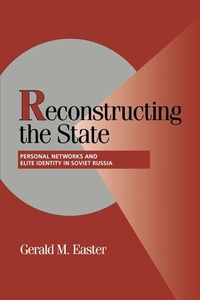
Reconstructing the State
Personal Networks and Elite Identity in Soviet Russia
Published on 23. March 2007
Book
Paperback/Softback
240 pages
978-0-521-03587-3 (ISBN)
Description
Why do some state-building efforts succeed when others fail? Using formerly unavailable archival sources, this book presents an explanation for the rise and subsequent collapse of the Soviet state. The study explains how personal networks and elite identity served as informal sources of power that influenced state strength. Reconstructing the State also offers alternative interpretations of how the weak Bolshevik state extended its reach to a vast rural and multi-ethnic periphery as well as the dynamics of the center-regional conflict in the 1930s that culminated in the Great Terror.
Reviews / Votes
'Easter's superb study illuminates the heretofore underappreciated role of regional elite networks in the evolution of the Soviet state. This lucidly written book is a fine political history embedded in a sophisticated and useful theoretical framework. It is an important contribution to political science and Soviet history.' Zoitan Barany, University of Texas, AustinMore details
Series
Language
English
Place of publication
Cambridge
United Kingdom
Target group
Professional and scholarly
Product notice
Paperback (trade)
Illustrations
9 Tables, unspecified
Dimensions
Height: 229 mm
Width: 152 mm
Thickness: 14 mm
Weight
396 gr
ISBN-13
978-0-521-03587-3 (9780521035873)
Copyright in bibliographic data and cover images is held by Nielsen Book Services Limited or by the publishers or by their respective licensors: all rights reserved.
Schweitzer Classification
Other editions
Additional editions
Book
01/2000
Cambridge University Press
€108.40
Shipment within 15-20 days
Person
Content
Preface; 1. Introduction: explaining state-building outcomes and the Soviet Russian case; Part I. Structure and Identity in the Post-Revolutionary State Elite: 2. Anatomy of a regional elite: the rise of the provincial Komitetchiki; 3. Constructing an elite identity: images of self, service and state; Part II. Informal Sources of Power in the Post-Revolutionary State: 4. Extending the reach of the state: personal networks and territorial administration; 5. The constraints of power: personal networks and central rulership; Part III. Intrastate Conflict and the Constraints of Power Redefined: 6. Center and regions in conflict I: collectivization and the crisis of regional leadership; 7. Center and regions in conflict II: the fall of the provincial Komitetchiki; 8. Conclusion: state building and the Soviet Russian case reconsidered; Notes; Bibliography; Index.