

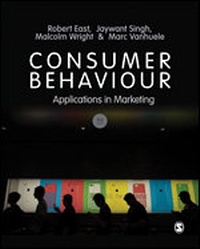
Consumer Behaviour
Applications in Marketing
3rd Edition
Published on 24. November 2016
Book
Paperback/Softback
368 pages
978-1-4739-1950-1 (ISBN)
Description
Extending beyond a basic psychological approach to Consumer Behaviour, this text provides an empirical understanding of the subject and will be of particular appeal to those of the Ehrenberg-Bass tradition and those who view Marketing as a science.
The third edition maintains a strong focus on the use of research, helping students to develop analytical and evidence-based thinking in marketing and to take into consideration not just the individual but also the marketing environment. New examples and research findings have been included with special attention paid to the digital environment, including online consumer behaviour and research.
Suitable for upper undergraduate and postgraduate students taking courses in consumer behaviour, as well as doctoral candidates with a focus on consumer behaviour.
The third edition maintains a strong focus on the use of research, helping students to develop analytical and evidence-based thinking in marketing and to take into consideration not just the individual but also the marketing environment. New examples and research findings have been included with special attention paid to the digital environment, including online consumer behaviour and research.
Suitable for upper undergraduate and postgraduate students taking courses in consumer behaviour, as well as doctoral candidates with a focus on consumer behaviour.
Reviews / Votes
A serious, thoughtful consumer behaviour text that focuses on substance rather than what's fashionable in academic circles. -- Professor Byron Sharp A thought-provoking text that challenges readers to consider consumer behaviour in new and refreshing ways and reflect on routine behaviours that occupy so much of daily life - buying brands, patronising stores, watching adverts, making recommendations. -- Professor Mark UnclesMore details
Edition
3rd Revised edition
Language
English
Place of publication
London
United Kingdom
Target group
College/higher education
Edition type
Revised edition
Dimensions
Height: 232 mm
Width: 186 mm
Weight
658 gr
ISBN-13
978-1-4739-1950-1 (9781473919501)
Copyright in bibliographic data and cover images is held by Nielsen Book Services Limited or by the publishers or by their respective licensors: all rights reserved.
Schweitzer Classification
Other editions
New editions

Book
12/2021
4th Edition
SAGE Publications Ltd
€168.60
Shipment within 15-20 days
Previous edition
Book
01/2013
2nd Edition
SAGE Publications Ltd
€75.70
Article exhausted; check for reprint
Persons
Robert East is emeritus professor at Kingston Business School, Kingston University London and adjunct professor at the Ehrenberg-Bass Institute of the University of South Australia. He trained as a social psychologist and is a postgraduate of London Business School. His research has mainly focused on word-of-mouth patterns where his new evidence has shown that some widely-held beliefs are mistaken. As a teacher of consumer behaviour, he has been keen to deliver knowledge that is useful to students while not over simplifying the subject.
Jaywant Singh is professor of marketing at Kingston Business School, Kingston University where he teaches consumer behaviour and research methods. He applies quantitative research methods to unravel how and why people buy goods and services, through the lenses of brand management, ethical consumption, status consumption, and service management. He has published in leading academic journals and he regularly presents his research at international conferences. In his teaching, he endeavours to deliver theoretically and empirically grounded research knowledge that has direct applications in marketing and business.
Malcolm Wright is professor of marketing at Massey University, New Zealand, and adjunct professor at the Ehrenberg-Bass Institute of the University of South Australia. He applies empirical principles to marketing problems and has made interrelated discoveries about brand loyalty, the use of probability scales, new product forecasting and optimizing the advertising budget. He has also published many articles critically examining the foundations of popular marketing knowledge.
Marc Vanhuele holds a PhD from UCLA and is professor of marketing at HEC Paris. As expert in consumer information processing, his research focuses on how consumers treat price information. A second field of research is how marketing managers can improve their decision making through better use of quantitative information on the consumer's mind-set. His research has been published in the leading academic journals. He also works as consultant to consumer goods and market research companies.
Jaywant Singh is professor of marketing at Kingston Business School, Kingston University where he teaches consumer behaviour and research methods. He applies quantitative research methods to unravel how and why people buy goods and services, through the lenses of brand management, ethical consumption, status consumption, and service management. He has published in leading academic journals and he regularly presents his research at international conferences. In his teaching, he endeavours to deliver theoretically and empirically grounded research knowledge that has direct applications in marketing and business.
Malcolm Wright is professor of marketing at Massey University, New Zealand, and adjunct professor at the Ehrenberg-Bass Institute of the University of South Australia. He applies empirical principles to marketing problems and has made interrelated discoveries about brand loyalty, the use of probability scales, new product forecasting and optimizing the advertising budget. He has also published many articles critically examining the foundations of popular marketing knowledge.
Marc Vanhuele holds a PhD from UCLA and is professor of marketing at HEC Paris. As expert in consumer information processing, his research focuses on how consumers treat price information. A second field of research is how marketing managers can improve their decision making through better use of quantitative information on the consumer's mind-set. His research has been published in the leading academic journals. He also works as consultant to consumer goods and market research companies.
Content
PART 1 - INTRODUCTION
Chapter 1: Ideas and Explanations in Consumer Research
PART 2 - CONSUMPTION PATTERNS
Chapter 2: Customer Loyalty
Chapter 3: Brand Knowledge, Brand Equity and Brand Extension
Chapter 4: Stationary Markets
Chapter 5: Market Dynamics
Chapter 6: Consumer Group Differences
PART 3 - EXPLAINING DECISION-MAKING
Chapter 7: Predicting and Explaining Behaviour
Chapter 8: Information Processing and Decision-Making
Chapter 9: Consumer Satisfaction and Quality
PART 4 - MARKET RESPONSE
Chapter 10: Consumer Response to Price and Sales Promotions
Chapter 11: The Retail Context
Chapter 12: Word-of-Mouth Influence
Chapter 13: The Response to Advertising
Chapter 1: Ideas and Explanations in Consumer Research
PART 2 - CONSUMPTION PATTERNS
Chapter 2: Customer Loyalty
Chapter 3: Brand Knowledge, Brand Equity and Brand Extension
Chapter 4: Stationary Markets
Chapter 5: Market Dynamics
Chapter 6: Consumer Group Differences
PART 3 - EXPLAINING DECISION-MAKING
Chapter 7: Predicting and Explaining Behaviour
Chapter 8: Information Processing and Decision-Making
Chapter 9: Consumer Satisfaction and Quality
PART 4 - MARKET RESPONSE
Chapter 10: Consumer Response to Price and Sales Promotions
Chapter 11: The Retail Context
Chapter 12: Word-of-Mouth Influence
Chapter 13: The Response to Advertising