

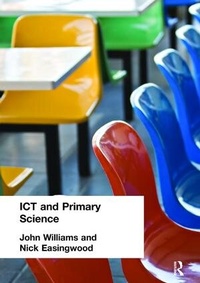
ICT and Primary Science
1st Edition
Published on 26. April 2017
Book
Hardback
174 pages
978-1-138-16638-7 (ISBN)
Description
Throughout this book, the authors emphasize that primary science is at its best as a practical, hands-on experience for children. When ICT is used in an integral way, it can enable practical work to be done at a more sophisticated level, helping children to make sense of their findings. The book includes several case studies from primary classrooms and each chapter includes practical suggestions for teachers.
The wide-ranging topics covered include:
databases and spreadsheets
data logging
control technology
ICT, drama and science
school visits
planning for ICT and science
choosing and using software.
ICT and Primary Science is an accessible and jargon-free resource for teachers and student teachers of primary science.
The wide-ranging topics covered include:
databases and spreadsheets
data logging
control technology
ICT, drama and science
school visits
planning for ICT and science
choosing and using software.
ICT and Primary Science is an accessible and jargon-free resource for teachers and student teachers of primary science.
Reviews / Votes
'An easy to read and well polished guide to using ICT in primary education for the technophobic and technosceptical teacher...This book is a great investment for all slightly nervous primary teachers who do not relish the idea of using the 'computer in the corner' and also those who would use computers in a limited way but are ready to take their next step towards seeing just how far ICT can take lessons.' - Education Today 'an easy to read and well polished guide to using ICT in primary education for the technophobic and technosceptical teacher ... This book is a great investment for all slightly nervous primary teachers who do not relish the idea of using the 'computer in the corner' and also those who would use computers in a limited way but are ready to take their next step towards seeing just how far ICT can take lessons.' - Education Today'This is a very useful book for all primary teachers, coordinators new to the role and students training to become primary teachers ... the book would be a valuable and hopefully, well-read addition to a primary school's resources.' - Primary Science Review
'This encouraging and well written book follows the traditional software-driven route to give readers an improved appreciation of the great potential of IT in the science classroom' - British Journal of Educational Technology
'ICT and Primary Science argues repeatedly for a hands-on approach to teaching and learning ... it does provide some useful guidance, information and discussion. The book will be a welcome addition to the libraries of teacher training establishments, and support for primary science tutors and their students.' - Anne Qualter, Educational Review
More details
Language
English
Place of publication
London
United Kingdom
Publishing group
Taylor & Francis Ltd
Target group
College/higher education
Professional and scholarly
Postgraduate, Professional, Professional Practice & Development, and Undergraduate
Dimensions
Height: 246 mm
Width: 174 mm
Weight
453 gr
ISBN-13
978-1-138-16638-7 (9781138166387)
Copyright in bibliographic data and cover images is held by Nielsen Book Services Limited or by the publishers or by their respective licensors: all rights reserved.
Schweitzer Classification
Other editions
Additional editions
Nick Easingwood | John Williams
ICT and Primary Science
E-Book
12/2003
Routledge
€51.49
Available for download
Nick Easingwood | John Williams
ICT and Primary Science
E-Book
12/2003
Routledge
€51.49
Available for download
Nick Easingwood | John Williams
ICT and Primary Science
Book
07/2003
1st Edition
Routledge
€65.79
Shipment within 15-20 days
Persons
John Williams has recently retired from full-time teaching at Anglia Polytechnic University. He remains involved with primary education,lecturing,supervising student teachers in schools and writing.
Content
1. Introduction 2. Data Handling 3. Use of Multimedia 4. Using the Internet 5. Control Technology 6. Data Logging 7. Modelling and Stimulation Software 8. Using Presentational Software to Support Science Investigations 9. Conclusions