

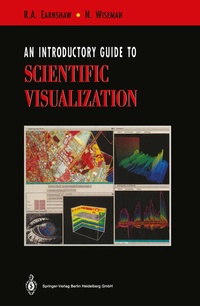
An Introductory Guide to Scientific Visualization
Published on 22. November 2012
Book
Paperback/Softback
XVI, 156 pages
978-3-642-63470-3 (ISBN)
Description
Scientific visualization is concerned with exploring data
and information insuch a way as to gain understanding and
insight into the data. This is a fundamental objective of
much scientific investigation. To achieve this goal,
scientific visualization utilises aspects in the areas of
computergraphics, user-interface methodology, image
processing, system design, and signal processing.
This volume is intended for readers new to the field and who
require a quick and easy-to-read summary of what scientific
visualization is and what it can do. Written in a popular
andjournalistic style with many illustrations it will
enable readers to appreciate the benefits of scientific
visualization and how current tools can be exploited in many
application areas. This volume is indispensible for
scientists and research workers who have never used
computer graphics or other visual tools before, and who
wish to find out the benefitsand advantages of the new
approaches.
More details
Edition
Softcover reprint of the original 1st ed. 1992
Language
English
Place of publication
Berlin
Germany
Publishing group
Springer Berlin
Target group
Professional and scholarly
Research
Illustrations
XVI, 156 p.
Dimensions
Height: 235 mm
Width: 155 mm
Thickness: 10 mm
Weight
277 gr
ISBN-13
978-3-642-63470-3 (9783642634703)
DOI
10.1007/978-3-642-58101-4
Schweitzer Classification
Other editions
Additional editions

Rae A. Earnshaw | Norman Wiseman
An Introductory Guide to Scientific Visualization
Book
1992
Springer
€88.76
Article exhausted; check different version
Content
I Basics of Scientific Visualization.- 1 Introduction and Background.- 2 What Scientific Visualization can do!.- 3 Explanation of Scientific Visualization Terminology.- 4 Facilities for Scientific Visualization.- 5 Outputting Results.- 6 Current Developments and Activities.- II Overview of Current Systems and Developments.- 7 Current Vendor Systems in Use.- 8 Current Public Domain Systems in Use.- 9 Other Uses of Visualization Tools.- 10 Conclusions.- References.- Sources of Figures.