

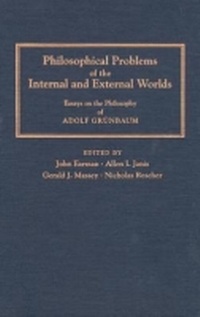
Philosophical Problems of the Internal and External Worlds
Essays on the Philosophy of Adolf Gruenbaum
Published on 15. April 1994
Book
Hardback
640 pages
978-0-8229-3738-8 (ISBN)
Description
The inaugural volume of the series, devoted to the work of philosopher Adolf Grunbaum, encompasses the philosophical problems of space, time, and cosmology, the nature of scientific methodology, and the foundations of psychoanalysis.
Reviews / Votes
This is a collection of 24 papers organized into five main sections: space, time, and cosmology; scientific rationality and methodology; philosophy of psychiatry; freedom and determinism; science and religion; and moral problems. The wealth of issues covered by these sections indicate the range of Grunbaum's thought, and the high standard of the volume's papers is a fitting testimony to the eminence and quality of Grunbaum's own writings. * Canadian Philosophical Reviews *More details
Language
English
Place of publication
Pittsburgh PA
United States
Target group
College/higher education
Dimensions
Height: 235 mm
Width: 156 mm
ISBN-13
978-0-8229-3738-8 (9780822937388)
Copyright in bibliographic data and cover images is held by Nielsen Book Services Limited or by the publishers or by their respective licensors: all rights reserved.
Schweitzer Classification
Other editions
Additional editions
John Earman | Allen Janis | Gerald J. Massey
Philosophical Problems of the Internal and External Worlds
Essays on the Philosophy of Adolf Grünbaum
E-Book
02/2014
David & Charles
€81.49
Available for download
Persons
John Earman (Editor)
John Earman is University Professor in the History and Philosopy of Science at the University of Pittsburgh. He is the author of numerous books including: Hume's Abject Failure: The Argument Against Miracles; World Enough and Space-time: Absolute vs. Relational Theories of Space and Time; Bayes or Bust: A Critical Examination of Bayesian Confirmation Theory; Bangs, Crunches, Whimpers and Shrieks: Singularities and Acausalities in Relativistic Spacetimes.
Allen Janis (Editor)
Allen I. Janis is professor emeritus in the department of physics and astronomy at the University of Pittsburgh.
Gerald J. Massey (Editor)
Gerald J. Massey is Distinguished Service Professor of Philosophy at the University of Pittsburgh. From 1988 to 1997 he was director of the University of Pittsburgh's renowned Center for Philosophy of Science. For the past several years he has been investigating the philosophical implications of the sciences of animals in an effort to create a new field that he calls philosophical ethology. In 1997, German President Roman Herzog conferred on him the Officer's Cross of the Order of Merit of the Federal Republic of Germany (Bundesverdienstkreuz 1. Klasse) for his contributions to German-American Philosophy.
Nicholas Rescher (Editor)
Nicholas Rescher was Distinguished University Professor of Philosophy at the University of Pittsburgh and co-chairman of the Center for Philosophy of Science. A member of the American Academy of Arts and Sciences, he served as president of the Eastern Division of the American Philosophical Association, the Leibniz Society of North America, the Charles S. Peirce Society, the American Catholic Philosophical Association, and the Metaphysical Society of America. Rescher was the author or editor of more than one hundred books, including Ignorance (On the Wider Implications of Deficient Knowledge), Philosophical Inquiries: An Introduction to Problems of Philosophy, and A Journey through Philosophy in 101 Anecdotes.
John Earman is University Professor in the History and Philosopy of Science at the University of Pittsburgh. He is the author of numerous books including: Hume's Abject Failure: The Argument Against Miracles; World Enough and Space-time: Absolute vs. Relational Theories of Space and Time; Bayes or Bust: A Critical Examination of Bayesian Confirmation Theory; Bangs, Crunches, Whimpers and Shrieks: Singularities and Acausalities in Relativistic Spacetimes.
Allen Janis (Editor)
Allen I. Janis is professor emeritus in the department of physics and astronomy at the University of Pittsburgh.
Gerald J. Massey (Editor)
Gerald J. Massey is Distinguished Service Professor of Philosophy at the University of Pittsburgh. From 1988 to 1997 he was director of the University of Pittsburgh's renowned Center for Philosophy of Science. For the past several years he has been investigating the philosophical implications of the sciences of animals in an effort to create a new field that he calls philosophical ethology. In 1997, German President Roman Herzog conferred on him the Officer's Cross of the Order of Merit of the Federal Republic of Germany (Bundesverdienstkreuz 1. Klasse) for his contributions to German-American Philosophy.
Nicholas Rescher (Editor)
Nicholas Rescher was Distinguished University Professor of Philosophy at the University of Pittsburgh and co-chairman of the Center for Philosophy of Science. A member of the American Academy of Arts and Sciences, he served as president of the Eastern Division of the American Philosophical Association, the Leibniz Society of North America, the Charles S. Peirce Society, the American Catholic Philosophical Association, and the Metaphysical Society of America. Rescher was the author or editor of more than one hundred books, including Ignorance (On the Wider Implications of Deficient Knowledge), Philosophical Inquiries: An Introduction to Problems of Philosophy, and A Journey through Philosophy in 101 Anecdotes.
Content
Part 1 Space, Time, Cosmology: Physical Force or Geometrical Curvature? Einstein, Gruenbaum and the Measurability of Physical Geometry, Martin Carrier; Substantivalism and the Hole Argument, Carl Hoffer and Nancy Cartwright; The Cosmic Censorship Hypothesis, John Earman; From Time to Time - Remarks on the Difference Between the Time of Nature and the Time of Man, Jurgen Mittelstrass; The Conventionality of Simultaneity, Michael Redhead; The Meaning of General Covariance - the Hole Story, John Stachel. Part 2 Scientific Rationality and Methodology: Sciences and Pseudosciences - An Attempt at a New Form of Demarcation, Robert E. Butts; The End of Epistemology?, Paul Feyerabend; Seven Theses on Thought Experiments, Paul Humphreys; On the Alleged Temporal Anisotropy of Explanation - A Letter to Professor Adolf Gruenbaum, Wesley C. Salmon; A New Theory of Reduction in Physics, Erhard Scheibe; Analogy by Similarity in Hyper-Carnapian Inductive Logic, Brian Skyrms; Capacities and Invariance, James Woodward; Falsification, Rationality and the Duhem Problem - Gruenbaum Versus Bayes, John Worrall. Part 3 Philosophy of Psychiatry: The Dynamics of Theory Change in Psychoanalysis, Morris Eagle; Philosophers on Freudianism - An Examination of Replies to Gruenbaum's ""Foundations"", Edward Erwin; How Freud Left Science, Clark Glymour; Isomorphism and the Modelling of Brain-Mind State, J. Allan Hobson; Psychoanalytic Conceptions of the Borderline Personality - a Sociocultural Alternative, Theodore Millon; On a Contribution to a Future Scientific Study of Dream Interpretation, Rosemarie Sand. Part 4 Freedom and Determinism - Science and Religion: Indeterminism and the Freedom of the Will, Arthur Fine; Adolf Gruenbaum and the Compatibilist Thesis, John Watkins; Creation, Conservation and the Big Bang, Philip L. Quinn. Part 5 Moral Problems: Moral Obligation and the Refugee, Nicholas Rescher.