

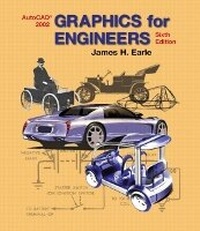
Graphics for Engineers with AutoCAD 2002
6th Edition
Published on 21. August 2002
Book
Paperback/Softback
584 pages
978-0-13-008172-8 (ISBN)
Description
For Engineering Graphics/Technical Drawing courses.
Graphics for Engineers is designed to help students expand their creative talents and communicate their ideas effectively. Its layout, format, and content have been classroom-tested to make it user friendly and excellent for both classroom use and independent study. Students who use this text will learn ANSI standards, techniques to prepare working drawings, the solution of 3D problems and graphical analysis, and the use of graphics as a medium of design.
Graphics for Engineers is designed to help students expand their creative talents and communicate their ideas effectively. Its layout, format, and content have been classroom-tested to make it user friendly and excellent for both classroom use and independent study. Students who use this text will learn ANSI standards, techniques to prepare working drawings, the solution of 3D problems and graphical analysis, and the use of graphics as a medium of design.
More details
Edition
6th edition
Language
English
Place of publication
Berkeley
United States
Publishing group
Pearson Education (US)
Target group
Professional and scholarly
Dimensions
Height: 210 mm
Width: 243 mm
Thickness: 27 mm
Weight
1152 gr
ISBN-13
978-0-13-008172-8 (9780130081728)
Copyright in bibliographic data and cover images is held by Nielsen Book Services Limited or by the publishers or by their respective licensors: all rights reserved.
Schweitzer Classification
Other editions
Previous edition

James H. Earle
Graphics for Engineers with AutoCAD 2000i Update
Book
02/2002
5th Edition
Peachpit Press Publications
€45.79
Article exhausted; check for reprint
Person
James H. Earle is a recognized authority in the field of engineering graphics. He received the bachelor of architecture and Ph.D. degrees in education from Texas A&M, where he has taught engineering design graphics since 1957. His books have introduced the concepts and techniques of engineering graphics to over half a million students.
Content
1. Engineering and Technology.
2. The Design Process.
3. Problem Identification.
4. Preliminary Ideas.
5. Refinement.
6. Design Analysis.
7. Decision.
8. Implementation.
9. Design Problems.
10. Drawing Instruments.
11. Lettering.
12. Geometric Construction.
13. Freehand Sketching.
14. Orthographic Drawing with Instruments.
15. Primary Auxiliary Views.
16. Sections.
17. Screws, Fasteners, and Springs.
18. Materials and Processes.
19. Dimensioning.
20. Tolerances.
21. Welding.
22. Working Drawings.
23. Reproduction of Drawings.
24. Three-Dimensional Pictorials.
25. Graphs.
26. AutoCAD Computer Graphics.
27. Three-Dimensional Modeling.
2. The Design Process.
3. Problem Identification.
4. Preliminary Ideas.
5. Refinement.
6. Design Analysis.
7. Decision.
8. Implementation.
9. Design Problems.
10. Drawing Instruments.
11. Lettering.
12. Geometric Construction.
13. Freehand Sketching.
14. Orthographic Drawing with Instruments.
15. Primary Auxiliary Views.
16. Sections.
17. Screws, Fasteners, and Springs.
18. Materials and Processes.
19. Dimensioning.
20. Tolerances.
21. Welding.
22. Working Drawings.
23. Reproduction of Drawings.
24. Three-Dimensional Pictorials.
25. Graphs.
26. AutoCAD Computer Graphics.
27. Three-Dimensional Modeling.