

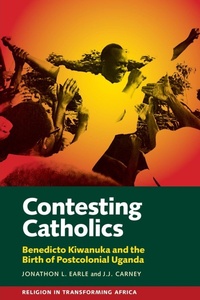
Contesting Catholics
Benedicto Kiwanuka and the Birth of Postcolonial Uganda
Published on 16. May 2023
Book
Paperback/Softback
272 pages
978-1-84701-365-1 (ISBN)
Description
First scholarly treatment of Uganda's first elected ruler; offers new insights into the religious and political history of modern Uganda.
Assassinated by Idi Amin and a democratic ally of J.F. Kennedy during the Cold War, Benedicto Kiwanuka was Uganda's most controversial and disruptive politician, and his legacy is still divisive. On the eve of independence, he led the Democratic Party (DP), a national movement of predominantly Catholic activists, to end political inequalities and religious discrimination. Along the way, he became Uganda's first prime minister and first Ugandan chief justice. Earle and Carney show how Kiwanuka and Catholic activists struggled to create an inclusive vision of the state, a vision that resulted in relentless intimidation and extra-judicial killings. Focusing closely on the competing Catholic projects that circulated throughout Uganda, this book offers new ways of thinking about the history of democratic thought, while pushing the study of Catholicism in Africa outside of the church and beyond the gaze of missionaries. Drawing on never before seen sources from Kiwanuka's personal papers, the authors upend many of the assumptions that have framed Uganda's political and religious history for over sixty years, as well as repositioning Uganda's politics within the global arena.
Fountain: Uganda
Assassinated by Idi Amin and a democratic ally of J.F. Kennedy during the Cold War, Benedicto Kiwanuka was Uganda's most controversial and disruptive politician, and his legacy is still divisive. On the eve of independence, he led the Democratic Party (DP), a national movement of predominantly Catholic activists, to end political inequalities and religious discrimination. Along the way, he became Uganda's first prime minister and first Ugandan chief justice. Earle and Carney show how Kiwanuka and Catholic activists struggled to create an inclusive vision of the state, a vision that resulted in relentless intimidation and extra-judicial killings. Focusing closely on the competing Catholic projects that circulated throughout Uganda, this book offers new ways of thinking about the history of democratic thought, while pushing the study of Catholicism in Africa outside of the church and beyond the gaze of missionaries. Drawing on never before seen sources from Kiwanuka's personal papers, the authors upend many of the assumptions that have framed Uganda's political and religious history for over sixty years, as well as repositioning Uganda's politics within the global arena.
Fountain: Uganda
Reviews / Votes
In six chapters, Jonathon Earle and Jay Carney present a new interpretation of the history of Uganda in the late colonial period and early postindependence period.... Contesting Catholics falls within the burgeoning body of revisionist literature in Uganda's historiography. * Journal of African History * The book is an important work of intellectual history. It is likewise an important work for Uganda, helping to reveal the connections between controversies and contexts that are often seen and studied in isolation. * Africa is a Country * The sources that Earle and Carney have been able to make use of here take us well beyond the traditional institutional archives used to examine religion and politics ... it is difficult to imagine a more complete biography of Kiwanuka being published. -- Journal of Ecclesiastical History As Jonathon Earle and Jay Carney demonstrate in this well documented book, Kiwanuka's real legacy was in opposition roles: as the driving force behind the Democratic Party (DP) and as the voice for the historically marginalised Catholic population. And these are the three guiding threads of the book: part biography of this over-looked individual, part historical account of a political party trying to find its footing between Christian democracy and African nationalism, and part ecclesial account of the implantation and growth of Roman Catholicism in this nation home to Africa's first modern canonised saints. At the start of Contesting Catholics, the authors advance a compelling argument for this narrative: that the story of Kiwanuka reveals a more inspiring account of African politics than the dominant narrative of la politique du ventre....For the reader interested in the broader arc of African Catholic history, this book offers many original insights... * African Studies Review * The authors [...] address oversimplifications that DP was "simply a sectarian 'Catholic Party' that sought to upend political Protestantism in the Kingdom of Buganda." [...] They make clear the fact that "Catholic politics constituted a dynamic moral economy of competing regional historiographies and disputations." -- Robert Madoi * Monitor * For a few short months Benedicto Kiwanuka wielded power as Uganda's first prime minister. Most of his political career, however, was spent in the opposition; and at the end he was martyred by President Idi Amin. In this insightful biography, Earle and Carney draw from Kiwanuka's private library and illuminate the logic of his politics. Here we see Uganda's history as Kiwanuka saw it: as a drama that demanded both principled clarity and pragmatic flexibility. This book gives religious history an exciting new vocation, and greatly expands the scope and scale of political biography. -- Derek R. Peterson, University of Michigan Earle and Carney's work sheds radically new understanding on the dramatic history of Uganda. It is centred on the Democratic Party and its staunch Catholic leader Ben Kiwanuka, who led the country to independence before being jailed by Obote and murdered by Idi Amin. Roman Catholics, the largest religious group in Uganda, have been politically discriminated against since the 1890s. This book challenges brilliantly Uganda's biased historical narrative and puts back "Contesting Catholics" where they belong, at the centre of the country's nation building. -- Henri Medard, Aix Marseille Universite - Institut des Mondes Africains By drawing on hitherto unused sources, and paying careful attention to regional complexities, Jay Carney and Jonathon Earle tell a new story of how religion inflected politics in twentieth century Uganda. Contesting Catholics is not merely about Catholic politics in the home of Africa's first canonized martyrs, rather it reframes our understanding of Ugandan history in the late colonial and postcolonial periods writ large. Moreover, the book delivers compelling insights about how to conceptualize the place of religion in politics in Africa and beyond. -- Elizabeth A. Foster, Tufts University The authors of this book have mined personal papers, especially of their major subject, Benedicto Kiwanuka and other decolonization political actors in Uganda. They interviewed key witnesses of the late colonial and early post-colonial period, mastered local languages, including Luganda and Ateso, in order to read the literature first-hand. They also utilized archives in Uganda, Britain and the United States, in order to write an outstanding book on one of the leading Ugandan nationalists, Benedicto Kiwanuka, a leader of the Democratic Party who sought to build a united Uganda. I highly recommend this book for any student or researcher wishing to understand Uganda's religious and political history. -- Samwiri Lwanga-Lunyiigo, Makerere University This study throws a powerful searchlight on a critical population in Uganda struggling for political and social freedoms in the country immediately before and after Independence from Britain. -- Michael Twaddle, Institute of Commonwealth Studies This carefully researched and elegantly written story of admirable twentieth-century Ugandan Catholic layman Benedicto Kiwanuka shows how the political party he led was thwarted in Uganda's early years. Regional and ethnic differences stretched its pursuit of Catholic values while seeking national unity and blocked its electoral hopes. Carney and Earle demonstrate the oversimplification of earlier accounts of how religiously inflected politics tragically undermined Uganda's first few decades. -- Paul Kollman, CSC, University of Notre Dame ...covers the religious milieu of the 1950s and 1960s, and the era's complicated politics, connecting Kiwanuka and Catholicism to party formation, ethnicity, and the making of a new Uganda and new Ugandan political elite and set of practices. ... a well-researched, careful exploration of a complex, understudied, fascinating time. * Carol Summers, University of Richmond * In a context in which thinking about current politics and the history of politics in Uganda fall into well-worn, fundamentally unproductive habits of thought, the authors prove that basic assumptions about religion in Ugandan politics are deeply flawed. ... a superb book, meticulously evidenced and insightfully contextualized. * Holly Hanson, Mount Holyoke College *More details
Series
Language
English
Place of publication
Oxford
United Kingdom
Target group
Professional and scholarly
Product notice
Paperback (trade)
Illustrations
18 b/w and 2 line illus.
Dimensions
Height: 234 mm
Width: 156 mm
Thickness: 14 mm
Weight
409 gr
ISBN-13
978-1-84701-365-1 (9781847013651)
Copyright in bibliographic data and cover images is held by Nielsen Book Services Limited or by the publishers or by their respective licensors: all rights reserved.
Schweitzer Classification
Other editions
Additional editions
Jonathon L. Earle | J.J. Carney
Contesting Catholics
Benedicto Kiwanuka and the Birth of Postcolonial Uganda
Book
04/2021
James Currey
€120.20
Shipment within 3-4 weeks
Jonathon L. Earle | J.J. Carney
Contesting Catholics
Benedicto Kiwanuka and the Birth of Postcolonial Uganda
E-Book
04/2021
1st Edition
De Gruyter
€48.99
Available for download
Jonathon L. Earle | J.J. Carney
Contesting Catholics
Benedicto Kiwanuka and the Birth of Postcolonial Uganda
E-Book
04/2021
1st Edition
Boydell & Brewer
€48.99
Available for download
Persons
JONATHON L. EARLE is the Marlene and David Grissom Professor of Social Studies at Centre College and co-author of Contesting Catholics: Benedicto Kiwanuka and the Birth of Postcolonial Uganda. J.J. Carney is Associate Professor of Theology, Creighton University, and author of Rwanda before the Genocide: Catholic Politics and Ethnic Discourse in the Late Colonial Era (2014), which won the Ogot award.
Content
Introduction: Catholic Democracy and Political Duress in Colonial Uganda
Benedicto Kiwanuka, Catholic Uganda and the Gospel of Democracy
Republicanism and Secession in Tesoland and Rwenzururu
Catholic Violence and Political Revolution in Bunyoro and Kigezi
Acholi Alliances and Party Insurrection in Ankole
Catholic Patronage and Royalist Alternatives in Buganda
"I offer today my body and blood": Violence, Resistance, and Martyrdom
Conclusion: Memory and Memorialisation
Benedicto Kiwanuka, Catholic Uganda and the Gospel of Democracy
Republicanism and Secession in Tesoland and Rwenzururu
Catholic Violence and Political Revolution in Bunyoro and Kigezi
Acholi Alliances and Party Insurrection in Ankole
Catholic Patronage and Royalist Alternatives in Buganda
"I offer today my body and blood": Violence, Resistance, and Martyrdom
Conclusion: Memory and Memorialisation