

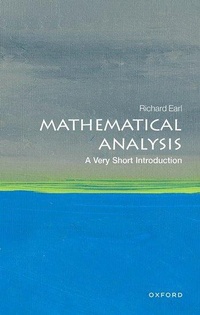
Mathematical Analysis
A Very Short Introduction
Published on 22. June 2023
Book
Paperback/Softback
224 pages
978-0-19-886891-0 (ISBN)
Description
Very Short Introductions: Brilliant, sharp, inspiring
The 17th-century calculus of Newton and Leibniz was built on shaky foundations, and it wasn't until the 18th and 19th centuries that mathematicians--especially Bolzano, Cauchy, and Weierstrass--began to establish a rigorous basis for the subject. The resulting discipline is now known to mathematicians as analysis.
This book, aimed at readers with some grounding in mathematics, describes the nascent evolution of mathematical analysis, its development as a subject in its own right, and its wide-ranging applications in mathematics and science, modelling reality from acoustics to fluid dynamics, from biological systems to quantum theory.
ABOUT THE SERIES: The Very Short Introductions series from Oxford University Press contains hundreds of titles in almost every subject area. These pocket-sized books are the perfect way to get ahead in a new subject quickly. Our expert authors combine facts, analysis, perspective, new ideas, and enthusiasm to make interesting and challenging topics highly readable.
The 17th-century calculus of Newton and Leibniz was built on shaky foundations, and it wasn't until the 18th and 19th centuries that mathematicians--especially Bolzano, Cauchy, and Weierstrass--began to establish a rigorous basis for the subject. The resulting discipline is now known to mathematicians as analysis.
This book, aimed at readers with some grounding in mathematics, describes the nascent evolution of mathematical analysis, its development as a subject in its own right, and its wide-ranging applications in mathematics and science, modelling reality from acoustics to fluid dynamics, from biological systems to quantum theory.
ABOUT THE SERIES: The Very Short Introductions series from Oxford University Press contains hundreds of titles in almost every subject area. These pocket-sized books are the perfect way to get ahead in a new subject quickly. Our expert authors combine facts, analysis, perspective, new ideas, and enthusiasm to make interesting and challenging topics highly readable.
Reviews / Votes
I think the author has provided a short and fabulous introduction to mathematical analysis. It isn't a short and simple introduction, nor does it pretend to be, but I think that those with the appropriate background will find the book enjoyable. * Anita T. Layton, SIAM Review *More details
Series
Language
English
Place of publication
Oxford
United Kingdom
Target group
College/higher education
Illustrations
c. 100 black and white line drawings and half-tone illustrations
Dimensions
Height: 170 mm
Width: 113 mm
Thickness: 20 mm
Weight
185 gr
ISBN-13
978-0-19-886891-0 (9780198868910)
Copyright in bibliographic data and cover images is held by Nielsen Book Services Limited or by the publishers or by their respective licensors: all rights reserved.
Schweitzer Classification
Other editions
Additional editions
E-Book
06/2023
1st Edition
OUP eBook
€9.49
Available for download
E-Book
05/2023
1st Edition
OUP eBook
€9.49
Available for download
Person
Richard Earl is a Departmental Lecturer in the Mathematical Institute, University of Oxford, and the Ben Delo Fellor in Mathematics at Worcester College, Oxford. From 2003-13, he was Admissions Coordinator and Schools Liaison Officer in the department, roles which included promoting mathematics within schools and colleges. From 2013-22, he was Director of Undergraduate Studies. He has won several teaching awards within the University for his teaching and lecturing. He is the author of Towards Higher Mathematics: A Companion (2017), Topology: A Very Short Introduction (OUP, 2019), and editor of the current edition of The Concise Oxford Dictionary of Mathematics (OUP, 2021).
Content
Acknowledgements 1: Taming Infinity 2: All change... 3: Should I believe my computer? 4: Dimensions aplenty 5: I'll name that tune in... 6: Putting the i in analysis 7: But there's more... Appendix Historical timeline References Further Reading Index