

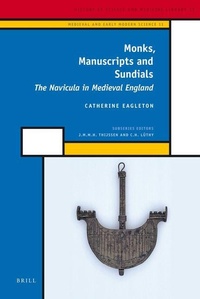
Monks, Manuscripts and Sundials
The Navicula in Medieval England
Published on 11. January 2010
Book
Hardback
304 pages
978-90-04-17665-2 (ISBN)
Description
The navicula sundial, because of its rarity and attractive form, has interested curators and historians alike: Derek J. de Solla Price described it as "one of the most ingenious and sophisticated mathematical artefacts of the Middle Ages". Although apparently a specifically English instrument, there is much debate about when and where it was invented, and about who made and used the five surviving medieval examples. This book brings together for the first time evidence from the surviving instruments, and written sources including four previously unknown texts describing how to make or use the instrument, along with previously unknown copies of the text on which previous studies were based.
Medieval and Early Modern Science, 11
Medieval and Early Modern Science, 11
Reviews / Votes
Thanks to this excellent study we now have a very complete working tool that allows us to know all the ingenuity embedded in these rare sundials.Denis Savoie, Journal for the History of Astronomy, xliii (February 2012), pp. 120-122
Eagleton has substantially advanced our knowledge of this curious instrument. [...] Her book provides much new grist for the scholarly mill, thanks to the new light it sheds on the interface between artefacts, texts, practices and problems of transmission.
Michael H. Shank, University of Wisconsin-Madison, British Journal for the History of Science, 2011, December, pp. 580-581
More details
Series
Language
English
Place of publication
Leiden
Netherlands
Target group
Professional and scholarly
Product notice
sewn/stitched
Cloth over boards
Illustrations
50 s/w Abbildungen
50 Illustrations, black and white
Dimensions
Height: 249 mm
Width: 169 mm
Thickness: 27 mm
Weight
683 gr
ISBN-13
978-90-04-17665-2 (9789004176652)
Copyright in bibliographic data and cover images is held by Nielsen Book Services Limited or by the publishers or by their respective licensors: all rights reserved.
Schweitzer Classification
Person
Catherine Eagleton, PhD (2005) in History of Science, University of Cambridge, is a curator at the British Museum and an Affiliated Research Scholar at the Department of History and Philosophy of Science, University of Cambridge.
Content
List of figures
1. Monks, manuscripts and sundials: the navicula in medieval England
2. Five fifteenth-century sundials
3. Manuscript sources about the navicula
4. Calendar tables and latitude lists
5. Texts, instruments, diagrams and relations between them
6. Using a sundial, understanding the heavens?
7. The navicula and the organum ptolomei
8. How sixteenth-century books redefined a medieval sundial
Appendix One Group A manuscripts
Appendix Two Group A manuscripts
Appendix Three Group A manuscripts
Appendix Four Group A stemmatics
Appendix Five The group B navicula manuscripts
Appendix Six The group C navicula manuscript
Appendix Seven The group D navicula manuscript
Appendix Eight The group E navicula text
Appendix Nine Organum Ptolomei ita sit...
Bibliography
Index
1. Monks, manuscripts and sundials: the navicula in medieval England
2. Five fifteenth-century sundials
3. Manuscript sources about the navicula
4. Calendar tables and latitude lists
5. Texts, instruments, diagrams and relations between them
6. Using a sundial, understanding the heavens?
7. The navicula and the organum ptolomei
8. How sixteenth-century books redefined a medieval sundial
Appendix One Group A manuscripts
Appendix Two Group A manuscripts
Appendix Three Group A manuscripts
Appendix Four Group A stemmatics
Appendix Five The group B navicula manuscripts
Appendix Six The group C navicula manuscript
Appendix Seven The group D navicula manuscript
Appendix Eight The group E navicula text
Appendix Nine Organum Ptolomei ita sit...
Bibliography
Index