

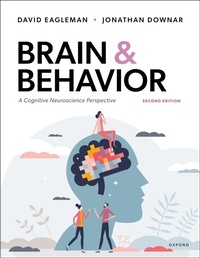
Brain and Behavior
2nd Edition
Published on 9. June 2023
Book
Paperback/Softback
688 pages
978-0-19-086165-0 (ISBN)
Description
Brain and Behavior: A Cognitive Neuroscience Perspective captures the excitement of cognitive and behavioral neuroscience by focusing on fundamental scientific principles, patterns, and ways of thinking.
Brain and Behavior is clear and vibrant writing, with fascinating real-life examples and applications that help to emphasize the dynamically changing nature of the brain. This text covers a wide territory critical for understanding the brain, from the basics of the nervous system to the sensory and motor systems, sleep, language, memory, emotions and motivation, social cognition, and brain disorders. Throughout the narrative, the authors emphasize the dynamically changing nature of the brain, through the mechanisms of neuroplasticity. The text pulls together the best current knowledge about the brain while acknowledging current areas of ignorance and pointing students toward the most promising directions for future research.
Brain and Behavior is clear and vibrant writing, with fascinating real-life examples and applications that help to emphasize the dynamically changing nature of the brain. This text covers a wide territory critical for understanding the brain, from the basics of the nervous system to the sensory and motor systems, sleep, language, memory, emotions and motivation, social cognition, and brain disorders. Throughout the narrative, the authors emphasize the dynamically changing nature of the brain, through the mechanisms of neuroplasticity. The text pulls together the best current knowledge about the brain while acknowledging current areas of ignorance and pointing students toward the most promising directions for future research.
Reviews / Votes
Brain and Behavior is an excellent introduction to cognitive neuroscience for the undergraduate student. It provides sufficient detail at this level for the students to gain an appreciation of the complexity and the importance of brain function in cognition."- Joseph H. Porter, Virginia Commonwealth University The text is an excellent adoption as an introduction to important topics in neuroscience, is well researched, and well written."
- John E. Bryant, Bowie State University A great resource for students interested in neuroscience. Well-written, student-friendly, and easy to understand."
- Maura Mitrushina, California State University - Northridge
More details
Edition
2nd Revised edition
Language
English
Place of publication
New York
United States
Target group
College/higher education
Edition type
Revised edition
Dimensions
Height: 283 mm
Width: 220 mm
Thickness: 30 mm
Weight
1674 gr
ISBN-13
978-0-19-086165-0 (9780190861650)
Copyright in bibliographic data and cover images is held by Nielsen Book Services Limited or by the publishers or by their respective licensors: all rights reserved.
Schweitzer Classification
Persons
David Eagleman is a neuroscientist, New York Times best-selling author, abnd Guggenheim Fellow who currently holds an Adjunct appointment at the Stanford University School of Medicine. Dr. Eagleman's areas of research include time perception, vision, synesthesia, and the intersection of neuroscience with the legal system.
Jonathan Downar is the Director of the MRI-Guided rTMS Clinic at the University Health network in Toronto, Canada, and a scientist a tthe Toronto Western Research Institute. He currently holds appointments with the department of Psychiatry and the Institute of Medical Science at the University of Toronto. As a physician-scientist, his clinical work focuses on using noninvasive brain stimulation to treat patients with severe and medical-resistant forms of psyhiatric illnesses. His research focuses on developing a new generation of more effective, more accessible, and less costly techniques for brain stimulation in these disorders.
Jonathan Downar is the Director of the MRI-Guided rTMS Clinic at the University Health network in Toronto, Canada, and a scientist a tthe Toronto Western Research Institute. He currently holds appointments with the department of Psychiatry and the Institute of Medical Science at the University of Toronto. As a physician-scientist, his clinical work focuses on using noninvasive brain stimulation to treat patients with severe and medical-resistant forms of psyhiatric illnesses. His research focuses on developing a new generation of more effective, more accessible, and less costly techniques for brain stimulation in these disorders.
Content
1 - Introduction 2 - The Brain and the Nervous System
3 - Neurons and Synapses 4 - Neuroplasticity 5 - Vision 6 - Other Senses 7 - The Motor System 8 - Attention and Consciousness 9 - Memory 10 - Sleep 11 - Language and Lateralization 12 - Decision Making 13 - Emotions 14 - Motivation and Reward 15 - Social Cognition 16 - Neurological and Psychiatric Disorders
3 - Neurons and Synapses 4 - Neuroplasticity 5 - Vision 6 - Other Senses 7 - The Motor System 8 - Attention and Consciousness 9 - Memory 10 - Sleep 11 - Language and Lateralization 12 - Decision Making 13 - Emotions 14 - Motivation and Reward 15 - Social Cognition 16 - Neurological and Psychiatric Disorders