

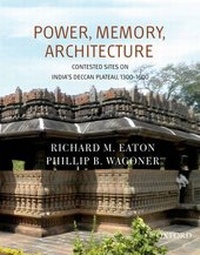
Power, Memory, Architecture
Contested Sites on India's Deccan Plateau, 1300-1600
Published on 24. April 2014
Book
Hardback
436 pages
978-0-19-809221-6 (ISBN)
Description
Most studies of the history of the early modern Deccan focus on struggles between the region's primary centers, that is, the great capital cities such as Bijapur, Vijayanagara, or Golconda. This study, by contrast, examines the political histories and material culture of smaller, fortified strongholds both on the plains and atop hills, the control of which was repeatedly contested by rival primary centers. Exceptionally high levels of conflict over such secondary centers occurred between 1300 and 1600, and especially during the turbulent sixteenth century when gunpowder technology had become widespread in the region. The authors bring two principal objectives to the enquiry. One is to explore how political power, monumental architecture, and collective memory interacted with one another in the period under study. The study's authors-one trained in history, the other in art history and archaeology-argue for systematically integrating the methodologies of history, art history, and archaeology in attempts to reconstruct the past.
The study's other aim is to radically rethink the usefulness of Hindu-Muslim relations as the master key by which to interpret this period of South Asian history, and to propose instead a model informed by Sanskrit and the Persian literary traditions.
The study's other aim is to radically rethink the usefulness of Hindu-Muslim relations as the master key by which to interpret this period of South Asian history, and to propose instead a model informed by Sanskrit and the Persian literary traditions.
More details
Language
English
Place of publication
New Delhi
India
Illustrations
161 (147 b/w illustrations and 14 maps)
Dimensions
Height: 248 mm
Width: 193 mm
Thickness: 35 mm
Weight
972 gr
ISBN-13
978-0-19-809221-6 (9780198092216)
Copyright in bibliographic data and cover images is held by Nielsen Book Services Limited or by the publishers or by their respective licensors: all rights reserved.
Schweitzer Classification
Persons
Richard M. Eaton, Professor, Department of History, University of Arizona, Tucson Phillip B. Wagoner, Professor, Art History Program, Wesleyan University, Middletown
Content
ACKNOWLEDGMENTS; LIST OF FIGURES AND TABLES; NOTE ON TRANSLATION, TRANSLITERATION, AND ABBREVIATIONS; INTRODUCTION; I. ORIENTATIONS; II. KALYANA AND THE CHALUKYA LEGACY; III. WARANGAL AND THE KAKATIYA LEGACY; IV. THE RAICHUR DOAB IN THE AGE OF GUNPOWDER; CONCLUSION; APPENDIX 1: NOTES ON METHOD; APPENDIX 2: AN OVERVIEW OF THE THREE PRIMARY STUDY SITES; SELECT BIBLIOGRAPHY; INDEX; ABOUT THE AUTHORS