

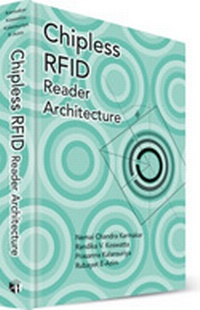
Chipless RFID Reader Architecture
Published in September 2013
Book
Hardback
326 pages
978-1-60807-561-4 (ISBN)
Description
In the era of information communication technology (ICT), radio frequency identification (RFID) has been going through tremendous development. RFID technology has the potential of replacing barcodes due to its large information carrying capacity, flexibility in operations, and applications. The deployment of RFID has been hindered by its cost. However, with the advent of low powered ICs, energy scavenging techniques, and low-cost chipless tags, RFID technology has achieved significant development. This book addresses the new reader architecture, presents fundamentals of chipless RFID systems, and covers protocols. It also presents proof-of-concept implementations with potential to replace trillions of barcodes per year. Overall, this resource aims to not only explain the technology, but to make the chipless RFID reader system a viable commercial product for mass deployment. It is certainly a very useful resource in the new field.
In the era of information communication technology (ICT), radio frequency identification (RFID) has been going through tremendous development. RFID technology has the potential of replacing barcodes due to its large information carrying capacity, flexibility in operations, and applications. The deployment of RFID has been hindered by its cost. However, with the advent of low powered ICs, energy scavenging techniques, and low-cost chipless tags, RFID technology has achieved significant development. This book addresses the new reader architecture, presents fundamentals of chipless RFID systems, and covers protocols. It also presents proof-of-concept implementations with potential to replace trillions of barcodes per year. Overall, this resource aims to not only explain the technology, but to make the chipless RFID reader system a viable commercial product for mass deployment. It is certainly a very useful resource in the new field.
In the era of information communication technology (ICT), radio frequency identification (RFID) has been going through tremendous development. RFID technology has the potential of replacing barcodes due to its large information carrying capacity, flexibility in operations, and applications. The deployment of RFID has been hindered by its cost. However, with the advent of low powered ICs, energy scavenging techniques, and low-cost chipless tags, RFID technology has achieved significant development. This book addresses the new reader architecture, presents fundamentals of chipless RFID systems, and covers protocols. It also presents proof-of-concept implementations with potential to replace trillions of barcodes per year. Overall, this resource aims to not only explain the technology, but to make the chipless RFID reader system a viable commercial product for mass deployment. It is certainly a very useful resource in the new field.
More details
Edition
Unabridged edition
Language
English
Place of publication
Norwood
United States
Target group
Professional and scholarly
Edition type
Unabridged edition
ISBN-13
978-1-60807-561-4 (9781608075614)
Copyright in bibliographic data and cover images is held by Nielsen Book Services Limited or by the publishers or by their respective licensors: all rights reserved.
Schweitzer Classification
Other editions
Additional editions
Nemai Chandra Karmakar
Chipless RFID Reader Architecture
E-Book
01/2013
1st Edition
Artech House
€139.99
Available for download
Persons
Nemai Chandra Karmakar is an associate professor at Monash University in Clayton, Australia, Department of Electrical and Computer Systems Engineering. He earned a PhD in ITEE from University of Queensland. Randika Koswatta is currently working toward a PhD in Electrical Engineering at Monash University in Clayton, Australia. Prasanna Kalansuriya is currently working toward a PhD in Electrical and Computer Systems Engineering at Monash University in Clayton, Australia. Rubayet E-Azim is currently working toward a PhD in Engineering at Monash University in Clayton, Australia.
Nemai Chandra Karmakar is an associate professor at Monash University in Clayton, Australia, Department of Electrical and Computer Systems Engineering. He earned a PhD in ITEE from University of Queensland. Randika Koswatta is currently working toward a PhD in Electrical Engineering at Monash University in Clayton, Australia. Prasanna Kalansuriya is currently working toward a PhD in Electrical and Computer Systems Engineering at Monash University in Clayton, Australia. Rubayet E-Azim is currently working toward a PhD in Engineering at Monash University in Clayton, Australia.
Nemai Chandra Karmakar is an associate professor at Monash University in Clayton, Australia, Department of Electrical and Computer Systems Engineering. He earned a PhD in ITEE from University of Queensland. Randika Koswatta is currently working toward a PhD in Electrical Engineering at Monash University in Clayton, Australia. Prasanna Kalansuriya is currently working toward a PhD in Electrical and Computer Systems Engineering at Monash University in Clayton, Australia. Rubayet E-Azim is currently working toward a PhD in Engineering at Monash University in Clayton, Australia.
Content
Chipless RFID, RFID Reader Architecture, RFID Reader Antennas, Microwave Transceiver, Detection and Error Correction Coding, Anti-collision Protocol