

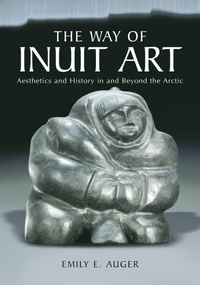
The Way of Inuit Art
Aesthetics and History in and Beyond the Arctic
Published on 6. June 2011
Book
Paperback/Softback
304 pages
978-0-7864-6412-8 (ISBN)
Description
Inuit art, both ancient and contemporary, has inspired the interest of scholars, collectors and art lovers around the globe. This book examines Inuit art from prehistory to the present with special attention to methodology and aesthetics, exploring the ways in which it has been influenced by and has influenced non-Inuit artists and scholars.
Part One gives the history of the main art-producing prehistoric traditions in the North American arctic, concentrating on the Dorset who once flourished in the Canadian region. It also demonstrates the influence of theories such as evolutionism, diffusionism, ethnographic comparison, and shamanism on the interpretation of prehistoric Inuit art.
Part Two demonstrates the influence of such popular theories as nationalism, primitivism, modernism, and postmodernism on the aesthetics and representation of twentieth-century Canadian Inuit art. This discussion is supported by interviews conducted with Inuit artists. A final chapter shows the presence of Inuit art in the mainstream multi-cultural environment, with a discussion of its influence on Canadian artist Nicola Wojewoda. The work also presents various Inuit artists' reactions to Wojewoda's work.
Part One gives the history of the main art-producing prehistoric traditions in the North American arctic, concentrating on the Dorset who once flourished in the Canadian region. It also demonstrates the influence of theories such as evolutionism, diffusionism, ethnographic comparison, and shamanism on the interpretation of prehistoric Inuit art.
Part Two demonstrates the influence of such popular theories as nationalism, primitivism, modernism, and postmodernism on the aesthetics and representation of twentieth-century Canadian Inuit art. This discussion is supported by interviews conducted with Inuit artists. A final chapter shows the presence of Inuit art in the mainstream multi-cultural environment, with a discussion of its influence on Canadian artist Nicola Wojewoda. The work also presents various Inuit artists' reactions to Wojewoda's work.
Reviews / Votes
"comprehensive, well-written...a welcome addition to any collection...highly recommended"-Choice; "Emily Auger...does a great service...extensively researched volume...copious endnotes"-Catholic Library World.More details
Language
English
Place of publication
Jefferson, NC
United States
Target group
College/higher education
Interest Age: From 18 years
Product notice
Paperback (trade)
Illustrations
184 photos, maps, notes, bibliography, index
Dimensions
Height: 254 mm
Width: 178 mm
Thickness: 17 mm
Weight
579 gr
ISBN-13
978-0-7864-6412-8 (9780786464128)
Copyright in bibliographic data and cover images is held by Nielsen Book Services Limited or by the publishers or by their respective licensors: all rights reserved.
Schweitzer Classification
Person
Emily E. Auger (Ph.D.) is a retired art historian and author of numerous reviews, articles, and books. Founder and chair of the "Tarot and Other Divination Methods" area at the Popular Culture Association/American Culture Association (2004-2020), she lives in rural southwestern Ontario.
Content
Table of Contents
Acknowledgments
Preface
Introduction
PART
1. Arctic Traditions
The Traditional Way of Life
"Primitive" Patterns I (Primitive and Paleolithic)
The Arctic Small Tool Tradition (ASTt)
Post-Arctic Small Tool Tradition in Alaska
2. Shamanistic Traditions
Shamanism
The Supernatural Basis of Shamanistic Power
The Shaman's Initiation
"Primitive" Patterns II (Shamanism and Art)
3. Dorset and Thule Traditions in Canada
"Primitive" Patterns III (Style and Culture)
The Dorset
The Thule
PART
4. Historic Inuit
New Traditions of Inuit Carving
New Traditions of Inuit Printmaking
Market and Educational Expansions
5. Western Aesthetics and Inuit
The Western Categorical Context
"Primitive" Patterns IV ("Low" Art)
Inuit Art in the Modernist Context
Inuit Art in the Postmodernist Context
"Primitive" Patterns V (Primitivist Art)
6. Interviews with Inuit Artists
The Interviews
Female Inuit Carvers from Arviat (Eskimo Point) and Kangiqsliniq (Rankin Inlet)
Male Inuit Carvers from Arviat, Kangiqsliniq and Qamani'tuaq (Baker Lake)
Female and Male Inuit Printmakers from Qamani'tuaq
7. Art by Nicola Wojewoda and Inuit Artists' Responses to
Nicola Wojewoda
Drawings and Paintings
Alternative Media
Sculpture
Conclusion
Notes
Bibliography
Index
Acknowledgments
Preface
Introduction
PART
1. Arctic Traditions
The Traditional Way of Life
"Primitive" Patterns I (Primitive and Paleolithic)
The Arctic Small Tool Tradition (ASTt)
Post-Arctic Small Tool Tradition in Alaska
2. Shamanistic Traditions
Shamanism
The Supernatural Basis of Shamanistic Power
The Shaman's Initiation
"Primitive" Patterns II (Shamanism and Art)
3. Dorset and Thule Traditions in Canada
"Primitive" Patterns III (Style and Culture)
The Dorset
The Thule
PART
4. Historic Inuit
New Traditions of Inuit Carving
New Traditions of Inuit Printmaking
Market and Educational Expansions
5. Western Aesthetics and Inuit
The Western Categorical Context
"Primitive" Patterns IV ("Low" Art)
Inuit Art in the Modernist Context
Inuit Art in the Postmodernist Context
"Primitive" Patterns V (Primitivist Art)
6. Interviews with Inuit Artists
The Interviews
Female Inuit Carvers from Arviat (Eskimo Point) and Kangiqsliniq (Rankin Inlet)
Male Inuit Carvers from Arviat, Kangiqsliniq and Qamani'tuaq (Baker Lake)
Female and Male Inuit Printmakers from Qamani'tuaq
7. Art by Nicola Wojewoda and Inuit Artists' Responses to
Nicola Wojewoda
Drawings and Paintings
Alternative Media
Sculpture
Conclusion
Notes
Bibliography
Index