

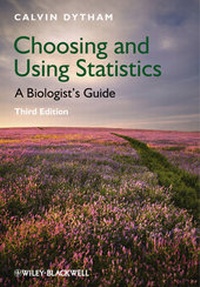
Choosing and Using Statistics
A Biologist's Guide
3rd Edition
Published on 10. December 2010
Book
Paperback/Softback
320 pages
978-1-4051-9839-4 (ISBN)
Description
Choosing and Using Statistics remains an invaluable guide for students using a computer package to analyse data from research projects and practical class work. The text takes a pragmatic approach to statistics with a strong focus on what is actually needed. There are chapters giving useful advice on the basics of statistics and guidance on the presentation of data. The book is built around a key to selecting the correct statistical test and then gives clear guidance on how to carry out the test and interpret the output from four commonly used computer packages: SPSS, Minitab, Excel, and (new to this edition) the free program, R. Only the basics of formal statistics are described and the emphasis is on jargon-free English but any unfamiliar words can be looked up in the extensive glossary. This new 3rd edition of Choosing and Using Statistics is a must for all students who use a computer package to apply statistics in practical and project work.
Features new to this edition:
* Now features information on using the popular free program, R
* Uses a simple key and flow chart to help you choose the right statistical test
* Aimed at students using statistics for projects and in practical classes
* Includes an extensive glossary and key to symbols to explain any statistical jargon
* No previous knowledge of statistics is assumed
Reviews / Votes
"Written in a concise and direct style, this book presents a selection of some of the most widely used statistical tests and data exploration techniques." (Biological Conservation, 1 March 2012) "Written in a concise and direct style, this book presents a selection of some of the most widely used statistical tests and data exploration techniques ... In general, this book is a very good primer for students with no statistical expertise." (Biological Conservation Reviews, 2011) "This book makes everything so easy. Complicated tests are effortlessly condensed, and the instructions are almost too easy to follow. Diagrams and sample data sets are used frequently so you can practise using tests before applying them to your own data sets, whilst the logical layout guides you toward the correct test for both your data, and what you want to prove (or disprove)." (Animals & Men, February 2011)More details
Other editions
New editions
Book
approx. 11/2026
4th Edition
Wiley
€45.00
Not yet published
Additional editions
E-Book
08/2011
3rd Edition
Wiley-Blackwell
€34.99
Available for download
Book
12/2010
3rd Edition
Wiley
€129.00
Shipment within 3-4 weeks
Person
Calvin Dytham has a wide range of research interests in ecology and evolutionary biology and is especially interested in the impacts of dispersal and the arrangement of individuals in space on ecological and evolutionary processes. He is a Reader in the Department of Biology at the University of York, UK, and has been teaching statistics to undergraduate and postgraduate students since 1994.
Content
Preface.
1 Eight steps to successful data analysis.
2 The basics.
Observations.
Hypothesis testing.
P-values.
Sampling.
Experiments.
Statistics.
3 Choosing a test: a key.
Remember: eight steps to successful data analysis.
The art of choosing a test.
A key to assist in your choice of statistical test.
4 Hypothesis testing, sampling and experimental design.
Hypothesis testing.
Acceptable errors.
P-values.
Sampling.
Experimental design.
5 Statistics, variables and distributions.
What are statistics?
Types of statistics.
What is a variable?
Types of variables or scales of measurement.
Types of distribution.
Discrete distributions.
Continuous distributions.
Non-parametric 'distributions'.
6 Descriptive and presentational techniques.
General advice.
Displaying data: summarizing a single variable.
Displaying data: showing the distribution of a single variable.
Descriptive statistics.
Using the computer packages.
Displaying data: summarizing two or more variables.
Displaying data: comparing two variables.
Displaying data: comparing more than two variables.
7 The tests 1: tests to look at differences.
Do frequency distributions differ?
Do the observations from two groups differ?
Do the observations from more than two groups differ?
There are two independent ways of classifying the data.
More than one observation for each factor combination (with replication).
There are more than two independent ways to classify the data.
Not all classifications are independent.
Nested or hierarchical designs.
8 The tests 2: tests to look at relationships.
Is there a correlation or association between two variables?
Is there a cause-and-effect relationship between two variables?
Tests for more than two variables.
9 The tests 3: tests for data exploration.
Types of data.
Observation, inspection and plotting.
Symbols and letters used in statistics.
Greek letters.
Symbols.
Upper-case letters.
Lower-case letters.
Glossary.
Assumptions of the tests.
Hints and tips.
A table of statistical tests.
Index.