

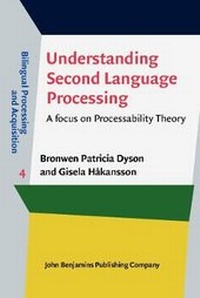
Understanding Second Language Processing
A focus on Processability Theory
Published on 24. May 2017
Book
Hardback
211 pages
978-90-272-4375-1 (ISBN)
Description
This book aims to help researchers and teachers interested in language processing and Processability Theory (PT) to understand this theory and its applications. PT is an influential account of second language processing which hypothesizes that, due to the architecture of language processing, learners acquire second languages in developmental stages. This book lays out PT's predictions and research on the development of diverse target languages - particularly English and Scandinavian languages - by learners of various categories. It discusses the typological issues facing PT and its contribution to an understanding of variation and cognitive constraints on pedagogy. However, the book also raises a critical eye to the literature which, after almost twenty years of evolution, requires explanation, clarification and, in some cases, extension. Why do some phenomena belong to different stages in different languages? Why are important types of variation under-represented? Is teaching as constrained as proposed in PT?
More details
Series
Language
English
Place of publication
Amsterdam
Netherlands
Target group
Professional and scholarly
Weight
540 gr
ISBN-13
978-90-272-4375-1 (9789027243751)
Copyright in bibliographic data and cover images is held by Nielsen Book Services Limited or by the publishers or by their respective licensors: all rights reserved.
Schweitzer Classification
Persons
Content
1. Acknowledgements; 2. Chapter 1. Introduction; 3. Chapter 2. L2 development of English; 4. Chapter 3. L2 development of Scandinavian languages; 5. Chapter 4. The typological challenge in PT; 6. Chapter 5. Learner categories and PT; 7. Chapter 6. Variation in second language processing; 8. Chapter 7. Language teaching, assessment and processing; 9. Chapter 8. Discussion and conclusion; 10. References; 11. Appendix; 12. Index