

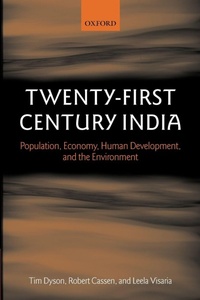
Twenty-First Century India
Population, Economy, Human Development, and the Environment
Published on 5. May 2005
Book
Paperback/Softback
440 pages
978-0-19-928382-8 (ISBN)
Description
Twenty-First Century India is the first study of India's development giving a fully integrated account of population and development. It is built on new projections of the population for fifty years from the Census of 2001. India's population then had already passed 1 billion. Twenty-five years later it will exceed 1.4 billion, and will almost certainly pass 1.5 billion by mid-century. The projections incorporate for the first time both inter-state migration and the role of HIV/AIDS. They also show India's urban future, with close to half a billion urban inhabitants by the year 2026.
The implications of this population growth are then traced out in a range of modelling and analytical work. Growing numbers are found to complicate the task of achieving widespread education in a number of India's states, while other states are already experiencing declines in their school-age population. Demographic growth also contributes to poverty, and increasing divergence in social conditions among the states. As population growth slows in the country overall, the labour force continues to grow relatively fast, with difficult consequences for employment. But national economic growth could be accelerated by the 'demographic bonus' of the declining proportion of dependents to workers in the population.
The book is reasonably optimistic about India's food prospects: the country can continue to feed itself. It can also enjoy higher levels of energy use, manufacturing, and modern forms of transport, while experiencing less chemical pollution. India's cities can become cleaner and healthier places to live. Perhaps the most difficult environmental issue, and the one most strongly related to population growth, is water. Some states also face severe pressures on common property resources. A policy chapter concludes the book. India's future problems are large, but in principle manageable. However, whether the country will actually achieve sustainable development for all is another matter.
The implications of this population growth are then traced out in a range of modelling and analytical work. Growing numbers are found to complicate the task of achieving widespread education in a number of India's states, while other states are already experiencing declines in their school-age population. Demographic growth also contributes to poverty, and increasing divergence in social conditions among the states. As population growth slows in the country overall, the labour force continues to grow relatively fast, with difficult consequences for employment. But national economic growth could be accelerated by the 'demographic bonus' of the declining proportion of dependents to workers in the population.
The book is reasonably optimistic about India's food prospects: the country can continue to feed itself. It can also enjoy higher levels of energy use, manufacturing, and modern forms of transport, while experiencing less chemical pollution. India's cities can become cleaner and healthier places to live. Perhaps the most difficult environmental issue, and the one most strongly related to population growth, is water. Some states also face severe pressures on common property resources. A policy chapter concludes the book. India's future problems are large, but in principle manageable. However, whether the country will actually achieve sustainable development for all is another matter.
Reviews / Votes
A valuable reference book and a model of quantitative analysis and sound prediction. * Foreign Affairs *More details
Language
English
Place of publication
Oxford
United Kingdom
Target group
Professional and scholarly
Academics, researchers, and graduate students of Development Studies, Geography, Economics, and Anthropology, and all policy-makers with an interest in India.
Illustrations
numerous figures and tables, 1 map
Dimensions
Height: 234 mm
Width: 156 mm
Thickness: 23 mm
Weight
661 gr
ISBN-13
978-0-19-928382-8 (9780199283828)
Copyright in bibliographic data and cover images is held by Nielsen Book Services Limited or by the publishers or by their respective licensors: all rights reserved.
Schweitzer Classification
Other editions
Additional editions
Tim Dyson | Robert Cassen | Leela Visaria
Twenty-First Century India
Population, Economy, Human Development, and the Environment
Book
03/2004
Oxford University Press
€92.85
Shipment within 15-20 days
Persons
Tim Dyson is Professor of Population Studies at the Development Studies Institute at the London School of Economics. Educated in England and Canada, he has held visiting positions at the Australian National University in Canberra, the International Institute of Population Sciences in Mumbai, and the American University of Beirut. Between 1994 and 1996 he was President of the British Society for Population Studies, and in 2001 he was elected a Fellow of the British Academy.
Robert Cassen is Visiting Professor at the London School of Economics. He has held positions at Queen Elizabeth House and St. Antony's College at the University of Oxford, the Institute of Development Studies at the University of Sussex, and the World Bank.
Leela Visaria is Professor at the Gujarat Institute of Development Research, Ahmedabad. She has been an Associate Professor at the Sardar Patel Institute of Economic and Social Research in Ahmedabad, a research demographer at the Population Reference Bureau in Washington DC, and a demographer at the Economic and Social Commission for Asia and the Pacific (ESCAP) in Bangkok, Thailand.
Robert Cassen is Visiting Professor at the London School of Economics. He has held positions at Queen Elizabeth House and St. Antony's College at the University of Oxford, the Institute of Development Studies at the University of Sussex, and the World Bank.
Leela Visaria is Professor at the Gujarat Institute of Development Research, Ahmedabad. She has been an Associate Professor at the Sardar Patel Institute of Economic and Social Research in Ahmedabad, a research demographer at the Population Reference Bureau in Washington DC, and a demographer at the Economic and Social Commission for Asia and the Pacific (ESCAP) in Bangkok, Thailand.
Content
1. Overview ; DEMOGRAPHY ; 2. India's Population: The Past ; 3. Mortality Trends and the Health Transition ; 4. The Continuing Fertility Transition ; 5. India's Population: The Future ; 6. Migration and Urbanization: Retrospect and Prospects ; SOCIAL SECTORS AND THE ECONOMY ; 7. Education and Literacy ; 8. Employment ; 9. The Condition of the People ; 10. The Economy, the Past, and the Future ; POPULATION, FOOD, AND ENVIRONMENT ; 11. Prospects for Food Demand and Supply ; 12. Modelling the Environment ; 13. India's Urban Environment, Current Knowledge, and Future Possibilities ; 14. Water ; 15. Common Pool Resources ; POLICY ; 16. Lessons and Policies