

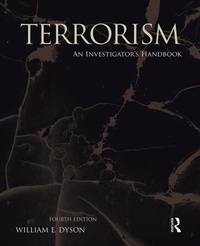
Terrorism
An Investigator's Handbook
4th Edition
Published on 2. September 2011
Book
Paperback/Softback
524 pages
978-1-4377-3487-4 (ISBN)
Description
This handbook introduces the reader to the field of terrorism investigation. Describing how terrorists operate and how they differ from other criminals, it provides an outline of how terrorism investigations should be conducted. By helping investigators to develop skills and knowledge, this guide helps them to prepare prosecutable cases against terrorists.
Reviews / Votes
"This is one of the finest and most important handbooks written on the discipline of terrorism investigations...The author is a former FBI agent who conducted numerous terrorist investigations, so readers will greatly benefit from his extensive practitioner knowledge of counterterrorism."-Perspectives on Terrorism online, Vol. 7, No. 3, 2013"Equipped with a superior ancillary package... This handbook introduces the reader to the field of terrorism investigation."-Criminal Justice Educators Today
More details
Edition
4th edition
Language
English
Place of publication
Cincinnati
United States
Publishing group
Taylor & Francis Inc
Target group
Professional and scholarly
Students and beginning professionals in the criminal justice field.
Dimensions
Height: 235 mm
Width: 191 mm
Thickness: 28 mm
Weight
971 gr
ISBN-13
978-1-4377-3487-4 (9781437734874)
Copyright in bibliographic data and cover images is held by Nielsen Book Services Limited or by the publishers or by their respective licensors: all rights reserved.
Schweitzer Classification
Other editions
Additional editions
E-Book
09/2014
4th Edition
Routledge
€86.99
Available for download
E-Book
09/2014
4th Edition
Routledge
€86.99
Available for download
Previous edition
Terrorism
An Investigator's Handbook
Book
08/2008
3rd Edition
Anderson Publishing
€67.11
Article exhausted; check for reprint
Person
William E. Dyson
Content
Section I: The Nature of Terrorism and the Threat It Presents 1. An Overview of Terrorism 2. Defining, Delineating, and Dissecting Terrorism 3. Religious-Based Terrorism 4. What Investigators Need to Know About Terrorists Section II: Investigative Techniques 5. An Overview of Investigative Techniques as They Apply to Terrorism 6. What the Terrorist Knows About Law Enforcement 7. Interviewing 8. Polygraph Examinations 9. Records Checks 10. Surveillance 11. Informants 12. Trash Cover 13. Pretext Telephone Calls 14. Physical Evidence 15. The Crime Scene 16. Mail Cover 17. The Investigative Task Force 18. Undercover Operations 19. Technical Investigative Techniques 20. Investigative Review 21. Locating Clandestine and Fugitive Terrorists Section III: Factors to Be Considered When Implementing Investigative Techniques Against Terrorists 22. The Terrorist in Court 23. Ethical Issues and Investigative Techniques 24. The Law Enforcement "Offsite" Location Section IV: Applying Investigative Techniques to Terrorism Investigations 25. When a Clandestine Terrorist Is Identified 26. Handling a Terrorist Attack 27. Crisis Preparation Section V: The Future 28. The Future of Terrorism Investigation Appendix I. What to Do in Response to a Terrorist Attack Appendix II. What Not to Do in Response to a Terrorist Attack Appendix III. In a Nutshell: Bringing Terrorists to Justice Appendix IV. Domestic Terrorist Attacks Appendix V. Key Terms and Concepts Appendix VI. Selected Extremist Terms