

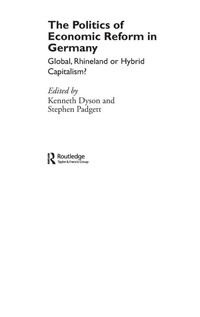
The Politics of Economic Reform in Germany
Global, Rhineland or Hybrid Capitalism
1st Edition
Published on 13. April 2006
Book
Hardback
174 pages
978-0-415-36679-3 (ISBN)
Description
This new volume situates current debates about economic reform in Germany in illuminating historical and structural contexts.
Showing how economic reform has become the central issue on the German political agenda, raising contentious issues of policy management and posing deeper questions about political beliefs and identities. It also examines the politics of the reform process, outlining competing views about the root causes of Germany's economic problems, the appropriate policy responses, and the distribution of costs. It situates the reform process in the wider context of the decline of the German economic model (Modell Deutschland) and Germany's transition from European 'pace-setter' to economic 'laggard'.
Particular attention is paid to the following key questions:
What continuities and discontinuities can be seen in Germany's political economy?
Are globalization and Europeanization associated with a progressive neo-liberal ascendancy in economic reform?
How does economic reform in Germany compare with that in other states, notably Britain and France?
Are there distinctive patterns in the way domestic policymakers negotiate economic reform?
How do the characteristics of the German labour market and welfare state condition economic reform?
How much variation exists at the Laender levels?
This book was previously published as a special issue of German Politics.
Showing how economic reform has become the central issue on the German political agenda, raising contentious issues of policy management and posing deeper questions about political beliefs and identities. It also examines the politics of the reform process, outlining competing views about the root causes of Germany's economic problems, the appropriate policy responses, and the distribution of costs. It situates the reform process in the wider context of the decline of the German economic model (Modell Deutschland) and Germany's transition from European 'pace-setter' to economic 'laggard'.
Particular attention is paid to the following key questions:
What continuities and discontinuities can be seen in Germany's political economy?
Are globalization and Europeanization associated with a progressive neo-liberal ascendancy in economic reform?
How does economic reform in Germany compare with that in other states, notably Britain and France?
Are there distinctive patterns in the way domestic policymakers negotiate economic reform?
How do the characteristics of the German labour market and welfare state condition economic reform?
How much variation exists at the Laender levels?
This book was previously published as a special issue of German Politics.
More details
Language
English
Place of publication
London
United Kingdom
Publishing group
Taylor & Francis Ltd
Target group
College/higher education
Professional and scholarly
Dimensions
Height: 240 mm
Width: 161 mm
Thickness: 14 mm
Weight
435 gr
ISBN-13
978-0-415-36679-3 (9780415366793)
Copyright in bibliographic data and cover images is held by Nielsen Book Services Limited or by the publishers or by their respective licensors: all rights reserved.
Schweitzer Classification
Other editions
Additional editions
Kenneth Dyson | Stephen Padgett
The Politics of Economic Reform in Germany
Global, Rhineland or Hybrid Capitalism
E-Book
07/2014
1st Edition
Routledge
€41.99
Available for download
Kenneth Dyson | Stephen Padgett
The Politics of Economic Reform in Germany
Global, Rhineland or Hybrid Capitalism
E-Book
07/2014
1st Edition
Routledge
€41.99
Available for download
Kenneth Dyson | Stephen Padgett
The Politics of Economic Reform in Germany
Global, Rhineland or Hybrid Capitalism
Book
10/2009
1st Edition
Routledge
€47.60
Shipment within 15-20 days
Persons
Kenneth Dyson is Research Professor in the School of European Studies, Cardiff University, Wales. He has written widely on European and comparative political economy and public policy.,
Stephen Padgett is Professor of Politics at the University of Strathclyde, Scotland. He has written widely on European politics and policy.
Stephen Padgett is Professor of Politics at the University of Strathclyde, Scotland. He has written widely on European politics and policy.
Content
Introduction 1. Globalization and National Models of Capitalism: Is Rhineland Capitalism Viable? 2. Domestic Political Strategies for Economic Reform in Germany: The Innovative Power of Consensus? 3. The Political Economy of the Welfare State and Economic Reform 4. Mapping the Politics of Labour Market Reform 5. The Finance Sector in Transition: A Motor for Economic Reform? 6. Economic Reform at the Laender Level 7. Reform in the Shadow of European Community Law: Highly Regulated Economic Sectors 8. The Party Politics of Economic Reform. Conclusion: External and Domestic Policy Implications