

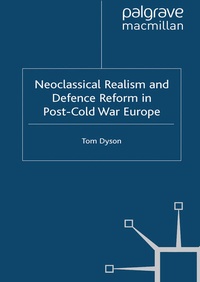
Neoclassical Realism and Defence Reform in Post-Cold War Europe
Published on 1. January 2010
Book
Paperback/Softback
XX, 328 pages
978-1-349-31935-0 (ISBN)
Description
Dyson explains the convergence and divergence between British, French and German defence reforms in the post-Cold War era. He engages with cultural and realist theories and develops a neoclassical realist approach to change and stasis in defence policy, bringing new material to bear on the factors which have affected defence reforms.
More details
Series
Edition
1st ed. 2010
Language
English
Place of publication
London
United Kingdom
Target group
Professional and scholarly
Illustrations
XX, 328 p.
Dimensions
Height: 235 mm
Width: 155 mm
Thickness: 20 mm
Weight
534 gr
ISBN-13
978-1-349-31935-0 (9781349319350)
DOI
10.1057/9780230283299
Schweitzer Classification
Other editions
Additional editions
Book
07/2010
Palgrave Macmillan
€53.49
Shipment within 15-20 days
Person
TOM DYSON is Lecturer in International Security at the University of Surrey's Department of Political, International and Policy Studies, UK. He is currently undertaking a two year sabbatical as an Alexander von Humboldt Foundation Research Fellow at the Stiftung Wissenschaft und Politik, Berlin, Germany. His published work focuses on British and German foreign, defence and security policies and European defence co-operation.
Content
PART I: CONTEXT: THE CASE FOR CONVERGENCE Europe's Partial and Selective Emulation of the US-led Revolution in Military Affairs Convergence and Divergence in the Institutional Forums of Defence Policy: Functional Complementarity; Spatial and Temporal Differentiation PART II: THEORISING AND TESTING DEFENCE POLICY CONVERGENCE Competing Theoretical Frameworks: Realist and Cultural Approaches PART III: TESTING CULTURAL AND REALIST APPROACHED: DEFENCE POLICIES BETWEEN INTERNATIONAL STRUCTURE AND EXECUTIVE AUTONOMY France: Domestic Incentives and Timely Adaptation to Systemic Imperatives Germany: Domestic Constraint and the Temporal Management of Reform The United Kingdom High Executive Autonomy and Timely Adaptation to Systemic Imperatives Conclusions: The Empirical and Theoretical Implications