

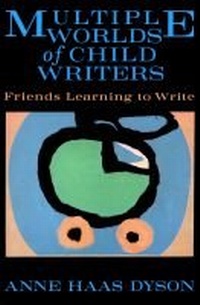
The Multiple Worlds of Child Writers
Friends Learning to Write
Will be published approx. on 15. June 1990
Book
Paperback/Softback
336 pages
978-0-8077-2971-7 (ISBN)
Description
Based on a two-year study of first graders at a magnet school in the San Francisco Bay Area, Multiple Worlds of Child Writers: Friends Learning to Write provides an important missing link in the study of emergent literacy: the peer group and the classroom contexts that surround it. Using four richly detailed case studies, the author portrays the process through which Margaret, the teacher, and her children form a community, one supported by and supporting of the children's growth as writers.
Dyson offers new perspectives by displaying the quality of life in the classroom through children's talk, drawings, and writing. The theoretical framework presented here for understanding children's growth moves what is usually considered background to the foreground for study. Most works on children's writing stress that children must "disembed" or "decontextualize" their written texts from dependency on other symbolic media and other people. Dyson, however, shows that to develop as writers, children's text must become progressively more embedded in the social, affective, and intellectual parts of their lives. The book also emphasizes the nature of the classroom rather than the home as a distinctive context for early literacy growth. Moreover, the classroom is an urban one that includes children from diverse social and ethnic backgrounds. The classroom and children whose lives fill this book challenge current thinking about such critical issues as the developmental links between writing and other symbol systems, sequence and variability in early writing growth, the relationship between form and function in young children's writing, and the development of literary language.
This book is a must for early childhood educators, reading and language arts specialists, and scholars/researchers in the field of literacy.
Dyson offers new perspectives by displaying the quality of life in the classroom through children's talk, drawings, and writing. The theoretical framework presented here for understanding children's growth moves what is usually considered background to the foreground for study. Most works on children's writing stress that children must "disembed" or "decontextualize" their written texts from dependency on other symbolic media and other people. Dyson, however, shows that to develop as writers, children's text must become progressively more embedded in the social, affective, and intellectual parts of their lives. The book also emphasizes the nature of the classroom rather than the home as a distinctive context for early literacy growth. Moreover, the classroom is an urban one that includes children from diverse social and ethnic backgrounds. The classroom and children whose lives fill this book challenge current thinking about such critical issues as the developmental links between writing and other symbol systems, sequence and variability in early writing growth, the relationship between form and function in young children's writing, and the development of literary language.
This book is a must for early childhood educators, reading and language arts specialists, and scholars/researchers in the field of literacy.
More details
Series
Language
English
Place of publication
New York
United States
Target group
Professional and scholarly
Dimensions
Height: 230 mm
Width: 150 mm
Thickness: 23 mm
Weight
525 gr
ISBN-13
978-0-8077-2971-7 (9780807729717)
Copyright in bibliographic data and cover images is held by Nielsen Book Services Limited or by the publishers or by their respective licensors: all rights reserved.
Schweitzer Classification