

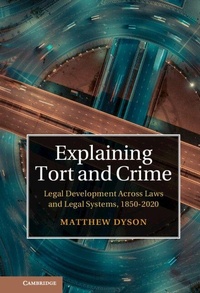
Explaining Tort and Crime
Legal Development Across Laws and Legal Systems, 1850-2020
Published on 21. July 2022
Book
Hardback
558 pages
978-1-107-14486-6 (ISBN)
Description
Tracing almost 200 years of history, Explaining Tort and Crime explains the development of tort law and criminal law in England compared with other legal systems. Referencing legal systems from around the globe, it uses innovative comparative and historical methods to identify patterns of legal development, to investigate the English law of fault doctrine across tort and crime, and to chart and explain three procedural interfaces: criminal powers to compensate, timing rules to control parallel actions, and convictions as evidence in later civil cases. Matthew Dyson draws on decades of research to offer an analysis of the field, examining patterns of legal development, visible as motifs in the law of many legal systems.
Reviews / Votes
'Explaining Tort and Crime is a terrific book, and we are deeply in Matt Dyson's debt. Not only does it realise the ambition of promoting scholarship on tort and crime, it also makes a major contribution to the literature on doctrinal development and change in the law. It has taught me a great deal. One can ask and expect no more.' Peter Cane, Criminal Law and Criminal Justice BooksMore details
Language
English
Place of publication
Cambridge
United Kingdom
Dimensions
Height: 235 mm
Width: 157 mm
Thickness: 34 mm
Weight
949 gr
ISBN-13
978-1-107-14486-6 (9781107144866)
Copyright in bibliographic data and cover images is held by Nielsen Book Services Limited or by the publishers or by their respective licensors: all rights reserved.
Schweitzer Classification
Other editions
Additional editions
E-Book
07/2022
Cambridge University Press
€100.99
Available for download
E-Book
07/2022
Cambridge University Press
€100.99
Available for download
Person
Matthew Dyson is Professor of Civil and Criminal Law at the Faculty of Law, University of Oxford, and a Tutorial Fellow at Corpus Christi College, Oxford. He is also an Associate Member of 6KBW College Hill Chambers, and a Visiting Professor and Senior Fellow at the Notre Dame London Law Program. He was previously a Fellow of Jesus College, Cambridge and then Trinity College, Cambridge. He teaches tort law, criminal law, Roman law, comparative law and European legal history.
Content
Part I. Setting the Scene: Introduction and Methods for Explaining: 1. Introduction; 2. Organising tort and crime; Part II. Mental States and Careless Acts: The Development of Fault Doctrine in Crime and Tort: 3. Fault doctrines in criminal law; 4. Fault doctrines in tort law; 5. Explaining the criminal and tortious developments in fault doctrine; Part III. Procedures Interfacing Tort and Crime: 6. Claims and formats; 7. Timing rules; 8. Criminal judgments in the civil law; Part IV. Conclusions: 9. Patterns of development; 10. Conclusions.