

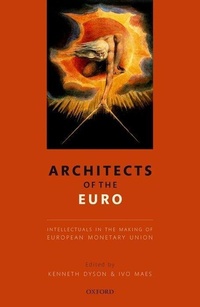
Architects of the Euro
Intellectuals in the Making of European Monetary Union
Published on 18. August 2016
Book
Hardback
336 pages
978-0-19-873591-5 (ISBN)
Description
Who were key figures in the making of European monetary union? Which ideas did they contribute to ensuring that monetary union would be sustainable? How prescient were they in identifying the necessary and sufficient foundations of a sustainable monetary union?
This book provides the first systematic historical examination of key architects of European monetary union in the period before its launch in 1999. Using original archival and interview research, it investigates the intellectual and career backgrounds of these architects, their networking skills, and their own doubts and reservations about the way in which monetary union was being constructed. In the light of the later Euro Area, Architects of the Euro deals critically with not just
their contribution to the making of European monetary union but also their legacy. The book brings together a distinguished group of scholars working on the history of Economic and Monetary Union.
This book provides the first systematic historical examination of key architects of European monetary union in the period before its launch in 1999. Using original archival and interview research, it investigates the intellectual and career backgrounds of these architects, their networking skills, and their own doubts and reservations about the way in which monetary union was being constructed. In the light of the later Euro Area, Architects of the Euro deals critically with not just
their contribution to the making of European monetary union but also their legacy. The book brings together a distinguished group of scholars working on the history of Economic and Monetary Union.
Reviews / Votes
With their collection of essays on high level bureaucrats the Architects of the Euro Maes and Dyson have broken new ground. The editors and their authors provide first-hand biographical accounts of these so far neglected figures and use them to explain their actions during the constitutive phase of the European monetary integration. * Josef Hien, EU Visions * This book is welcome for those who want to understand the complex process of getting to the single currency, while taking into account the driving forces of the individual personalities who were at the origin of the major ideas. The human aspect is never far away. In that respect, the biographic sketches are interesting reading which brings ideas in a historic and human perspective. For example, the way Otto Pohl defended his vision in the Delors Committee andin Germany, including the concept of the independence of the Central bank, reads almost like a thriller. * Prof. Dr. Freddy Van den Spiegel, Vrije Universiteit Brussel and Vlerick Business School * In a model of historiography, Dyson and Maes assemble biographical vignettes of ten economists and economic policymakers, including Robert Triffin and Jacques Delors, who helped establish the euro,' 'demonstrates the value of sophisticated syntheses of policy analysis and intellectual history.' * Andrew Moravcsik * This book, Architects of the Euro, is an impressive work on the personalities who built in a technical way the European Monetary Union. It is also useful for those readers willing to revise economic, and sometimes political, ideas about the Euro, from the creation of the European Community to the recent economic crisis. * Francesco Paolo Marco Leti, History of Economic Thought and Policy (HETP). * The originality of Architects of the Euro, edited by Dyson and Maes, is that it brings out the vital role played by ten senior officials and policy-oriented economists, well chosen by the editors, in starting the process towards the euro. Despite major differences in views, these architects had a shared motivation to start with what appeared at the time both economically justified and politically feasible, leaving the completion of the work-in-progress for later
challenges. * Niels Thygesen, Emeritus Professor of Economics, University of Copenhagen, and former member of the Delors Committee. * This remarkable volume by eminent scholars will help readers to better understand what the intellectual underpinning of the euro was and where it eventually proved wanting. It shows well how unprepared the system was to deal with the recent crisis and what are the challenges to fix it. * Andre Sapir, Professor of Economics at the Universite libre de Bruxelles, Belgium,and former economic advisor to the president of the European Commission. * It is often claimed, perhaps particularly by its detractors, that European Economic and Monetary Union was mainly created by an elite. This book records the identity, thinking and objectives of such key protagonists. It is an important study of political economy, how ideas and structures develop, an essential part of the political and economic history of our times. I am delighted to have played a minor role in the exercise, put together by Kenneth Dyson and Ivo
Maes, to deploy the best historians of political economic thought, to illuminate the process by which EMU was constructed. * Charles Goodhart FBA, Emeritus Professor of Economics at the London School of Economics, and former chief economist at the Bank of England. *
More details
Other editions
Additional editions
Kenneth Dyson | Ivo Maes
Architects of the Euro
Intellectuals in the Making of European Monetary Union
E-Book
03/2017
1st Edition
OUP eBook
€56.49
Available for download
Kenneth Dyson | Ivo Maes
Architects of the Euro
Intellectuals in the Making of European Monetary Union
E-Book
08/2016
1st Edition
OUP eBook
€56.49
Available for download
Persons
Kenneth Dyson is a Fellow of the British Academy, a Fellow of the Royal Historical Society, a Founding Fellow of the Learned Society of Wales, and Research Professor in European Political Studies at Cardiff University. His research interests encompass the European state, German policies and politics, comparative and international political economy, and the EU. His recent publication States, Debt, and Power: 'Saints' and 'Sinners' in European History and
Integration (OUP, 2014) won the UACES Best Book Prize.
Ivo Maes is Senior Advisor at the Research Department of the National Bank of Belgium and a Professor, Robert Triffin Chair, at the Université Catholique de Louvain, as well as at ICHEC Brussels Management School. In 2003, he was a member of the Committee for Institutional Reform of the West African Monetary Union. He has been a visiting professor at Duke University (USA), the Université de Paris-Sorbonne and the Università Roma Tre. He is the Chair of the Council of the European
Society for the History of Economic Thought.
Integration (OUP, 2014) won the UACES Best Book Prize.
Ivo Maes is Senior Advisor at the Research Department of the National Bank of Belgium and a Professor, Robert Triffin Chair, at the Université Catholique de Louvain, as well as at ICHEC Brussels Management School. In 2003, he was a member of the Committee for Institutional Reform of the West African Monetary Union. He has been a visiting professor at Duke University (USA), the Université de Paris-Sorbonne and the Università Roma Tre. He is the Chair of the Council of the European
Society for the History of Economic Thought.
Editor
Research Professor, School of Law and PoliticsResearch Professor, School of Law and Politics, Cardiff University
Senior Advisor, Research Department of the National Bank of Belgium and a professor, Robert Triffin Chair, at the Université Catholique de LouvainSenior Advisor, Research Department of the National Bank of Belgium and a professor, Robert Triffin Chair, at the Universite Catholique de Louvain