

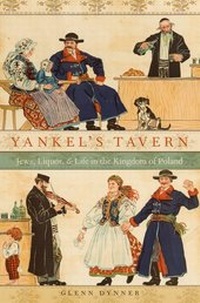
Yankel's Tavern
Jews, Liquor, and Life in the Kingdom of Poland
Published on 9. January 2014
Book
Hardback
272 pages
978-0-19-998851-8 (ISBN)
Description
In nineteenth-century Eastern Europe, the Jewish-run tavern was often the center of leisure, hospitality, business, and even religious festivities. This unusual situation came about because the nobles who owned taverns throughout the formerly Polish lands believed that only Jews were sober enough to run taverns profitably, a belief so ingrained as to endure even the rise of Hasidisms robust drinking culture. As liquor became the regions boom industry, Jewish tavernkeepers became integral to both local economies and local social life, presiding over Christian celebrations and dispensing advice, medical remedies and loans. Nevertheless, reformers and government officials, blaming Jewish tavernkeepers for epidemic peasant drunkenness, sought to drive Jews out of the liquor trade. Their efforts were particularly intense and sustained in the Kingdom of Poland, a semi-autonomous province of the Russian empire that was often treated as a laboratory for social and political change. Historians have assumed that this spelled the end of the Polish Jewish liquor trade. However, newly discovered archival sources demonstrate that many nobles helped their Jewish tavernkeepers evade fees, bans and expulsions by installing Christians as fronts for their taverns. The resulta vast underground Jewish liquor tradereflects an impressive level of local Polish-Jewish co-existence that contrasts with the more familiar story of anti-Semitism and violence. By tapping into sources that reveal the lives of everyday Jews and Christians in the Kingdom of Poland, Yankels Tavern transforms our understanding of the region during the tumultuous period of Polish uprisings and Jewish mystical revival.
Reviews / Votes
Dynner has carried out impressive archival research ... [his] archival discoveries lead him into multifarious aspects of Jewish life in the Congress Kingdom. * Larry Wolff, The Time Literary Supplement * Dynner's short monograph is a remarkable achievement. The book is one of those rare academic accomplishments: persuasive yet concise. * Kevin Goldberg, European History Quarterly *More details
Language
English
Place of publication
New York
United States
Target group
College/higher education
Dimensions
Height: 241 mm
Width: 163 mm
Thickness: 22 mm
Weight
506 gr
ISBN-13
978-0-19-998851-8 (9780199988518)
Copyright in bibliographic data and cover images is held by Nielsen Book Services Limited or by the publishers or by their respective licensors: all rights reserved.
Schweitzer Classification
Other editions
Additional editions
Book
01/2015
Oxford University Press Inc
€53.50
Shipment within 15-20 days
E-Book
11/2014
OUP eBook
€24.99
Available for download
E-Book
11/2013
1st Edition
OUP eBook
€24.99
Available for download
Person
Glenn Dynner is Associate Professor of History at Sarah Lawrence College.
Content
Author's Preface ; A Note on Translations ; Introduction ; Chapter 1: Entrance: Myths and Countermyths ; Chapter 2: Rural Jewish Prohibition in the Kingdom of Poland ; Chapter 3: The Urban Jewish Liquor Trade in the Kingdom of Poland ; Chapter 4: Patriots, Smugglers and Spies: Tavernkeepers during the Polish Uprisings of 1830 and 1863 ; Chapter 5: The Tavernkeepers Speak: Polish Jewish Tavernkeeping in the Wake of Peasant Emancipation ; Chapter 6: Farmers, Soldiers, and Students: Attempts to Transform Jewish Tavernkeepers ; Conclusion ; Notes ; Bibliography ; Index