

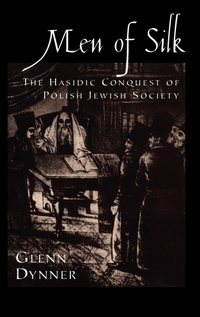
Men of Silk
The Hasidic Conquest of Polish Jewish Society
Published on 18. May 2006
Book
Hardback
396 pages
978-0-19-517522-6 (ISBN)
Description
Hasidism is a Kabbalah-inspired Jewish spiritual revival that centers on charismatic leaders and miracle workers known as "Zaddikim." By the beginning of the 19th century, Zaddikim and their devotees had forged Hasidism into a movement of such power and scop that it had dramatically altered the spiritual, cultural, and social timbre of Jewish communities across Eastern and East Central Europe. Glenn Dynner provides a first critical look at Hasidism's stunning transformation into a mass movement by highlighting the variegated region of Central Poland. His research shatters prevailing romantic notions about Hasidism during its meteoric rise, revealing Polish Zaddikim as shrewd populists who cultivated folksy images and achieved immense grassroots appeal, and yet proved equally adept at securing elite support, neutralizing powerful opponents, and seizing control of Jewish communal institutions across Central Poland.
Reviews / Votes
Dynner's book represents an important contribution to the previously understudied historiography of nineteenth-century Hasidism. His thorough and careful archival research, combined with his nuanced analysis of important zadikim, their ideology, and their social power, sets a new standard for the study of Hasidism. This is an indispensable volume for scholars and enthusiastic students of nineteenth-century East European Jewish culture and society. * American Historical Review * Men of Silk is an original research study which contextualizes the emergence of Hasidism as a wide ranging popular movement taking place throughout central Poland between the years 1754 and 1830. The book presents recently discovered archival material from Poland pertaining to the social and cultural aspects of the Hasidic movement and introduces new questions concerning the internal and external dimensions of the development of Hasidism. The author contributes to a better understanding of the challenge offered to the social historian in the presentation of Hasidic Jewry in its social and political context, while not losing insight into inner Jewish life. * Rachel Elior, author of The Mystical Origins of Hasidism * With precision and learning, Glenn Dynner manages to cut through so much of the multi-layered mythology surrounding the etiology, the organization, and the spread of hasidism in Poland. He provides a new, lucid account of its leaders, the lives of its devotees, and its relationship with government and Jewish society. He extracts much historical insight from seemingly recalcitrant hasidic hagiography, and draws on the widest range of sources -- hasidic, anti-hasidic, travelers' accounts, official, and more -- in what is a fascinating, fresh account of one of the most resonant Jewish religious ideologies in modern times. * Steven J. Zipperstein, author of Imagining Russian Jewry: Memory, History, Identity * The story of Hasidism has been told by both fervent believers and sworn secularists. This great east-European religious movement stood for several generations in the center of modern Jewish Historiography, and yet its diverse nature has been reduced to fit changing cultural modes, as well as long-forgotten political agendas. Men of Silk revises the story of Polish Hasidism. It offers a critical reading of inside and outside contemporaneous sources. Dynner's careful reading of the texts reveals Hasidism as a complex historical phenomenon, quite different from the simplistic portrait drawn by earlier schools of Jewish historians. * Israel Bartal, author of The Jews of Eastern Europe, 1772-1881 * Dynner's book addresses the heretofore neglected but crucially important subject of 19th-century Hasidism, shedding much light on this vital chapter of Jewish (and Polish) history. * Gershon David Hundert, author of Jews in Poland-Lithuania in the Eighteenth Century: A Genealogy of Modernity *More details
Language
English
Place of publication
New York
United States
Target group
College/higher education
Professional and scholarly
Illustrations
2 maps
Dimensions
Height: 240 mm
Width: 161 mm
Thickness: 26 mm
Weight
763 gr
ISBN-13
978-0-19-517522-6 (9780195175226)
Copyright in bibliographic data and cover images is held by Nielsen Book Services Limited or by the publishers or by their respective licensors: all rights reserved.
Schweitzer Classification
Other editions
Additional editions
Book
01/2009
Oxford University Press Inc
€71.00
Shipment within 15-20 days
E-Book
12/2008
1st Edition
OUP eBook
€31.99
Available for download
E-Book
04/2006
1st Edition
OUP eBook
€31.99
Available for download
Person
Content
Introduction:
1. Hasidism in Central Poland 1754-1830:
2. Anatomy of a Hasidic Conquest:
3. Warsaw and the Patrons of Polish Hasidism:
4. Yihus: The Social Composition of Early Hasidic Leadership:
5. Charlatans of "Lovers of Israel?" Evaluating Hasidic Populism:
6. Sermons, Stories, and Songs: Marketing Hasidism:
Conclusion:
Appendix A -Yihus and Marriage Strategies of early Zaddikim Outside Central Poland: Examples through 1815:
Appendix B -An Exorcism in Warsaw, 1818:
Appendix C -Works by Hasidic Authors, through 1815:
Bibliography:
Notes:
Index:
1. Hasidism in Central Poland 1754-1830:
2. Anatomy of a Hasidic Conquest:
3. Warsaw and the Patrons of Polish Hasidism:
4. Yihus: The Social Composition of Early Hasidic Leadership:
5. Charlatans of "Lovers of Israel?" Evaluating Hasidic Populism:
6. Sermons, Stories, and Songs: Marketing Hasidism:
Conclusion:
Appendix A -Yihus and Marriage Strategies of early Zaddikim Outside Central Poland: Examples through 1815:
Appendix B -An Exorcism in Warsaw, 1818:
Appendix C -Works by Hasidic Authors, through 1815:
Bibliography:
Notes:
Index: