

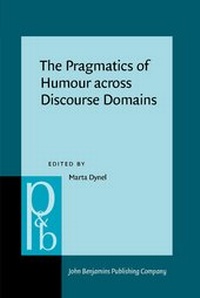
The Pragmatics of Humour across Discourse Domains
Published on 13. July 2011
Book
Hardback
382 pages
978-90-272-5614-0 (ISBN)
Description
This edited volume brings together a range of contributions solely on the linguistics of humour. Rather than favour one approach, this collection of articles gives a state-of-the-art picture of current directions in pragmatic humour studies. The contributors assume multifarious theoretical perspectives and discuss a wide array of issues germane to different types of humour across discourse domains. Consequently, the whole gamut of humorous forms and mechanisms are elucidated, such as surrealist irony, incongruity in register humour, mechanisms of pun formation, as well as interpersonal functions of conversational humour. In addition, the papers address diversified manifestations of humour, such as puns in Shakespeare's plays, gendered jokes on the Internet, sexuality in anti-proverbs, Woody Allen's prose, humour in "Friends", and parody by Monty Python's Flying Circus. Most importantly, the chapters offer new research findings and advocate novel theoretical conceptualisations of humorous phenomena, drawing on the wealth of existing scholarship. Therefore, the volume is bound to serve as a well of knowledge and inspiration for both seasoned and beginning researchers with interests in the pragmatics of humour.
More details
Series
Language
English
Place of publication
Amsterdam
Netherlands
Target group
Professional and scholarly
Illustrations
+ index
Dimensions
Height: 245 mm
Width: 164 mm
Weight
865 gr
ISBN-13
978-90-272-5614-0 (9789027256140)
Copyright in bibliographic data and cover images is held by Nielsen Book Services Limited or by the publishers or by their respective licensors: all rights reserved.
Schweitzer Classification
Other editions
Additional editions
E-Book
07/2011
1st Edition
John Benjamins Publishing Company
€123.99
Available for download
Person
Content
1. Pragmatics and linguistic research into humour (by Dynel, Marta); 2. Part 1. Stylistic figures as forms of humour; 3. 1.1: Irony; 4. Will anticipating irony facilitate it immediately? (by Giora, Rachel); 5. "That's not ironic, that's just stupid": Towards an eclectic account of the discourse of irony (by Simpson, Paul); 6. Irony via "surrealism" (by Kapogianni, Eleni); 7. 1.2 Puns and other wordplay; 8. The role of syllables and morphemes as mechanisms in humorous pun formation (by Seewoester Cain, Sarah); 9. Context-sensitive aspects of Shakespeare's use of puns in comedies: An enquiry into clowns' and pages' punning practices (by Adamczyk, Magdalena); 10. Dimensions of incongruity in register humour (by Venour, Chris); 11. Part 2. (Non)interactive forms of humour; 12. 2.1: Jokes; 13. Displays of "new" gender arrangements in Russian jokes (by Thielemann, Nadine); 14. Understanding ethnic humour in Romanian jokes (by Popescu, Carmen); 15. Sexuality in Anglo-American anti-proverbs (by Litovkina, Anna T.); 16. 2.2 Conversational humour; 17. Joker in the pack: Towards determining the status of humorous framing in conversations (by Dynel, Marta); 18. Humour in quasi-conversations: Constructing fun in online sports journalism (by Chovanec, Jan); 19. Humour and the integration of new staff in the workplace: An interactional study (by Pullin, Patricia); 20. Part 3. Forms of humour in public discourse; 21. Parody in the light of the incongruity-resolution model: The case of political sketches by Monty Pythons's Flying Circus (by Kaczorowski, Maciej); 22. "I'll be there for you!" On participation-based sitcom humour (by Dynel, Marta); 23. "Losers, poltroons and nudniks" in Woody Allen's Mere Anarchy: A linguistic approach to comic failure (by Ermida, Isabel); 24. Notes on humour and persuasion in advertising and legal discourse (by Forabosco, Giovannantonio); 25. Comic takeover or comic makeover?: Notes on humour-translating, translation and (un)translatability (by Chiaro, Delia); 26. Name index; 27. Subject index