

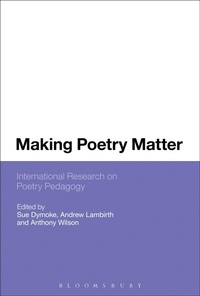
Making Poetry Matter
International Research on Poetry Pedagogy
Published on 6. June 2013
Book
Hardback
240 pages
978-1-4411-0147-1 (ISBN)
Description
Making Poetry Matter draws together contributions from leading scholars in the field to offer a variety of perspectives on poetry pedagogy. A wide range of topics are covered including:
- Teacher attitudes to teaching poetry in the urban primary classroom
- Digital poetry and multimodality
- Resistance to poetry in Post-16 English
Throughout, the internationally recognised contributors draw on case studies to ensure that the theory is clearly linked to classroom practice. They consider the teaching and learning challenges that poetry presents for those working with learners aged between 5 and 19 and explore these challenges with reference to reading; writing; speaking and listening and the transformative nature of poetry in different contexts.
- Teacher attitudes to teaching poetry in the urban primary classroom
- Digital poetry and multimodality
- Resistance to poetry in Post-16 English
Throughout, the internationally recognised contributors draw on case studies to ensure that the theory is clearly linked to classroom practice. They consider the teaching and learning challenges that poetry presents for those working with learners aged between 5 and 19 and explore these challenges with reference to reading; writing; speaking and listening and the transformative nature of poetry in different contexts.
Reviews / Votes
A timely and much needed collection of research essays which probe the current teaching of poetry at all stages of schooling. * English in Education * Both [this book and Making Poetry Happen] offer reassuring and affirming accounts of the innate power of poetry as a means of expressing identity and individuality in the classroom. ... [They] replace fears and anxieties with practical strategies and evidence of how creative and shared approaches to poetry can empower students within the classroom environment and beyond. * The Uses of English * This rich and invigorating book provides a much-needed argument for the place of poetry in 21st century english curriculum, and a grounded and practical resource for reading, teaching, writing, analysing, performing and making poetry. Bringing together academics, practicing poets and classroom teachers, it offers a set of nuanced and wide ranging reflections on the pragmatics and possibilities of teaching poetry and timely and sensitive instances of good pedagogy and responsive teaching in current times. It will be warmly welcomed by english and literacy teachers, academics and the profession alike. Most importantly, it provides real opportunities to make a difference; to enhance and open up the experience of literature in young people's lives. * Catherine Beavis, Professor of Education, Griffith University, Australia *More details
Language
English
Place of publication
New York
United States
Publishing group
Bloomsbury Publishing Plc
Target group
College/higher education
Professional and scholarly
Dimensions
Height: 240 mm
Width: 161 mm
Thickness: 17 mm
Weight
523 gr
ISBN-13
978-1-4411-0147-1 (9781441101471)
DOI
CBID169040
Copyright in bibliographic data and cover images is held by Nielsen Book Services Limited or by the publishers or by their respective licensors: all rights reserved.
Schweitzer Classification
Other editions
Additional editions
Sue Dymoke | Andrew Lambirth | Anthony Wilson
Making Poetry Matter
International Research on Poetry Pedagogy
E-Book
06/2013
1st Edition
Bloomsbury Academic USA
€41.99
Available for download
Sue Dymoke | Andrew Lambirth | Anthony Wilson
Making Poetry Matter
International Research on Poetry Pedagogy
E-Book
06/2013
1st Edition
Bloomsbury Academic USA
€41.99
Available for download
Persons
Sue Dymoke is Reader in Education in the School of Education at the University of Leicester, UK, where she is Course Leader of the Secondary PGCE.
Andrew Lambirth is Professor of Education at the University of Greenwich, UK.
Anthony Wilson is a Lecturer in the Graduate School of Education at the University of Exeter, UK, where he is Subject Leader for Primary English.
Andrew Lambirth is Professor of Education at the University of Greenwich, UK.
Anthony Wilson is a Lecturer in the Graduate School of Education at the University of Exeter, UK, where he is Subject Leader for Primary English.
Content
Introduction, Sue Dymoke (School of Education, University of Leicester, UK), Andrew Lambirth (School of Education, University of Greenwich, UK) and Anthony Wilson (Graduate School of Education, University of Exeter, UK)
Part I: Speaking and Listening
1. From Page to Performance, Janine L. Certo (Department of Teacher Education, Michigan State University, USA)
2. Listening to the Voice of Poetry, Joy Alexander (School of Education, Queen's University, Belfast)
3. Interpreting Classroom Responses to Heard Poetry, John Gordon (Department of Education and Lifelong Learning, University of East Anglia, UK)
4. Commentary on the Emerging Issues, Julie Blake (Poetry Archive, UK)
Part II: Reading
5. Teachers as Readers of Poetry, Teresa Cremin (Open University, UK)
6. Primary Student Teachers' Attitudes towards Poetry, Fiona Collins (Roehampton University, UK) and Alison Kelly (Roehampton University, UK)
7. Exploring Resistance to Poetry in Advanced English Studies, Gary Snapper (Brunel University, UK, and Cheney School, Oxford, UK)
8. Commentary on the Emerging Issues, David Whitely (Faculty of Education, University of Cambridge, UK)
Part III: Writing
9. Developing Grammar and Metalinguistic Understanding through Poetry Writing, Debra Myhill (College of Social Sciences and International Studies, University of Exeter, UK)
10. Teachers' Metaphors for Poetry Writing Pedagogy, Anthony Wilson (Graduate School of Education, University of Exeter, UK)
11. Ecocritical Approaches to Writing Nature Poetry, Sasha Matthewman (University of Bristol, UK)
12. Leading and Teaching Poetry 5-11, Andrew Lambirth (School of Education, University of Greenwich, UK), Sarah Smith (School of Education, University of Greenwich, UK) and Susanna Steele (School of Education, University of Greenwich, UK)
13. Commentary on the Emerging Issues, Jane Spiro (Oxford Brookes University, UK)
Part IV: Transformative Poetry Cultures
14. Developing Poetry Pedagogy for EAL Learners, Vicky Obied (Department of Educational Studies, Goldsmiths, University of London, UK)
15. Teaching Poetry in New Zealand Secondary Schools at a Time of Curriculum Change, Sue Dymoke (School of Education, University of Leicester, UK)
16. Using Digital Poetry to Provide a Multimodal Literacy Experience, Janette Hughes (Faculty of Education, University of Ontario Institute of Technology, Canada)
17. Commentary on the Emerging Issues, Andrey Rosowsky (School of Education, University of Sheffield, UK)
18. Afterword, Myra Barrs (Centre for Literacy in Primary Education, UK) and Morag Styles (Faculty of Education, University of Cambridge, UK)
Index
Part I: Speaking and Listening
1. From Page to Performance, Janine L. Certo (Department of Teacher Education, Michigan State University, USA)
2. Listening to the Voice of Poetry, Joy Alexander (School of Education, Queen's University, Belfast)
3. Interpreting Classroom Responses to Heard Poetry, John Gordon (Department of Education and Lifelong Learning, University of East Anglia, UK)
4. Commentary on the Emerging Issues, Julie Blake (Poetry Archive, UK)
Part II: Reading
5. Teachers as Readers of Poetry, Teresa Cremin (Open University, UK)
6. Primary Student Teachers' Attitudes towards Poetry, Fiona Collins (Roehampton University, UK) and Alison Kelly (Roehampton University, UK)
7. Exploring Resistance to Poetry in Advanced English Studies, Gary Snapper (Brunel University, UK, and Cheney School, Oxford, UK)
8. Commentary on the Emerging Issues, David Whitely (Faculty of Education, University of Cambridge, UK)
Part III: Writing
9. Developing Grammar and Metalinguistic Understanding through Poetry Writing, Debra Myhill (College of Social Sciences and International Studies, University of Exeter, UK)
10. Teachers' Metaphors for Poetry Writing Pedagogy, Anthony Wilson (Graduate School of Education, University of Exeter, UK)
11. Ecocritical Approaches to Writing Nature Poetry, Sasha Matthewman (University of Bristol, UK)
12. Leading and Teaching Poetry 5-11, Andrew Lambirth (School of Education, University of Greenwich, UK), Sarah Smith (School of Education, University of Greenwich, UK) and Susanna Steele (School of Education, University of Greenwich, UK)
13. Commentary on the Emerging Issues, Jane Spiro (Oxford Brookes University, UK)
Part IV: Transformative Poetry Cultures
14. Developing Poetry Pedagogy for EAL Learners, Vicky Obied (Department of Educational Studies, Goldsmiths, University of London, UK)
15. Teaching Poetry in New Zealand Secondary Schools at a Time of Curriculum Change, Sue Dymoke (School of Education, University of Leicester, UK)
16. Using Digital Poetry to Provide a Multimodal Literacy Experience, Janette Hughes (Faculty of Education, University of Ontario Institute of Technology, Canada)
17. Commentary on the Emerging Issues, Andrey Rosowsky (School of Education, University of Sheffield, UK)
18. Afterword, Myra Barrs (Centre for Literacy in Primary Education, UK) and Morag Styles (Faculty of Education, University of Cambridge, UK)
Index