

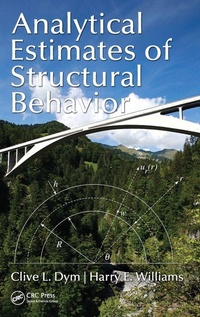
Analytical Estimates of Structural Behavior
1st Edition
Published on 10. February 2012
Book
Hardback
224 pages
978-1-4398-7089-1 (ISBN)
Description
Explicitly reintroducing the idea of modeling to the analysis of structures, Analytical Estimates of Structural Behavior presents an integrated approach to modeling and estimating the behavior of structures. With the increasing reliance on computer-based approaches in structural analysis, it is becoming even more important for structural engineers to recognize that they are dealing with models of structures, not with the actual structures. As tempting as it is to run innumerable simulations, closed-form estimates can be effectively used to guide and check numerical results, and to confirm physical insights and intuitions.
Spend Less Time Generating Numbers, and More Time Understanding What They Mean
This book encourages readers to think about structures and their models in a way that is rooted in classic elementary elasticity-depending less on advanced mathematical techniques and more on the dimensions and magnitudes of the underlying physics. The authors stretch the mold, emphasizing and more explicitly describing the modeling process. The focus is on learning which calculations to perform and how to validate and interpret the results-skills that will be increasingly useful for professional engineers.
Chapters cover:
Key principles and techniques of mathematical modeling, including dimensional analysis, scaling, linearity, and balance and conservation laws
Basic structural models
How to develop and express physical intuition
How to track the behavior of arches under lateral load
Two methods of analyzing coupled discrete systems-Castigliano's theorems and Rayleigh's quotient-to lay a foundation for their application to continuous systems
How to derive simple, accurate estimates of the transverse displacements of structures modeled in terms of coupled Timoshenko beams
How to
Spend Less Time Generating Numbers, and More Time Understanding What They Mean
This book encourages readers to think about structures and their models in a way that is rooted in classic elementary elasticity-depending less on advanced mathematical techniques and more on the dimensions and magnitudes of the underlying physics. The authors stretch the mold, emphasizing and more explicitly describing the modeling process. The focus is on learning which calculations to perform and how to validate and interpret the results-skills that will be increasingly useful for professional engineers.
Chapters cover:
Key principles and techniques of mathematical modeling, including dimensional analysis, scaling, linearity, and balance and conservation laws
Basic structural models
How to develop and express physical intuition
How to track the behavior of arches under lateral load
Two methods of analyzing coupled discrete systems-Castigliano's theorems and Rayleigh's quotient-to lay a foundation for their application to continuous systems
How to derive simple, accurate estimates of the transverse displacements of structures modeled in terms of coupled Timoshenko beams
How to
Reviews / Votes
I cannot agree more with the driving vision of the authors. Teaching of structural analysis is getting further and further away from what is needed for understanding design. Dym and Williams have the right idea. Very few structural engineers think about the relationship of the model to the structure. As I have complained often in question form 'Is the exact analysis of an approximate model good enough to serve as an approximate analysis of the exact model?' I sense that Dym and Williams are on the same page. -Mete A. Sozen, Kettelhut Distinguished Professor of Structural Engineering, Purdue University The authors, in their book Analytical Estimates of Structural Behavior, have done an excellent job of demonstrating the value of the classical approach in a modern digital world. -Bungale S. Taranath, Corporate Consultant, DeSimone Consulting EngineersMore details
Language
English
Place of publication
Bosa Roca
United States
Publishing group
Taylor & Francis Inc
Target group
Professional and scholarly
Academic and Professional Practice & Development
Illustrations
50 s/w Abbildungen, 13 s/w Tabellen
13 Tables, black and white; 50 Illustrations, black and white
Dimensions
Height: 240 mm
Width: 161 mm
Thickness: 17 mm
Weight
505 gr
ISBN-13
978-1-4398-7089-1 (9781439870891)
Copyright in bibliographic data and cover images is held by Nielsen Book Services Limited or by the publishers or by their respective licensors: all rights reserved.
Schweitzer Classification
Other editions
Additional editions
Clive L. Dym | Harry E. Williams
Analytical Estimates of Structural Behavior
Book
09/2019
1st Edition
CRC Press
€100.60
Shipment within 15-20 days
Clive L. Dym | Harry E. Williams
Analytical Estimates of Structural Behavior
E-Book
02/2012
CRC Press
€91.99
Available for download
Clive L. Dym | Harry E. Williams
Analytical Estimates of Structural Behavior
E-Book
02/2012
CRC Press
€92.49
Available for download
Persons
Clive L. Dym is Fletcher Jones Professor of Engineering Design and director of the Center for Design Education at Harvey Mudd College. After receiving his PhD from Stanford University, Dr. Dym held appointments at the University of Buffalo; the Institute for Defense Analyses; Carnegie Mellon University; Bolt, Beranek and Newman; and the University of Massachusetts at Amherst. He has held visiting appointments at the TECHNION-Israel Institute of Technology, the Institute for Sound and Vibration Research at Southampton, Stanford, Xerox PARC, Carnegie Mellon, Northwestern, USC, and the Singapore University of Technology and Design. Dr. Dym has authored or coauthored more than a dozen books and 90 refereed journal articles, was founding editor of the journal Artificial Intelligence for Engineering Design, Analysis, and Manufacturing, and has served on the editorial boards of several other journals, including the ASME's Journal of Mechanical Design. Dr. Dym is also a co-winner of the NAE's 2012 Bernard M. Gordon Prize "for creating and disseminating innovations in undergraduate engineering design education to develop engineering leaders" (NAE).
Harry E. Williams is Professor Emeritus of Engineering at Harvey Mudd College. After receiving his PhD from the California Institute of Technology, Dr. Williams joined the research staff of the Jet Propulsion Laboratory and then joined Harvey Mudd College as one of the founding faculty of its engineering program, serving there for 40 years. He has also been a Fulbright fellow at the University of Manchester, a liaison scientist for the Office of Naval Research, and a consultant to General Dynamics, Teledyne Microelectronics, the Naval Weapons Center, Aerojet-General, and the Boeing Company. He has published widely over the years, reflecting his interests in fluid mechanics, therm
Harry E. Williams is Professor Emeritus of Engineering at Harvey Mudd College. After receiving his PhD from the California Institute of Technology, Dr. Williams joined the research staff of the Jet Propulsion Laboratory and then joined Harvey Mudd College as one of the founding faculty of its engineering program, serving there for 40 years. He has also been a Fulbright fellow at the University of Manchester, a liaison scientist for the Office of Naval Research, and a consultant to General Dynamics, Teledyne Microelectronics, the Naval Weapons Center, Aerojet-General, and the Boeing Company. He has published widely over the years, reflecting his interests in fluid mechanics, therm
Content
Mathematical Modeling for Structural Analysis. Structural Models and Structural Modeling. Exploring Intuition: Beams, Trusses, and Cylinders. Estimating Stresses and Displacements in Arches. Estimating the Behavior of Coupled Discrete Systems. Buildings Modeling as Coupled Beams: Static Response Estimates. Buildings Modeled as Coupled Beams: Natural Frequency Estimates. Index.