

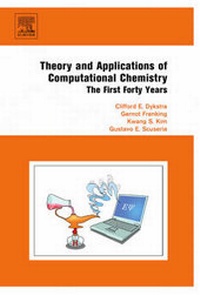
Theory and Applications of Computational Chemistry
The First Forty Years
Published on 13. October 2005
Book
Hardback
1336 pages
978-0-444-51719-7 (ISBN)
Description
Computational chemistry is a means of applying theoretical ideas using computers and a set of techniques for investigating chemical problems within which common questions vary from molecular geometry to the physical properties of substances. Theory and Applications of Computational Chemistry: The First Forty Years is a collection of articles on the emergence of computational chemistry. It shows the enormous breadth of theoretical and computational chemistry today and establishes how theory and computation have become increasingly linked as methodologies and technologies have advanced. Written by the pioneers in the field, the book presents historical perspectives and insights into the subject, and addresses new and current methods, as well as problems and applications in theoretical and computational chemistry. Easy to read and packed with personal insights, technical and classical information, this book provides the perfect introduction for graduate students beginning research in this area. It also provides very readable and useful reviews for theoretical chemists.
More details
Language
English
Place of publication
Oxford
United Kingdom
Publishing group
Elsevier Science & Technology
Target group
Professional and scholarly
Graduate students and researchers in chemistry and theoretical chemistry
Dimensions
Height: 240 mm
Width: 165 mm
Weight
2540 gr
ISBN-13
978-0-444-51719-7 (9780444517197)
Copyright in bibliographic data and cover images is held by Nielsen Book Services Limited or by the publishers or by their respective licensors: all rights reserved.
Schweitzer Classification
Other editions
Additional editions
Clifford Dykstra | Clifford Dykstra | Gernot Frenking
Theory and Applications of Computational Chemistry
The First Forty Years
E-Book
10/2011
Elsevier
€375.00
Available for download
Persons
Content
Selected Chapters
A Dynamical, Time-Dependent View of Molecular Theory.
Computation of Non-covalent Binding Affinities.
The Beginnings of Coupled Cluster Theory: An Eyewitness Account.
Controlling Quantum Phenomena with Photonic Reagents.
First-Principles Calculations of Anharmonic Vibrational Spectroscopy of Large Molecules.
Finding Minima, Transition States, and Following Reaction Pathways on Ab Initio Potential Energy Surfaces.
Progress in the Quantum Description of Vibrational Motion of Polyatomic Molecules.
Equations of Motion (EOM) Methods for Computing Electron Affinities and Ionization Potentials.
Semiempirical Quantum-Chemical Methods in Computational Chemistry.
Size-consistent State-specific Multi-reference Methods: A Survey of Some Recent Developments.
The Valence Bond Diagram Approach - A Paradigm for Chemical Reactivity.
Concepts of Perturbation, Orbital interaction, Orbital Mixing and Orbital Occupation.
G2, G3 and Associated Quantum Chemical Models for Accurate Theoretical Thermochemistry.
A Dynamical, Time-Dependent View of Molecular Theory.
Computation of Non-covalent Binding Affinities.
The Beginnings of Coupled Cluster Theory: An Eyewitness Account.
Controlling Quantum Phenomena with Photonic Reagents.
First-Principles Calculations of Anharmonic Vibrational Spectroscopy of Large Molecules.
Finding Minima, Transition States, and Following Reaction Pathways on Ab Initio Potential Energy Surfaces.
Progress in the Quantum Description of Vibrational Motion of Polyatomic Molecules.
Equations of Motion (EOM) Methods for Computing Electron Affinities and Ionization Potentials.
Semiempirical Quantum-Chemical Methods in Computational Chemistry.
Size-consistent State-specific Multi-reference Methods: A Survey of Some Recent Developments.
The Valence Bond Diagram Approach - A Paradigm for Chemical Reactivity.
Concepts of Perturbation, Orbital interaction, Orbital Mixing and Orbital Occupation.
G2, G3 and Associated Quantum Chemical Models for Accurate Theoretical Thermochemistry.