

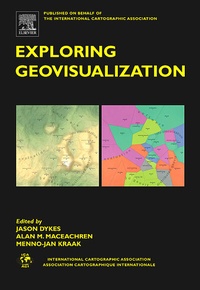
Exploring Geovisualization
Published on 10. February 2005
Book
Hardback
730 pages
978-0-08-044531-1 (ISBN)
Description
Sophisticated interactive maps are increasingly used to explore information - guiding us through data landscapes to provide information and prompt insight and understanding. Geovisualization is an emerging domain that draws upon disciplines such as computer science, human-computer interaction
design, cognitive sciences, graphical statistics, data visualization, information visualization, geographic information science and cartography to discuss, develop and evaluate interactive cartography.
This review and exploration of the current and future status of geovisualization has been produced by key researchers and practitioners from around the world in various cognate fields of
study. The thirty-six chapters present summaries of work undertaken, case studies focused on new methods and their application, system descriptions, tests of their implementation, plans for collaboration and reflections on experiences of using and developing geovisualization techniques.
In total, over 50 pages of color are provided in the book along with more than 250 color images on an enclosed CD-ROM.
design, cognitive sciences, graphical statistics, data visualization, information visualization, geographic information science and cartography to discuss, develop and evaluate interactive cartography.
This review and exploration of the current and future status of geovisualization has been produced by key researchers and practitioners from around the world in various cognate fields of
study. The thirty-six chapters present summaries of work undertaken, case studies focused on new methods and their application, system descriptions, tests of their implementation, plans for collaboration and reflections on experiences of using and developing geovisualization techniques.
In total, over 50 pages of color are provided in the book along with more than 250 color images on an enclosed CD-ROM.
Reviews / Votes
"I confess I have found this well set out, academically rigorous account very satisfying, and have been seriously educated by it...The text is surprisingly easy to read and comprehend. The contents are well ordered adn flow logically from 'exploring geovisualization' in the first chapter to 'Advancing geovisualization' in the final chapter...If you want a book which drags you from the wall maps of ogilby via mudge to the state of the art cartography of the 21st century, this is the kindest and (I believe) most authoritative way of achieving it. If you wish for expert and exhaustive information about present trends you need look no further."-Dr. Geoffrey Tapper, Shaftesbury,Dorset, IMCOS JOURNAL
More details
Series
Language
English
Place of publication
London
United Kingdom
Publishing group
Elsevier Science & Technology
Target group
Professional and scholarly
Computer science (particularly scientific visualization), information science (particularly information visualization and human-computer interaction), geographic information science (particularly cartography and geocomputation), statistics (particularly exploratory data analysis), and information design.
Dimensions
Height: 240 mm
Width: 165 mm
Weight
1610 gr
ISBN-13
978-0-08-044531-1 (9780080445311)
Copyright in bibliographic data and cover images is held by Nielsen Book Services Limited or by the publishers or by their respective licensors: all rights reserved.
Schweitzer Classification
Other editions
Additional editions
J. Dykes | M. -J Kraak | A. M. MacEachren
Exploring Geovisualization
E-Book
03/2005
Pergamon
€190.00
Available for download
Persons
Content
Section A. Geovisualization in context: perspectives from related disciplines.
Section B. Creating instruments for ideation: software approaches to geovisualization perspectives.
Section C. Using 3D in visualization.
Section D. Connecting people, data and resources: distributed geovisualization.
Conclusion: advancing geovisualization.
Section B. Creating instruments for ideation: software approaches to geovisualization perspectives.
Section C. Using 3D in visualization.
Section D. Connecting people, data and resources: distributed geovisualization.
Conclusion: advancing geovisualization.