

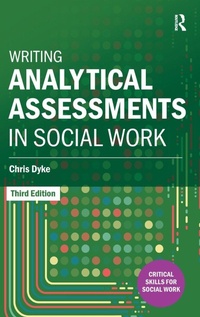
Writing Analytical Assessments in Social Work
3rd Edition
Published on 31. March 2025
Book
Hardback
242 pages
978-1-041-05796-3 (ISBN)
Description
You write something so that it can be read, not in order that it can be written - write reports that achieve and illuminate!
The third edition of the best-selling Writing Analytical Assessments in Social Work guides you through the principles of good writing and methodically shows you:
how to analyse
how to structure the process of writing an assessment (researching, chronologising, informed data-gathering, putting it all together),
how to get this done under time constraints.
how to break down the practical and psychological barriers to good practice and
how to turn good analysis into useful recommendations.
This new edition features brand new content, on subjects such as decision-making and cognitive fallacies in assessment, how to conduct analysis on domestic violence and systematic thinking and reflexivity in assessment. There are also updates on MCA assessments, new legislation and documents.
Written in an accessible way and packed with examples and case studies, this book is both practically-minded and constantly returning to first principles: reminding you what it is you are trying to achieve and teaching you how to write reports that can be read by families and judges alike. You will learn how to write high quality, useful and timely assessments without becoming mechanistic or managerial. This book kills the myth of a trade-off between efficiency and quality of work.
Writing Analytical Assessments in Social Work is an essential companion whether you are a newly-qualified social worker, a student about to undertake your first placement or a seasoned professional looking to improve your skills. It is also suitable for all branches of social work.
The third edition of the best-selling Writing Analytical Assessments in Social Work guides you through the principles of good writing and methodically shows you:
how to analyse
how to structure the process of writing an assessment (researching, chronologising, informed data-gathering, putting it all together),
how to get this done under time constraints.
how to break down the practical and psychological barriers to good practice and
how to turn good analysis into useful recommendations.
This new edition features brand new content, on subjects such as decision-making and cognitive fallacies in assessment, how to conduct analysis on domestic violence and systematic thinking and reflexivity in assessment. There are also updates on MCA assessments, new legislation and documents.
Written in an accessible way and packed with examples and case studies, this book is both practically-minded and constantly returning to first principles: reminding you what it is you are trying to achieve and teaching you how to write reports that can be read by families and judges alike. You will learn how to write high quality, useful and timely assessments without becoming mechanistic or managerial. This book kills the myth of a trade-off between efficiency and quality of work.
Writing Analytical Assessments in Social Work is an essential companion whether you are a newly-qualified social worker, a student about to undertake your first placement or a seasoned professional looking to improve your skills. It is also suitable for all branches of social work.
Reviews / Votes
....For those who are familiar with the first edition of the text, it is important to note that the author has written two completely new chapters for this second edition, which cover the topics of 'why assessment is important' and 'what happens after assessment' - in my opinion, these are welcome additions which significantly improve what was already an excellent book, and one which I thoroughly recommend to all social workers and those working in social care - be they still in training, newly qualified or with many years of experience - as well as practice teachers, field educators and trainers.Sue Taplin
More details
Series
Edition
3rd edition
Language
English
Place of publication
London
United Kingdom
Publishing group
Taylor & Francis Ltd
Target group
Professional and scholarly
Professional Practice & Development
Dimensions
Height: 240 mm
Width: 161 mm
Thickness: 18 mm
Weight
531 gr
ISBN-13
978-1-041-05796-3 (9781041057963)
Copyright in bibliographic data and cover images is held by Nielsen Book Services Limited or by the publishers or by their respective licensors: all rights reserved.
Schweitzer Classification
Other editions
New editions
Book
approx. 08/2026
4th Edition
Routledge
€191.50
Not yet published
Additional editions
E-Book
02/2025
3rd Edition
Routledge
€37.99
Available for download
E-Book
02/2025
3rd Edition
Routledge
€37.99
Available for download
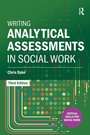
Book
09/2023
3rd Edition
Critical Publishing Ltd
€45.00
Shipment within 3-4 weeks
Person
Chris Dyke graduated in social work from Goldsmith's in 2006, before working in statutory teams in London, and as an independent social worker from 2015. He started teaching at Goldsmith's in 2013 and has taught social work, education, economics, and social policy. He completed his PhD at UCL in 2022, on parole decisions about domestic violence perpetrators. Chris has work published in Community Care, Professional Social Work magazine, the British Journal of Social Work and Criminal Behaviour and Mental Health.
Content
Introduction 1) Chronologies: The start and heart of a good assessment 2) Genograms and ecomaps:Knowing the networks 3) How to get it done: Planning your report in the real world 4) Writing 5) Analysis 6) What Next? 7) Summary Appendix 1: Writing for child care proceedings Appendix 2: Deprivation of Liberty assessments