

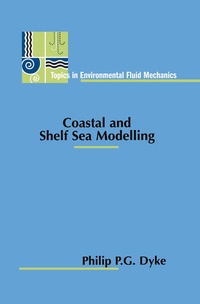
Coastal and Shelf Sea Modelling
Published on 30. November 2000
Book
Hardback
VIII, 264 pages
978-0-7923-7995-9 (ISBN)
Description
Since the computing revolution, modelling has become the most important way in which we further our knowledge about how the sea moves and how the processes in the sea operate. The coast and the continental shelf are two of the most important areas of the sea to understand.
Coastal and Shelf Sea Modelling
is therefore very timely and important. In this text, modelling the processes that occur in the sea is motivated continually through real life examples. Sometimes these are incorporated naturally within the text, but there are also a number of case studies taken from the recent research literature. These will be particularly valuable to students as they are presented in a style more readily accessible than that found in a typical research journal. The motivation for modelling is care for the environment. The well publicised problem of global warming, the phenomenon of El Niño, more localised pollution scares caused by tanker accidents and even smaller scale coastal erosion caused by storms all provide motivation for modelling and all get coverage in this text. Particularly novel features of the book include a systematic treatment of the modelling process in a marine context, the inclusion of diffusion in some detail, ecosystems modelling and a brief foray into wave prediction. The final chapter provides the reader with the opportunity to do some modelling; there are many worked examples followed by exercises that readers can try themselves. All answers are provided. Throughout, the style is informal and the technicalities in term of mathematics are kept to a minimum.
Coastal and Shelf Sea Modelling is particularly suitable for graduate marine and oceanographic modelling courses, but will also prove useful to coastal engineers and students at any level interested in the quantitative modelling of marine processes. It is stressed that only a minimal level of mathematics (first year calculus or less) is required; thestyle and content is introductory.
Coastal and Shelf Sea Modelling is particularly suitable for graduate marine and oceanographic modelling courses, but will also prove useful to coastal engineers and students at any level interested in the quantitative modelling of marine processes. It is stressed that only a minimal level of mathematics (first year calculus or less) is required; thestyle and content is introductory.
More details
Series
Edition
2001 ed.
Language
English
Place of publication
New York
United States
Target group
College/higher education
Professional and scholarly
Research
Illustrations
VIII, 264 p.
Dimensions
Height: 241 mm
Width: 160 mm
Thickness: 20 mm
Weight
582 gr
ISBN-13
978-0-7923-7995-9 (9780792379959)
DOI
10.1007/978-1-4757-4786-7
Schweitzer Classification
Other editions
Additional editions
Philip P. G. Dyke
Coastal and Shelf Sea Modelling
E-Book
04/2013
Springer
€96.29
Available for download
Philip P. G. Dyke
Coastal and Shelf Sea Modelling
Book
12/2010
Springer
€106.99
Shipment within 15-20 days
Content
1 The Modelling Process...- 2 Dynamic Balances.- 3 Numerical Methods.- 4 Boundary Conditions.- 5 Modelling Diffusion.- 6 Modelling on the Continental Shelf.- 7 Environmental Impact Modelling.- 8 Modelling in Action.