

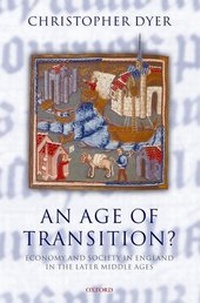
An Age of Transition?
Economy and Society in England in the Later Middle Ages
Published on 22. March 2007
Book
Paperback/Softback
304 pages
978-0-19-921526-3 (ISBN)
Description
This significant work by a prominent medievalist focuses on the period of transition between 1250 and 1550, when the wealth and power of the great lords was threatened and weakened, and when new social groups emerged and new methods of production were adopted.
Professor Dyer examines both the commercial growth of the thirteenth century, and the restructuring of farming, trade, and industry in the fifteenth century. The subjects investigated include the balance between individuals and the collective interests of families and villages. The role of the aristocracy and in particular the gentry are scrutinized, and emphasis placed on the initiatives taken by peasants, traders, and craftsmen. The growth in consumption moved the economy in new directions after 1350, and this encouraged investment in productive enterprises. A commercial mentality persisted and grew, and producers, such as farmers, profited from the market. Many people lived on wages, but not enough of them to justify describing the sixteenth century economy as capitalist. The conclusions are supported by research in sources not much used before, such as wills, and non-written evidence, including buildings.
Dyer argues for a reassessment of the whole period, and shows that many features of the sixteenth, seventeenth, and eighteenth centuries can be found before 1500.
Professor Dyer examines both the commercial growth of the thirteenth century, and the restructuring of farming, trade, and industry in the fifteenth century. The subjects investigated include the balance between individuals and the collective interests of families and villages. The role of the aristocracy and in particular the gentry are scrutinized, and emphasis placed on the initiatives taken by peasants, traders, and craftsmen. The growth in consumption moved the economy in new directions after 1350, and this encouraged investment in productive enterprises. A commercial mentality persisted and grew, and producers, such as farmers, profited from the market. Many people lived on wages, but not enough of them to justify describing the sixteenth century economy as capitalist. The conclusions are supported by research in sources not much used before, such as wills, and non-written evidence, including buildings.
Dyer argues for a reassessment of the whole period, and shows that many features of the sixteenth, seventeenth, and eighteenth centuries can be found before 1500.
Reviews / Votes
If this book becomes mandatory reading for all scholars of English economic history, as it should well be, we can be sure that there will emerge a clearer and more unified view of English economic history from the thirteenth through the eighteenth centuries. * Joseph F. Huffman, EH.NET * Always lucid, authoritative, splendidly documented, and obviously destined for a long-shelf-life. * Southern History 27 * the wealth of new thinking it represents, and the thoroughness of the scholarship underlying it, make it a work of exceptional importance * Neil Faulkner, Current Archaeology *More details
Series
Language
English
Place of publication
Oxford
United Kingdom
Target group
Professional and scholarly
Illustrations
15 maps & 6 figures
Dimensions
Height: 230 mm
Width: 150 mm
Thickness: 16 mm
Weight
459 gr
ISBN-13
978-0-19-921526-3 (9780199215263)
Copyright in bibliographic data and cover images is held by Nielsen Book Services Limited or by the publishers or by their respective licensors: all rights reserved.
Schweitzer Classification
Other editions
Additional editions
Book
02/2005
Oxford University Press
€135.10
Shipment within 15-20 days
Person
Content
Introduction ; 1. A New Middle Ages ; 2. Community and Privacy ; 3. Authority and Freedom ; 4. Consumption and Investment ; 5. Subsistence and Markets ; 6. Work and Leisure ; Conclusion ; Bibliography ; Index