

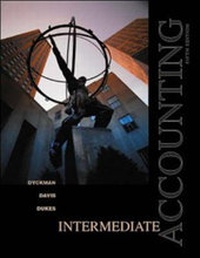
Intermediate Accounting
5th Edition
Published on 1. December 2000
Book
Paperback/Softback
1400 pages
978-0-07-118112-9 (ISBN)
Description
The mission of this text is to present critical concepts in a clear, concise way that is most helpful to learning and enhancing the student's interest. Rather than emphasizing rote learning of rules and regulations, the authors underscore how important it is for users and preparers of financial statements to understand accounting principles and how they are applied in financial reporting decisions. The text presents GAAP as the current solution to a continually evolving host of financial reporting questions. By acquainting students with the political nature of standard setting, the reader becomes aware that both users and preparers are affected by the outcome of the standard setting process.
More details
Edition
5th Revised edition
Language
English
Place of publication
London
United Kingdom
Publishing group
McGraw-Hill Education - Europe
Target group
College/higher education
Edition type
Revised edition
Dimensions
Height: 277 mm
Width: 215 mm
Thickness: 52 mm
Weight
2706 gr
ISBN-13
978-0-07-118112-9 (9780071181129)
Copyright in bibliographic data and cover images is held by Nielsen Book Services Limited or by the publishers or by their respective licensors: all rights reserved.
Schweitzer Classification
Persons
Thomas R. Dyckman received his Ph.D from the University of Michigan. He is presently the Ann Whitney Olin Professor of Accounting, and Associate Dean for Academic Affairs at Cornell University. Dyckman was President of the AAA in 1982 and the AAA's Outstanding Educator of the Year in 1987. Charles Davis received his Ph.D. from the University of Illinois. He is Professor of Accounting at California State University at Sacramento. He has served as the Manuscript Director of the NAA and has also served as a member of the Editorial Board of Advances in Accounting. Roland (Pete) Dukes received his Ph.D. from Stanford University. He is currently Professor of Accounting at the University of Washington. He has served as a consultant to the FASB and SEC and has served on the Editorial Boards of both The Journal of Accounting Research and The Journal of Accounting Literature.
Content
PART I. FOUNDATION AND REVIEW1. The Environment of Accounting2. The FASB's Conceptual Framework of Accounting3. Review: The Accounting Information Processing System4. Review: The Income Statement and the Retained Earnings Statement5. Review: The Balance Sheet and the Statement of Cash Flows6. Interest: Concepts of Future and Present ValuePART II. ASSET RECOGNITION AND MEASUREMENT7. Revenue and Expense Recognition8. Cash and Receivables9. Inventory: Basic Valuation Methods10. Inventory: Alternative Valuation Methods11. Operational Assets: Acquisition, Disposal, and Exchange12. Operational Assets: Depreciation and Impairment13. Intangible Assets and Natural Resources14. Investments in Debt and Equity Securities PART III. LIABILITIES15. Short-Term Liabilities16. Long-Term Liabilities17. Accounting for Leases18. Accounting for Pensions and Other Postemployment Benefits19. Accounting for Income TaxesPART IV. OWNERS' EQUITY20. Corporations: Contributed Capital21. Corporations: Retained Earnings and Stock Options22. Earnings per SharePART V. SPECIAL TOPICS23. Statement of Cash Flows24. Accounting Changes and Error Corrections25. Special Topics: Disclosures, Segment Reporting,and Interim Reporting.