

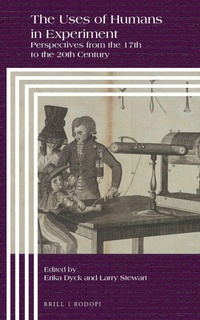
The Uses of Humans in Experiment
Perspectives from the 17th to the 20th Century
Published on 24. March 2016
Book
Hardback
312 pages
978-90-04-28670-2 (ISBN)
Description
Scientific experimentation with humans has a long history. Combining elements of history of science with history of medicine, The Uses of Humans in Experiment illustrates how humans have grappled with issues of consent, and how scientists have balanced experience with empiricism to achieve insights for scientific as well as clinical progress. The modern incarnation of ethics has often been considered a product of the second half of the twentieth century, as enshrined in international laws and codes, but these authors remind us that this territory has long been debated, considered, and revisited as a fundamental part of the scientific enterprise that privileges humans as ideal subjects for advancing research.
Reviews / Votes
"The Uses of Human Experiment is a collection of what individually are very interesting and useful essays that cover little-studied episodes in the history of human subject research."Piers J. Hale (University of Oklahoma), in Metascience (2019). https://doi.org/10.1007/s11016-019-00398-x.
'[...] from colorful tales on exploring the bodies of 18th-century hermaphrodites and the follies of self-experimentation by people of the stature of Alexander von Humboldt to well-intentioned nutritional experiments with prisoners, the risks and promises of radium, race and eugenics, and the horrors of the Nazis' coerced research. The essays keep readers interested and intrigued and provoke reflection on the status of humans as subjects for experimentation. This volume will be useful to scholars who have worked or are currently working on the history and ethics of research on humans and need to further illustrate or enhance their work with the addition of historical facts or colorful notes.'
- P. Rodriguez del Pozo (Weill Cornell Medical College), in: CHOICE, November 2016 Vol. 54 No. 3
More details
Series
Language
English
Place of publication
Leiden
Netherlands
Target group
College/higher education
Product notice
sewn/stitched
Cloth over boards
Dimensions
Height: 241 mm
Width: 159 mm
Thickness: 25 mm
Weight
573 gr
ISBN-13
978-90-04-28670-2 (9789004286702)
Copyright in bibliographic data and cover images is held by Nielsen Book Services Limited or by the publishers or by their respective licensors: all rights reserved.
Schweitzer Classification
Persons
Erika Dyck is Professor and Canada Research Chair in the History of Medicine at the University of Saskatchewan. She is the author of Psychedelic Psychiatry (Johns Hopkins University Press, 2008) and Facing Eugenics (University of Toronto Press, 2013).
Larry Stewart is Professor of History at the University of Saskatchewan, Canada. He is currently writing a study of experiment during the Enlightenment and the first industrial revolution. He has recently edited, with Bernie Lightman and Gordon McOuat, Circulating Knowledge, East and West (Brill, 2013), and is currently completing, with Trevor Levere and Hugh Torrens, The Democratic Vision of Thomas Beddoes; Science, Medicine and Reform.
Larry Stewart is Professor of History at the University of Saskatchewan, Canada. He is currently writing a study of experiment during the Enlightenment and the first industrial revolution. He has recently edited, with Bernie Lightman and Gordon McOuat, Circulating Knowledge, East and West (Brill, 2013), and is currently completing, with Trevor Levere and Hugh Torrens, The Democratic Vision of Thomas Beddoes; Science, Medicine and Reform.
Content
1 The Hermphrodite of Charing Cross
2 Galvanic Humans
Rob Iliffe
3 The Subject as Instrument: Galvanic Experiments, Organic Apparatus and Problems of Calibration
Joan Steigerwald
4 Shocking Subjects: Human Experiments and the Material Culture of Medical Electricity in Eighteenth-Century England
Paola Bertucci
5 Pneumatic Chemistry, Self-Experimentation and the Burden of Revolution, 1780-1805
Larry Stewart
6 Food Fights: Human Experiments in Late Nineteenth-Century Nutrition Physiology
Elizabeth Neswald
7 Experimenting with Radium Therapy: In the Laboratory & the Clinic
Katherine Zwicker
8 Anthropometry, Race, and Eugenic Research: "Measurements of Growing Negro Children"
Paul A. Lombardo
9 Nazi Human Experiments: The Victims' Perspective and the Post-Second World War Discourse
Paul Weindling
10 A Eugenics Experiment: Sterilization, Hyperactivity and Degeneration
Erika Dyck
2 Galvanic Humans
Rob Iliffe
3 The Subject as Instrument: Galvanic Experiments, Organic Apparatus and Problems of Calibration
Joan Steigerwald
4 Shocking Subjects: Human Experiments and the Material Culture of Medical Electricity in Eighteenth-Century England
Paola Bertucci
5 Pneumatic Chemistry, Self-Experimentation and the Burden of Revolution, 1780-1805
Larry Stewart
6 Food Fights: Human Experiments in Late Nineteenth-Century Nutrition Physiology
Elizabeth Neswald
7 Experimenting with Radium Therapy: In the Laboratory & the Clinic
Katherine Zwicker
8 Anthropometry, Race, and Eugenic Research: "Measurements of Growing Negro Children"
Paul A. Lombardo
9 Nazi Human Experiments: The Victims' Perspective and the Post-Second World War Discourse
Paul Weindling
10 A Eugenics Experiment: Sterilization, Hyperactivity and Degeneration
Erika Dyck