

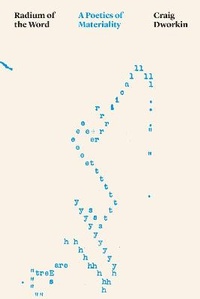
Radium of the Word
A Poetics of Materiality
Published on 18. November 2020
Book
Hardback
264 pages
978-0-226-74342-4 (ISBN)
Description
With fresh insight and contemporary relevance, Radium of the Word argues that a study of the form of language yields meanings otherwise inaccessible through ordinary reading strategies. Attending to the forms of words rather than to their denotations, Craig Dworkin traces hidden networks across the surface of texts, examining how typography, and even individual letters and marks of punctuation, can reveal patterns that are significant without being symbolic-fully meaningful without communicating any preordained message.
Radium of the Word takes its title from Mina Loy's poem for Gertrude Stein, which hails her as the Madame "Curie / of the laboratory / of vocabulary." In this spirit, Dworkin considers prose as a dynamic literary form, characterized by experimentation. Dworkin draws on examples from writers as diverse as Lyn Hejinian, William Faulkner, and Joseph Roth. He takes up the status of the proper name in Modernism, with examples from Stein, Loy, and Guillaume Apollinaire, and he offers in-depth analyses of individual authors from the counter-canon of the avant-garde, including P. Inman, Russell Atkins, N. H. Pritchard, and Andy Warhol. The result is an inspiring intervention in contemporary poetics.
Radium of the Word takes its title from Mina Loy's poem for Gertrude Stein, which hails her as the Madame "Curie / of the laboratory / of vocabulary." In this spirit, Dworkin considers prose as a dynamic literary form, characterized by experimentation. Dworkin draws on examples from writers as diverse as Lyn Hejinian, William Faulkner, and Joseph Roth. He takes up the status of the proper name in Modernism, with examples from Stein, Loy, and Guillaume Apollinaire, and he offers in-depth analyses of individual authors from the counter-canon of the avant-garde, including P. Inman, Russell Atkins, N. H. Pritchard, and Andy Warhol. The result is an inspiring intervention in contemporary poetics.
Reviews / Votes
"We count on Dworkin to say the smartest things about contemporary poetics, so the smartness of Radium of the Word comes as no surprise. What does come as a surprise is the book's first sentence: 'This book proposes a methodology.' And it does not disappoint. Dworkin is reinventing the practice of reading by unscrewing the locks on its doors. Not close, not distant, not surface, not formal, not historical, not reparative, not paranoid reading. This book bypasses adjectives and heads straight for the nouns: the death penalty, paper cuts, opera queens, gossip, songs, riots, print, quotation marks, homelessness, names, the typeset line, spaces, prose. Oh, and poetry. This is a difficult book that everybody should read." * Virginia Jackson, University of California, Irvine * "Dworkin is the closest reader we have. In startling, revelatory, and delightful essays on an astonishing range of writers and artists, Dworkin resists the systematic and canonical in pursuit of the peculiar, specific, and particular. Radium of the Word proposes a radically new approach to reading poetry, focusing on textual features that are not necessarily intentional. This book will be of importance to scholars of modernist and avant-garde literature, postwar African American poetry, and anyone interested in contemporary poetics." * Charles Bernstein, author of 'Near/Miss' and 'Topsy-Turvy' * "At a moment when claims for the thematic achievements of poetic language (cognitive mapping, climate graphing, racial and sexual tracking, worldmaking, self constructing, cultural undoing, consciousness raising, history transcending) are even more extreme than they were two years ago when this book came out, we have never needed Dworkin's weird lens on poetry more." -- Virginia Jackson * Critical Inquiry *More details
Series
Language
English
Place of publication
Chicago
United States
Publishing group
The University of Chicago Press
Target group
Professional and scholarly
Illustrations
21 halftones
Dimensions
Height: 229 mm
Width: 152 mm
Thickness: 20 mm
Weight
481 gr
ISBN-13
978-0-226-74342-4 (9780226743424)
Copyright in bibliographic data and cover images is held by Nielsen Book Services Limited or by the publishers or by their respective licensors: all rights reserved.
Schweitzer Classification
Other editions
Additional editions
E-Book
12/2020
1st Edition
University of Chicago Press
from
€28.80
Available for download
Person
Craig Dworkin is professor of English at the University of Utah. He is the author of Reading the Illegible, No Medium, and Dictionary Poetics, as well as ten books of poetry, most recently, The Pine-Woods Notebook.
Content
List of Figures
Introduction
One The Prosaic Imagination
Two The Onomastic Imagination
Three The Logic of the Work (on P. Inman)
Four The Logic of Print (on Russell Atkins)
Five The Logic of Spacing (on N. H. Pritchard)
Six The Logic of Registration (on Andy Warhol)
Acknowledgments
Notes
Index
Introduction
One The Prosaic Imagination
Two The Onomastic Imagination
Three The Logic of the Work (on P. Inman)
Four The Logic of Print (on Russell Atkins)
Five The Logic of Spacing (on N. H. Pritchard)
Six The Logic of Registration (on Andy Warhol)
Acknowledgments
Notes
Index