

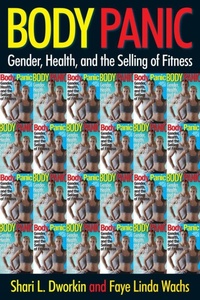
Body Panic
Gender, Health, and the Selling of Fitness
Published on 1. February 2009
Book
Hardback
235 pages
978-0-8147-1967-1 (ISBN)
Description
Dworkin and Wachs analyze 10 years of health and fitness magazines to uncover how bodies are made in popular culture
Are you ripped? Do you need to work on your abs? Do you know your ideal body weight? Your body fat index? Increasingly, Americans are being sold on a fitness ideal-not just thin but toned, not just muscular but cut-that is harder and harder to reach. In Body Panic, Shari L. Dworkin and Faye Linda Wachs ask why. How did these particular body types come to be "fit"? And how is it that having an unfit, or "bad," body gets conflated with being an unfit, or "bad," citizen?
Dworkin and Wachs head to the newsstand for this study, examining ten years worth of men's and women's health and fitness magazines to determine the ways in which bodies are "made" in today's culture. They dissect the images, the workouts, and the ideology being sold, as well as the contemporary links among health, morality, citizenship, and identity that can be read on these pages. While women and body image are often studied together, Body Panic considers both women's and men's bodies side-by-side and over time in order to offer a more in-depth understanding of this pervasive cultural trend.
Are you ripped? Do you need to work on your abs? Do you know your ideal body weight? Your body fat index? Increasingly, Americans are being sold on a fitness ideal-not just thin but toned, not just muscular but cut-that is harder and harder to reach. In Body Panic, Shari L. Dworkin and Faye Linda Wachs ask why. How did these particular body types come to be "fit"? And how is it that having an unfit, or "bad," body gets conflated with being an unfit, or "bad," citizen?
Dworkin and Wachs head to the newsstand for this study, examining ten years worth of men's and women's health and fitness magazines to determine the ways in which bodies are "made" in today's culture. They dissect the images, the workouts, and the ideology being sold, as well as the contemporary links among health, morality, citizenship, and identity that can be read on these pages. While women and body image are often studied together, Body Panic considers both women's and men's bodies side-by-side and over time in order to offer a more in-depth understanding of this pervasive cultural trend.
Reviews / Votes
"Body Panic is an interesting, careful, and timely book, and my guess is that it will be a valuable source for anyone interested in the sport-body-gender nexus for years to come." - Kevin Young (American Journal of Sociology) "A terrific critique of the ways that the media create and then sell the desire for perfect (but different) bodies to men and women. Dworkin and Wachs beautifully weave gender theory with empirical analyses of consumer culture for a very readable study." - Judith Lorber,author of Gendered Bodies: Feminist Perspectives and Breaking the Bowls: Degendering and Feminist Change "Dworkin and Wachs have produced the best analysis we have of this crucial moment in the history of sports and gender. They combine real rigor with wit and perceptiveness in a book that will become a standard reference for years to come." - Toby Miller,author of SportSex "In this critical cultural expose, Dworkin and Wachs peel back the surface layers of the health and fitness craze and reveal a festering, discomfiting malaise about gender and sexuality. If the old feminist slogan, 'Our Bodies, Ourselves' helped women regain control over their bodies, Dworkin and Sachs suggest a new slogan, 'Our Bodies, Our Culture.' For only when we see how our bodies have been taken from us, repackaged and returned as deformed and puny, can we see that we've been sold dis-ease and discomfort in the guise of health and fitness." - Michael Kimmel,author of The Gendered Society and editor, Men and Masculinities "Body Panic is an excellent media analysis for those interested in gender, cultural, or media studies. . .a book detailing the complex interplay of media message about health in relation to gender, race, class, and sexuality is a welcome addition to the ongoing dialogue on health and fitness." (Sex Roles)More details
Language
English
Place of publication
New York
United States
Target group
College/higher education
Professional and scholarly
Product notice
Cloth over boards
Dimensions
Height: 234 mm
Width: 156 mm
Thickness: 14 mm
Weight
480 gr
ISBN-13
978-0-8147-1967-1 (9780814719671)
Copyright in bibliographic data and cover images is held by Nielsen Book Services Limited or by the publishers or by their respective licensors: all rights reserved.
Schweitzer Classification
Other editions
Additional editions
E-Book
02/2009
1st Edition
New York University Press
€142.99
Available for download
Persons
Shari L. Dworkin is Professor in the Department of Social and Behavioral Sciences and Associate Dean for Academic Affairs at the University of California, San Francisco School of Nursing. She is the author or editor of several books, most recently Body Panic: Gender, Health, and the Selling of Fitness and Men at Risk, both with NYU Press.
Faye Linda Wachs is an Associate Professor of Sociology in the Department of Psychology and Sociology at California State Polytechnic University, Pomona (Cal Poly Pomona).
Faye Linda Wachs is an Associate Professor of Sociology in the Department of Psychology and Sociology at California State Polytechnic University, Pomona (Cal Poly Pomona).
Content
Acknowledgments 1 The Nature of Body Panic Culture 2 What Kinds of Subjects and Objects? Gender, Consumer Culture, and Convergence 3 Size Matters: Male Body Panic and the Third Wave "Crisis of Masculinity" 4 "Getting Your Body Back": Postindustrial Fit Motherhood and the Merger of the Second (Household Labor/Child Care) and Third (Fitness) Shifts 5 From Women's Sports & Fitness to Self : Third Wave Feminism and the Consumption Conundrum 6 Emancipatory Potential, Social Justice, and the Consumption Imperative Appendix Notes Bibliography Index About the Authors