

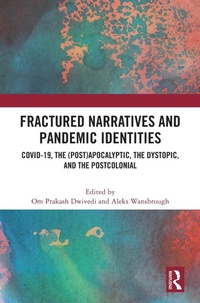
Fractured Narratives and Pandemic Identities
COVID-19, the (Post)Apocalyptic, the Dystopic, and the Postcolonial
1st Edition
Published on 30. August 2024
Book
Hardback
128 pages
978-1-032-72813-1 (ISBN)
Description
The book considers how identities have become more fractured since COVID-19, by thinking of COVID-19 in relation to other crises (economic, social, digital, and ecological) and by drawing parallels to literature, cinema, and visual art.
COVID-19 was a type of apocalypse, a catastrophic destructive event that produced dystopian measures in its wake and drew uncanny parallels to dystopic works of literature and speculative fiction. Yet the pandemic was apocalyptic in another sense too. The word apocalypse derives from apokalupsis, which means disclosure or uncovering. In this way, COVID-19 also revealed the dystopian processes already at work in the world, including digital forms of surveillance as well as the asymmetries within populations and divides in health outcomes between the Global North and Global South. Indeed, societies that have experienced the horrors of settler colonialism have already survived apocalypses. COVID-19 serves then as a premonition for our climate emergency as well as an echo of other apocalyptic situations, both real and imagined. This book consists of essays from acclaimed theorists and scholars writing amid the pandemic and exposes the asymmetries of our divided world. The volume will be indispensable for scholars and researchers of literature, postcolonial studies, cultural studies, and comparative literature including post-apocalyptic and speculative fiction.
The chapters in this book were originally published as a special issue of Journal of Postcolonial Writing and are accompanied by a new afterword.
COVID-19 was a type of apocalypse, a catastrophic destructive event that produced dystopian measures in its wake and drew uncanny parallels to dystopic works of literature and speculative fiction. Yet the pandemic was apocalyptic in another sense too. The word apocalypse derives from apokalupsis, which means disclosure or uncovering. In this way, COVID-19 also revealed the dystopian processes already at work in the world, including digital forms of surveillance as well as the asymmetries within populations and divides in health outcomes between the Global North and Global South. Indeed, societies that have experienced the horrors of settler colonialism have already survived apocalypses. COVID-19 serves then as a premonition for our climate emergency as well as an echo of other apocalyptic situations, both real and imagined. This book consists of essays from acclaimed theorists and scholars writing amid the pandemic and exposes the asymmetries of our divided world. The volume will be indispensable for scholars and researchers of literature, postcolonial studies, cultural studies, and comparative literature including post-apocalyptic and speculative fiction.
The chapters in this book were originally published as a special issue of Journal of Postcolonial Writing and are accompanied by a new afterword.
More details
Language
English
Place of publication
London
United Kingdom
Publishing group
Taylor & Francis Ltd
Target group
College/higher education
Postgraduate, Undergraduate Advanced, and Undergraduate Core
Dimensions
Height: 250 mm
Width: 175 mm
Thickness: 12 mm
Weight
434 gr
ISBN-13
978-1-032-72813-1 (9781032728131)
Copyright in bibliographic data and cover images is held by Nielsen Book Services Limited or by the publishers or by their respective licensors: all rights reserved.
Schweitzer Classification
Other editions
Additional editions
Om Prakash Dwivedi | Aleks Wansbrough
Fractured Narratives and Pandemic Identities
COVID-19, the (Post)Apocalyptic, the Dystopic, and the Postcolonial
Book
approx. 12/2025
1st Edition
Routledge
€68.10
Not yet published
Om Prakash Dwivedi | Aleks Wansbrough
Fractured Narratives and Pandemic Identities
COVID-19, the (Post)Apocalyptic, the Dystopic, and the Postcolonial
E-Book
08/2024
1st Edition
Routledge
€60.49
Available for download
Om Prakash Dwivedi | Aleks Wansbrough
Fractured Narratives and Pandemic Identities
COVID-19, the (Post)Apocalyptic, the Dystopic, and the Postcolonial
E-Book
08/2024
1st Edition
Routledge
€60.49
Available for download
Persons
Om Prakash Dwivedi is Associate Professor of English Literature at Bennett University, India. He is the author of Representations of Precarity in South Asian Literature in English (2022); Re-Orientalism and Indian Writing in English (2014) and Tracing the New Indian Diaspora (2014). His latest publication includes a special issue of The Journal of Commonwealth Literature on "Partition: 75 Years On", and a special issue of Metacritic Journal on "Hope and Utopia in Global South Literature" He is the Vice Chair of the international research group, Challenging Precarity (UK)
Aleks Wansbrough is a Writer and Cultural Theorist. The author of Capitalism and the Enchanted Screen: Myths and Allegories in the Digital Age (2021), his current research concerns ideological analyses of digital media and film. He is an editor of the Journal of Asia-Pacific Pop Culture published by Penn State University Press.
Aleks Wansbrough is a Writer and Cultural Theorist. The author of Capitalism and the Enchanted Screen: Myths and Allegories in the Digital Age (2021), his current research concerns ideological analyses of digital media and film. He is an editor of the Journal of Asia-Pacific Pop Culture published by Penn State University Press.
Content
Introduction - Living in dystopia: Fractured identities and COVID-19 1. Pandemic: Invisibility and silence 2. Thinking the delirious pandemic governance by numbers with Samit Basu's Chosen Spirits and Prayaag Akbar's Leila 3. Infection rebellion in Bina Shah's Before She Sleeps 4. The Adivasi and the undead: From (post)colonial carnage to Necrocene apocalypse in Betaal (2020) 5. Septopia and the wastialized Other: Allegorizing neo-liberalism in the age of COVID-19 6. Fragmentations, phantom limbs, re-memberings: Negotiating bodies, representation, and subjectivity in Caribbean British writing 7. Flattening the curse: Cooling down with Zadie Smith's Intimations 8. The art of COVID-19 Afterword - COVID-19 and the other virus