

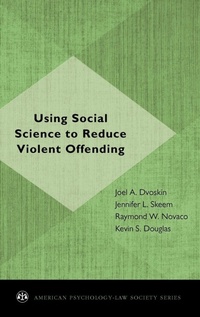
Using Social Science to Reduce Violent Offending
1st Edition
Published on 29. September 2011
Book
Hardback
352 pages
978-0-19-538464-2 (ISBN)
Description
Over the past three decades, the American criminal justice system has become unapologetically punitive. High rates of incarceration and frequent use of long-term segregation have become commonplace, with little concern for evidence that such practices make the public safer - and as the editors of this groundbreaking volume assert, they do not.
Bringing together experts in the fields of social science, forensic psychology and criminal justice, Using Social Science to Reduce Violent Offending addresses what truly works in reducing violent offending. Promoting an approach to correctional policy grounded in an evidence-based and nuanced understanding of human behavior, leading authorities from the United States, Canada, and Great Britain offer specific and practical strategies for improving the criminal and juvenile justice systems. Beginning by covering the history and scope of violent crime and incarceration in the U.S., this pioneering volume offers clear and practical recommendations for implementing approaches focused on behavioral change of even the most particular offender groups, such as juvenile offenders, sexual offenders, and offenders with mental illnesses. The authors argue for a more scientifically informed justice system, one where offenders-through correctional approaches such as community-based treatments and cognitive behavioral interventions-can be expected to learn the skills they will need to succeed in avoiding crime upon release. Authors also highlight methods for overcoming system inertia in order to implement these recommendations. Drawing on the science of human behavior to inform correctional practice, this book is an invaluable resource for policymakers, practitioners, mental health and criminal justice professionals, and anyone interested in the science behind the policies surrounding criminal punishment.
Bringing together experts in the fields of social science, forensic psychology and criminal justice, Using Social Science to Reduce Violent Offending addresses what truly works in reducing violent offending. Promoting an approach to correctional policy grounded in an evidence-based and nuanced understanding of human behavior, leading authorities from the United States, Canada, and Great Britain offer specific and practical strategies for improving the criminal and juvenile justice systems. Beginning by covering the history and scope of violent crime and incarceration in the U.S., this pioneering volume offers clear and practical recommendations for implementing approaches focused on behavioral change of even the most particular offender groups, such as juvenile offenders, sexual offenders, and offenders with mental illnesses. The authors argue for a more scientifically informed justice system, one where offenders-through correctional approaches such as community-based treatments and cognitive behavioral interventions-can be expected to learn the skills they will need to succeed in avoiding crime upon release. Authors also highlight methods for overcoming system inertia in order to implement these recommendations. Drawing on the science of human behavior to inform correctional practice, this book is an invaluable resource for policymakers, practitioners, mental health and criminal justice professionals, and anyone interested in the science behind the policies surrounding criminal punishment.
Reviews / Votes
An academically rigorous yet accessible book edited by Dvoskin, Skeem, Novaco, and Douglas, that intelligently explores gaps between empirical knowledge and criminal justice practice, and offers practical solutions to encourage researchers and policy makers to work together to create more informed policies. * PsycCritiques *More details
Series
Language
English
Place of publication
New York
United States
Target group
Professional and scholarly
Policymakers, practitioners, and professionals in criminal justice, forensic psychology, or the social sciences.
Dimensions
Height: 240 mm
Width: 161 mm
Thickness: 23 mm
Weight
681 gr
ISBN-13
978-0-19-538464-2 (9780195384642)
Copyright in bibliographic data and cover images is held by Nielsen Book Services Limited or by the publishers or by their respective licensors: all rights reserved.
Schweitzer Classification
Other editions
Additional editions
Jennifer L. Skeem Raymond W. Novaco Kevin S. Douglas Joel A. Dvoskin
Using Social Science to Reduce Violent Offending
E-Book
08/2011
1st Edition
Oxford University Press
€81.89
Available for download
Persons
Joel A. Dvoskin, Ph.D., ABPP is Clinical Assistant Professor of Psychiatry at the University of Arizona, Tucson and Past President of the American Psychology-Law Society.
Jennifer L. Skeem, Ph.D. is Professor of Psychology and Social Behavior, University of California, Irvine.
Raymond W. Novaco, Ph.D. is Professor of Psychology and Social Behavior, University of California, Irvine.
Kevin S. Douglas, Ph.D., LL.B. is Associate Professor of Psychology, Simon Fraser University.
Jennifer L. Skeem, Ph.D. is Professor of Psychology and Social Behavior, University of California, Irvine.
Raymond W. Novaco, Ph.D. is Professor of Psychology and Social Behavior, University of California, Irvine.
Kevin S. Douglas, Ph.D., LL.B. is Associate Professor of Psychology, Simon Fraser University.
Author
Clinical Associate Professor of PsychiatryClinical Associate Professor of Psychiatry, University of Arizona
Associate Professor of Psychology and Social BehaviorAssociate Professor of Psychology and Social Behavior, University of California, Irvine
Professor of Psychology and Social BehaviorProfessor of Psychology and Social Behavior, University of California, Irvine
Assistant Professor of PsychologyAssistant Professor of Psychology, Simon Fraser University
Content
Series Foreword ; Preface ; Contributors ; Part I. Defining the Problem: Crime, Incarceration, and Recidivism in the U.S. ; Chapter 1. Crime and rates of incarceration in the U.S. ; Alfred Blumstein ; Chapter 2. A short history of corrections: The rise, fall, and resurrection of rehabilitation through treatment ; Clive R. Hollin ; Part II. Targeting Contextual Contributors to the Problem ; Chapter 3. Contextual Influences on Violence ; David P. Farrington ; Chapter 4. The good, the bad, and the ugly of electronic media ; Muniba Saleem and Craig A. Anderson ; Chapter 5. Public attitudes and punitive policies ; Tom R. Tyler and Lindsay E. Rankin ; Part III. Improving Our Approach to Individual Offenders ; Chapter 6. The Risk-Need-Responsivity (RNR) Model of Correctional Assessment and Treatment ; Donald Andrews ; Chapter 7. Assessment and Treatment Strategies for Correctional Institutions ; Paul Gendreau and Paula Smith ; Chapter 8. Putting Science to Work: How the Principles of Risk, Responsivity and Need Apply to Reentry ; Susan Turner and Joan Petersilia ; Chapter 9. Reducing recidivism and violence among offending youth ; Barbara Oudekerk and Dickon Reppucci ; Chapter 10. Extending rehabilitative principles to violent sex offenders ; Judith V. Becker and Jill D. Stinson ; Chapter 11. Extending violence reduction principles to justice-involved persons with mental illness ; John Monahan and Henry J. Steadman ; Part IV. A Way Forward ; Chapter 12. Addressing system inertia to effect change ; James McGuire ; Chapter 13. What if psychology redesigned the criminal justice system? (Editors) ; Joel A. Dvoskin, Jennifer L. Skeem, Raymond W. Novaco, and Kevin S. Douglas ; Index