

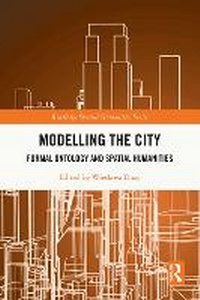
Modelling the City
Formal Ontology and Spatial Humanities
1st Edition
Published on 27. October 2025
Book
Paperback/Softback
216 pages
978-1-032-69587-7 (ISBN)
Description
Modelling the City focuses on European towns and cities, analysing the opportunities and limitations of modelling of urban space.
This book examines how urban space from the past is discovered, explained and presented. It discusses the multitude of historical sources mediating the past urban space, and the structural, technical, and epistemological issues raised around building a domain ontology, including continuity, and change within urban forms and functions.
Presentation of a formal domain ontology in spatial humanities makes this book unique and worth reading. It is strongly recommended to readers interested in the linked open data approach to research, data standards in Digital Humanities, urban planning, and old maps.
This book examines how urban space from the past is discovered, explained and presented. It discusses the multitude of historical sources mediating the past urban space, and the structural, technical, and epistemological issues raised around building a domain ontology, including continuity, and change within urban forms and functions.
Presentation of a formal domain ontology in spatial humanities makes this book unique and worth reading. It is strongly recommended to readers interested in the linked open data approach to research, data standards in Digital Humanities, urban planning, and old maps.
More details
Series
Language
English
Place of publication
London
United Kingdom
Publishing group
Taylor & Francis Ltd
Target group
College/higher education
Postgraduate and Undergraduate
Illustrations
34 s/w Photographien bzw. Rasterbilder, 1 s/w Zeichnung, 19 s/w Tabellen, 35 s/w Abbildungen
19 Tables, black and white; 1 Line drawings, black and white; 34 Halftones, black and white; 35 Illustrations, black and white
Dimensions
Height: 234 mm
Width: 156 mm
Thickness: 13 mm
Weight
357 gr
ISBN-13
978-1-032-69587-7 (9781032695877)
Copyright in bibliographic data and cover images is held by Nielsen Book Services Limited or by the publishers or by their respective licensors: all rights reserved.
Schweitzer Classification
Other editions
Additional editions
E-Book
06/2024
1st Edition
Taylor & Francis
€52.49
Available for download
E-Book
06/2024
1st Edition
Taylor & Francis
€52.49
Available for download
Book
06/2024
1st Edition
Routledge
€210.60
Shipment within 10-20 days
Person
Wieslawa Duzy is Assistant Professor at the Department of Historical Atlas at the Institute of History, Polish Academy of Sciences. She is also part of a project at the Faculty of History, "People, Places, and Events" of the University of Warsaw, Poland. Her research interests include social history of the eighteenth and nineteenth centuries, domain ontologies in the Humanities and spatial historical databases.
Content
I. Introduction How To Build A Solid House, Or About The Historical Ontology Of The Urban Space Project II. Media, sources, data model 1. Modelling As A Bridge Between Maps, Spatial Concepts, And The Territory; 2. An Ontology Of Geographical Places And Their Spatiotemporal, Social Evolution In The Context Of An Extension Of The CIDOC CRM For The Humanities And Social Sciences (SDHSS); 3. Naming the parts: identifying key features within the urban landscapes of Britain circa 1900 III. Investigating urban space 4. Narrating Szczecin. Creation of urban authenticity through touristic city trails; 5. How names transform space: The change of street names in Poznan and Gdynia in the nineteenth and twentieth centuries; 6. Uncertain information and spatial objects. Examples from works on the HOUSe project and the European Historic Towns Atlas series, Anna-Lena Schumacher IV. Mapping objects in urban space 7. Database of Topographic Objects 10k as the basis of the Historical Ontology of Urban Space ontology - construction, verification, validation; 8. Cartography and the city: Exploring urban ontologies through historic town-maps; 9. Changes in spatial development of Lviv from the second half of 18th century to the present day; Index