

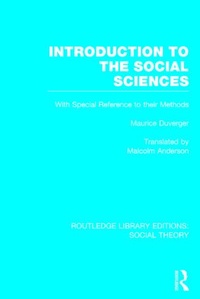
Introduction to the Social Sciences (RLE Social Theory)
With Special Reference to their Methods
1st Edition
Published on 8. August 2014
Book
Hardback
342 pages
978-1-138-78744-5 (ISBN)
Description
Professor Duverger at last provides the student with an overall view of the methodology of the social sciences. He briefly traces the origin of the notion of a social science, showing how it emerged from social philosophy. Its essential elements and pre-conditions are described; the splintering of social science into specialist disciplines is explained, and the need for a general sociology confirmed.
The techniques of observation used by social scientists are dealt with in some detail and the unity of the social sciences is illustrated by examples of the universal application of these techniques. Documentary evidence in its various forms are described along with the basic analytical techniques, including quantitative methods and content analysis. Other methods of gathering information through polls, interviews, attitude scales and participant observation are all described.
Professor Duverger brings together the different kinds of analysis used to assess the information thus gathered. Arguing that observing and theorizing are not two different stages or levels of research, he examines the practical value and difficulties of general sociological theories, partial theories and models and working hypotheses. He both describes and assesses the limitations of experiment and the scope of comparative methods in the social sciences. He then gives elementary instructions for using and assessing the value of mathematical techniques. The possibilities of presenting social phenomena through graphs and charts are also explored. There are useful book lists and diagrams.
The techniques of observation used by social scientists are dealt with in some detail and the unity of the social sciences is illustrated by examples of the universal application of these techniques. Documentary evidence in its various forms are described along with the basic analytical techniques, including quantitative methods and content analysis. Other methods of gathering information through polls, interviews, attitude scales and participant observation are all described.
Professor Duverger brings together the different kinds of analysis used to assess the information thus gathered. Arguing that observing and theorizing are not two different stages or levels of research, he examines the practical value and difficulties of general sociological theories, partial theories and models and working hypotheses. He both describes and assesses the limitations of experiment and the scope of comparative methods in the social sciences. He then gives elementary instructions for using and assessing the value of mathematical techniques. The possibilities of presenting social phenomena through graphs and charts are also explored. There are useful book lists and diagrams.
More details
Series
Language
English
Place of publication
London
United Kingdom
Publishing group
Taylor & Francis Ltd
Target group
College/higher education
Dimensions
Height: 234 mm
Width: 156 mm
Weight
790 gr
ISBN-13
978-1-138-78744-5 (9781138787445)
Copyright in bibliographic data and cover images is held by Nielsen Book Services Limited or by the publishers or by their respective licensors: all rights reserved.
Schweitzer Classification
Other editions
Additional editions
Maurice Duverger
Introduction to the Social Sciences (RLE Social Theory)
E-Book
09/2020
1st Edition
Routledge
€41.99
Available for download
Maurice Duverger
Introduction to the Social Sciences (RLE Social Theory)
E-Book
09/2020
1st Edition
Routledge
€41.99
Available for download
Maurice Duverger
Introduction to the Social Sciences (RLE Social Theory)
With Special Reference to their Methods
Book
05/2016
1st Edition
Routledge
€57.13
Shipment within 10-20 days
Persons
Content
Introduction: The Social Sciences 1. The Idea of Social Science 2. The Various Social Sciences Part 1: The Techniques of Observation 1. Documentary Observation 1.1. Categories of Documents 1.2. Methods of Analysing Documents 1.3. Technique of Content Analysis 2. Direct Extensive Observation 2.1. Sampling 2.2. Questionnaire Methods 2.3. The Results of Investigations 3. Direct Intensive Observation 3.1. Interviews 3.2. Tests and the Measurement of Attitudes 3.3. Participant Observation Part 2: Systematic Analysis 1. Elements of Systematic Analysis 1.1. Conceptual Frameworks for Research 1.2. Research 1.3. The Comparative Method 2. Mathematical and Graph Techniques 2.1. Mathematical Techniques 2.2. Graphs