

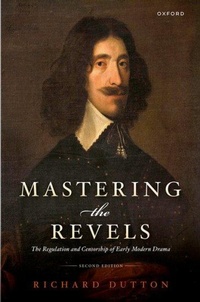
Mastering the Revels
The Regulation and Censorship of Early Modern Drama
2nd Edition
Published on 14. July 2022
Book
Hardback
414 pages
978-0-19-881945-5 (ISBN)
Description
Mastering the Revels traces the measures taken by the governments of Elizabeth I, James I, and Charles I to regulate the new phenomenon of fixed playhouses and resident playing companies in London, and to censor their plays. It focuses on the Masters of the Revels, whose primary function was to seek out theatrical entertainment for the court but whose role expanded to include oversight of the players and their playhouses.
The book proceeds chronologically, tracking each of the Masters in the period--Edmund Tilney (served 1579-1610), Sir George Buc (1610-22), Sir John Astley (1622-3), and Sir Henry Herbert (1623-1642). Tilney was the first to receive a Special Commission giving him wide-ranging powers over the players. When Buc first became involved is examined here in detail, as is the parallel history of the Children of the Queen's Revels who between 1604 and 1608 staged some of the most scandalous plays of the era. Astley succeeded Buc, but soon sold the office to Herbert, who then served to the closing of the theatres.
Manuscripts of plays censored by Tilney, Buc, and Herbert have survived and are examined in detail to assess their concerns. Large parts of Herbert's office-book have also survived, giving detailed insights into his professional life, including interactions with both the court and the players. It reveals the difficulties he faced negotiating recurrent popular pressure for war against Spain, resistance to Archbishop Laud's reforms of the church, and Henrietta Maria's problematic presence as a Catholic queen to Charles I.
The book proceeds chronologically, tracking each of the Masters in the period--Edmund Tilney (served 1579-1610), Sir George Buc (1610-22), Sir John Astley (1622-3), and Sir Henry Herbert (1623-1642). Tilney was the first to receive a Special Commission giving him wide-ranging powers over the players. When Buc first became involved is examined here in detail, as is the parallel history of the Children of the Queen's Revels who between 1604 and 1608 staged some of the most scandalous plays of the era. Astley succeeded Buc, but soon sold the office to Herbert, who then served to the closing of the theatres.
Manuscripts of plays censored by Tilney, Buc, and Herbert have survived and are examined in detail to assess their concerns. Large parts of Herbert's office-book have also survived, giving detailed insights into his professional life, including interactions with both the court and the players. It reveals the difficulties he faced negotiating recurrent popular pressure for war against Spain, resistance to Archbishop Laud's reforms of the church, and Henrietta Maria's problematic presence as a Catholic queen to Charles I.
Reviews / Votes
This book is thoroughly researched and presents a great deal of information about this subject in a manner that allows readers to follow the narrative or to skim to the sections relevant to their individual research. * Anna Faktorovich, editor-in-chief, Pennsylvania literary Journal * This second edition is must reading for those interested in Shakespeare and early modern English theater. * Choice *More details
Edition
2nd edition
Language
English
Place of publication
Oxford
United Kingdom
Target group
Professional and scholarly
Product notice
sewn/stitched
Cloth over boards
Illustrations
11 Illustrations
Dimensions
Height: 237 mm
Width: 164 mm
Thickness: 29 mm
Weight
794 gr
ISBN-13
978-0-19-881945-5 (9780198819455)
Copyright in bibliographic data and cover images is held by Nielsen Book Services Limited or by the publishers or by their respective licensors: all rights reserved.
Schweitzer Classification
Other editions
Additional editions
E-Book
06/2022
1st Edition
OUP eBook
€75.49
Available for download
E-Book
06/2022
1st Edition
OUP eBook
€75.49
Available for download
Person
Educated at King's College, Cambridge and the University of Nottingham, Professor Dutton taught English for 29 years at Lancaster University. He then moved to The Ohio State University where he was Humanities Distinguished Professor of English for 13 years, five of them as chair of department. Following retirement in 2016, he held a three-year part-time research position at Queen's University, Belfast. In the course of his career he has authored and edited some 30 books and received research funding from numerous sources, including the Arts and Humanities Research Board, the Folger and Huntington Libraries, and the National Endowment for the Humanities.
Content
- Introduction: Through a Glass, Darkly
- 1: Country and Court: A System of Control Emerges, 1549-79
- 2: Tilney, Patronage and Profit, 1579-89
- 3: 1586-1592: Decrees for Orders in Printing; 'Martin Marprelate'; Tilney Reappears; Christopher Marlowe
- 4: 1592-1602: The Theatrical World Reassembles; Tilney's Position Consolidated
- 5a: Transition and Transgression: From Tilney to Buc, 1603-10
- 5b: The 'Little Eyases' and the Early Years of James's Reign
- 6: Sir George Buc, 1610-22, and Topical Readings
- 7: From Astley to Herbert: the contest for office, 1622-3
- 8: 1623-42: Sir Henry Herbert, A Master at Work