

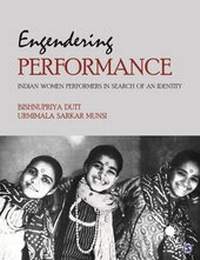
Engendering Performance
Indian Women Performers in Search of an Identity
1st Edition
Published on 9. September 2010
Book
Hardback
328 pages
978-81-321-0456-8 (ISBN)
Description
This book is a comprehensive critical history of women artistes in Indian theatre and dance of the colonial and post-colonial periods. Its underlying premise is that one cannot evaluate such performances in the Indian context without looking at dance and theatre together, unlike the course taken by traditional scholarship. The author weaves together issues of sexuality and colonialism, and culture and society to provide a holistic account of women performers in India.
The distinguishing features of this book are: a close reading of archival materials, field surveys and extensive interviews that provide new information and insights. The book is divided into two sections, on the Actress and on the Danseuse, and displays how the two evolved in different ways. In doing this, it explores the theme of identity and body politics, while simultaneously balancing a historical narrative with emphasis on crucial individual topics.
The book adopts a pluralistic approach combining history, economics, cultural studies, popular culture, anthropology, ethnography and feminist criticism. Archival photographs-some of which have never been published before-make it a collector's item.
The distinguishing features of this book are: a close reading of archival materials, field surveys and extensive interviews that provide new information and insights. The book is divided into two sections, on the Actress and on the Danseuse, and displays how the two evolved in different ways. In doing this, it explores the theme of identity and body politics, while simultaneously balancing a historical narrative with emphasis on crucial individual topics.
The book adopts a pluralistic approach combining history, economics, cultural studies, popular culture, anthropology, ethnography and feminist criticism. Archival photographs-some of which have never been published before-make it a collector's item.
Reviews / Votes
This is a book for academicians engaged in performing arts and for dancers and women performers in theatre especially. -- Organiser The book is a comprehensive critical history of women artistes in Indian theatre and dance of colonial and post-colonial periods. Its underlying premise is that one cannot evaluate such performances in the Indian context without looking at dance and theatre together, unlike the course taken by traditional scholarship. The author weaves together issues of sexuality and colonialism, and culture and society to provide a holistic account of women performers in India. Archival photographs-some of which have never been published before-make it a collector's item. -- The PioneerMore details
Edition
First Edition
Language
English
Place of publication
New Delhi
India
Target group
College/higher education
Dimensions
Height: 241 mm
Width: 184 mm
Weight
825 gr
ISBN-13
978-81-321-0456-8 (9788132104568)
Copyright in bibliographic data and cover images is held by Nielsen Book Services Limited or by the publishers or by their respective licensors: all rights reserved.
Schweitzer Classification
Persons
Bishnupriya Dutt, daughter of legendary theatre personalities Utpal Dutt and Sova Sen, is currently Associate Professor in Theatre Studies at the School of Arts and Aesthetics, Jawaharlal Nehru University, New Delhi. She was awarded a Ph.D. for her work on 'Contributions of Theatre Magazines in the Growth and Genesis of Theatre Aesthetics' from the University of Calcutta. Her recent publications include: 'Actress Stories: Binodini and Amal Allana', in Sue Ellen Case and Elaine Aston (eds), Staging International Feminisms (2007).
She received a DAAD fellowship in Germany to study alternate aesthetic models for the theatre in post-colonial India. Dr Dutt has been an active member of the Feminist Working Group of the International Federation of Theatre Research, and has worked with the People's Little Theatre, the largest repertoire in Calcutta. In 2006, she produced a play based on autobiographies of five actresses, titled Nati. This innovative play had its performance text created through a collaborative effort by the participant actresses.
Urmimala Sarkar Munsi is a Visiting Faculty at the School of Arts and Aesthetics, Jawaharlal Nehru University, New Delhi, where she teaches Dance Studies and Visual Ethnography. She has a Ph.D. in social anthropology on socio-cultural context of tribal and folk dance from Calcutta University. She has continued her post-doctoral work on issues of dance, gender and politics of performance. In March 2005, she was invited as the Artist-in-Residence by the Centre for World Performance Studies, University of Michigan, Ann Arbor. She has travelled widely for her research and has extensively documented traditional communities of professional women performers (Maibi, Nautanki, Nachni, Jogti) in India as a part of her research project.
She received a DAAD fellowship in Germany to study alternate aesthetic models for the theatre in post-colonial India. Dr Dutt has been an active member of the Feminist Working Group of the International Federation of Theatre Research, and has worked with the People's Little Theatre, the largest repertoire in Calcutta. In 2006, she produced a play based on autobiographies of five actresses, titled Nati. This innovative play had its performance text created through a collaborative effort by the participant actresses.
Urmimala Sarkar Munsi is a Visiting Faculty at the School of Arts and Aesthetics, Jawaharlal Nehru University, New Delhi, where she teaches Dance Studies and Visual Ethnography. She has a Ph.D. in social anthropology on socio-cultural context of tribal and folk dance from Calcutta University. She has continued her post-doctoral work on issues of dance, gender and politics of performance. In March 2005, she was invited as the Artist-in-Residence by the Centre for World Performance Studies, University of Michigan, Ann Arbor. She has travelled widely for her research and has extensively documented traditional communities of professional women performers (Maibi, Nautanki, Nachni, Jogti) in India as a part of her research project.
Content
Foreword SAMIK BANDOPADHYAY - Ghulam Nabi Azad
Introduction
I: THE STORY OF THE ACTRESS
Actresses of the Colonial Space: English Actresses in India
Locating a New Space and Identity: Coming of the Indian Actresses
Locating a New Space and Identity: Coming of the Indian Actresses
Actresses in the Jatra Space
II: OF THE WOMAN DANCER
Natyasastra: Emerging (Gender) Codes and the Woman Dancer
The Body and the Woman Dancer: What She is, or What She is Expected to be
Emergence of the Contemporary Woman Dancer: Contribution of Tagore, Shankar and IPTA
Tale of the Professional Woman Dancer in Folk Traditions in India: Commodification of Dance and the Traditional Dancing Women
Conclusion: In Conversation with Samik Bandyopadhyay
Bibliography
Index
Introduction
I: THE STORY OF THE ACTRESS
Actresses of the Colonial Space: English Actresses in India
Locating a New Space and Identity: Coming of the Indian Actresses
Locating a New Space and Identity: Coming of the Indian Actresses
Actresses in the Jatra Space
II: OF THE WOMAN DANCER
Natyasastra: Emerging (Gender) Codes and the Woman Dancer
The Body and the Woman Dancer: What She is, or What She is Expected to be
Emergence of the Contemporary Woman Dancer: Contribution of Tagore, Shankar and IPTA
Tale of the Professional Woman Dancer in Folk Traditions in India: Commodification of Dance and the Traditional Dancing Women
Conclusion: In Conversation with Samik Bandyopadhyay
Bibliography
Index