

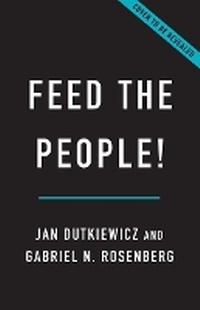
Feed the People!
Why Industrial Food Is Good and How to Make It Even Better
Will be published approx. on 17. February 2026
Book
Hardback
288 pages
978-1-5416-0378-3 (ISBN)
Description
Why Wendell Berry, Michael Pollan, and other slow-food-loving locavores are wrong about food in America—and why Waffle House can save us all.
“This book is sustenance for your mind as it imagines more democratic and delightful ways we can all fill our stomachs.” —Astra Taylor, author of Democracy May Not Exist, But We’ll Miss It When It’s Gone
The food industry is a major driver of climate change, pollution, obesity, animal suffering, and workplace exploitation. Many food writers blame the industrial food system and tell individual eaters to fix these problems by buying local, artisanal food from small farmers—a solution most Americans can’t afford.
But, as food-policy experts Jan Dutkiewicz and Gabriel Rosenberg remind us, modern technology has made food more affordable, abundant, varied, and tastier than at any other time in history. In Feed the People!, they argue that modern food pleasures like Waffle House waffles, and the industrial systems that make them possible, are actually good. With smart technology and commonsense policies, we can make them even better.
Dutkiewicz and Rosenberg have traveled around the United States to find the people changing the way we make and eat food, from the innovators behind plant-based burgers to the cooks serving free school lunches to the labor organizers unionizing fast food joints. They show that building a food system that works for everyone will take more than just eating your vegetables.
Feed the People! invites you to sit at the table and join this delicious movement.
“This book is sustenance for your mind as it imagines more democratic and delightful ways we can all fill our stomachs.” —Astra Taylor, author of Democracy May Not Exist, But We’ll Miss It When It’s Gone
The food industry is a major driver of climate change, pollution, obesity, animal suffering, and workplace exploitation. Many food writers blame the industrial food system and tell individual eaters to fix these problems by buying local, artisanal food from small farmers—a solution most Americans can’t afford.
But, as food-policy experts Jan Dutkiewicz and Gabriel Rosenberg remind us, modern technology has made food more affordable, abundant, varied, and tastier than at any other time in history. In Feed the People!, they argue that modern food pleasures like Waffle House waffles, and the industrial systems that make them possible, are actually good. With smart technology and commonsense policies, we can make them even better.
Dutkiewicz and Rosenberg have traveled around the United States to find the people changing the way we make and eat food, from the innovators behind plant-based burgers to the cooks serving free school lunches to the labor organizers unionizing fast food joints. They show that building a food system that works for everyone will take more than just eating your vegetables.
Feed the People! invites you to sit at the table and join this delicious movement.
More details
Language
English
Place of publication
United States
Product notice
sewn/stitched
Cloth over boards
Dimensions
Height: 240 mm
Width: 161 mm
Thickness: 30 mm
Weight
468 gr
ISBN-13
978-1-5416-0378-3 (9781541603783)
Copyright in bibliographic data and cover images is held by Nielsen Book Services Limited or by the publishers or by their respective licensors: all rights reserved.
Schweitzer Classification
Other editions
Additional editions
Jan Dutkiewicz | Gabriel N. Rosenberg
Feed the People!
Why Industrial Food Is Good and How to Make It Even Better
E-Book
02/2026
Basic Books
€14.99
Available for download
Persons
Jan Dutkiewicz is an assistant professor at Pratt Institute. He is a contributing writer at Vox and a contributing editor at The New Republic. He lives in Brooklyn, New York.
Gabriel N. Rosenberg is an associate professor at Duke University and a Senior Research Scholar at the Max Planck Institute for the History of Science in Berlin. He lives in Durham, North Carolina.