

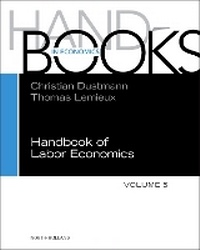
Handbook of Labor Economics: Volume 5
Published on 13. December 2024
Book
Hardback
860 pages
978-0-443-29764-9 (ISBN)
Description
Volumes 5 and 6 of the Handbook of Labor Economics will systematically review the research topics, empirical findings, and methods that constitute frontier research in the field. The focus will be on the most important research advances that have taken place since the publication of the previous Handbook Volume 4 almost 15 years ago.
More details
Series
Language
English
Place of publication
United States
Publishing group
Elsevier Science & Technology
Target group
Professional and scholarly
Product notice
Laminated cover
Dimensions
Height: 236 mm
Width: 159 mm
Thickness: 47 mm
Weight
1483 gr
ISBN-13
978-0-443-29764-9 (9780443297649)
Copyright in bibliographic data and cover images is held by Nielsen Book Services Limited or by the publishers or by their respective licensors: all rights reserved.
Schweitzer Classification
Other editions
Additional editions
Persons
Christian Dustmann is Professor of Economics at University College London (UCL), Honorary Professor at Humboldt University Berlin, Director of the Rockwool Foundation Berlin Institute for the Economy and the Future of Work (RFBerlin), and founding Director of the Centre for Research and Analysis of Migration (CReAM). He is a leading labor economist who has worked on topics such as migration, the economics of education, the economics of crime, social networks, technology, income mobility, wage dynamics, and inequality. Professor Dustmann has been a visiting professor at UC Berkeley, Harvard, Princeton, Stanford, and Yale. He served as President of the Asian and Australasian Society of Labour Economics (AASLE) (2017-2021), which he co-founded. He has also served as President of the European Association of Labour Economists (EALE) and the European Society for Population Economics (ESPE). Professor Dustmann is an elected Fellow of the British Academy (FBA), the German Academy of Sciences (Leopoldina), the Academy of Europe (Academia Europaea), the Econometric Society, and the Society of Labor Economists (SOLE). In 2020, Professor Dustmann received the Carl Friedrich von Weizsaecker Prize from the German National Academy of Sciences for scientific contributions to socially important challenges. Dustmann is the first economist honored with this prize. In 2023, he received the Reimar Luest Prize for International Science and Cultural Communication, awarded by the Alexander von Humboldt Foundation and the Fritz Thyssen Foundation. In the 2019 German Economic Association ranking, he was first among economists in German-speaking countries and German economists abroad. He regularly advises government bodies, international organizations, and the media on policy issues.
Thomas Lemieux is a Professor at UBC's Vancouver School of Economics. Prior to moving to UBC in 1999, Professor Lemieux held appointments at the Universite de Montreal and at the Massachusetts Institute of Technology (MIT). He is a Research Associate of the National Bureau of Economic Research and a fellow of the Royal Society of Canada, the Society of Labor Economists, and the Econometric Society. Professor Lemieux is a past President of the Society of Labor Economists and of the Canadian Economics Association, which awarded him the Rae Prize for outstanding research in 1998. He has served as co-editor major journals in economics, including the American Economic Review. Lemieux has written extensively on labour markets and earnings inequality in Canada, the United States and other countries. He has also made contributions to the methodology of empirical research in labour economics.
Thomas Lemieux is a Professor at UBC's Vancouver School of Economics. Prior to moving to UBC in 1999, Professor Lemieux held appointments at the Universite de Montreal and at the Massachusetts Institute of Technology (MIT). He is a Research Associate of the National Bureau of Economic Research and a fellow of the Royal Society of Canada, the Society of Labor Economists, and the Econometric Society. Professor Lemieux is a past President of the Society of Labor Economists and of the Canadian Economics Association, which awarded him the Rae Prize for outstanding research in 1998. He has served as co-editor major journals in economics, including the American Economic Review. Lemieux has written extensively on labour markets and earnings inequality in Canada, the United States and other countries. He has also made contributions to the methodology of empirical research in labour economics.
Content
1. Crime and the Labor Market
Randi Hjalmarsson, Stephen Machin and Paolo Pinotti
2. Empirical Bayes Methods in Labor Economics
Christopher Walters
3. Families and the Labor Market
Gordon Dahl and Katrine V. Loken
4. Immigration
Christian Dustmann and Uta Schoenberg
5. Instrumental Variables with Heterogeneous Treatment Effects
Magne Mogstad and Alexander Torgovitsky
6. Job Search, UI and ALMP
Thomas Le Barbanchon, Johannes Schmieder and Andrea Weber
7. Labor Force Transitions
Rui Castro, Fabian Lange and Markus Poschke
8. Short-term work policies
Pierre Cahuc
9. Minimum Wages
Arindrajit Dube and Attila Lindner
10. Trade and the Labor Market
David Autor, David Dorn, Gordon Hanson, Margaret R. Jones and Bradley Setzler
11. Education, Skills and the Wage Structure
David Deming and Mikko Silliman
12. Compensating Differences
Alexandre Mas
13. Gender inequalities
Claudia Olivetti, Jessica Pan and Barbara Petrongolo
14. Labor Market Concentration
Ioana Marinescu and Jose Azar
15. Race in the Labor Market
Patrick Bayer, Kerwin Charles and Ellora Derenoncourt
16. Recent Advances in Personell Economics
Mitchell Hoffman, Kathryn Shaw and Christopher Stanton
17. Technology, Automation, and the Labor Market
Daron Acemoglu and Pascual Restrepo
18. Unions
Suresh Naidu, Benjamin Schoefer and Simon Jaeger
19. Wage Setting Power: Theory and Evidence
Patrick Kline
Randi Hjalmarsson, Stephen Machin and Paolo Pinotti
2. Empirical Bayes Methods in Labor Economics
Christopher Walters
3. Families and the Labor Market
Gordon Dahl and Katrine V. Loken
4. Immigration
Christian Dustmann and Uta Schoenberg
5. Instrumental Variables with Heterogeneous Treatment Effects
Magne Mogstad and Alexander Torgovitsky
6. Job Search, UI and ALMP
Thomas Le Barbanchon, Johannes Schmieder and Andrea Weber
7. Labor Force Transitions
Rui Castro, Fabian Lange and Markus Poschke
8. Short-term work policies
Pierre Cahuc
9. Minimum Wages
Arindrajit Dube and Attila Lindner
10. Trade and the Labor Market
David Autor, David Dorn, Gordon Hanson, Margaret R. Jones and Bradley Setzler
11. Education, Skills and the Wage Structure
David Deming and Mikko Silliman
12. Compensating Differences
Alexandre Mas
13. Gender inequalities
Claudia Olivetti, Jessica Pan and Barbara Petrongolo
14. Labor Market Concentration
Ioana Marinescu and Jose Azar
15. Race in the Labor Market
Patrick Bayer, Kerwin Charles and Ellora Derenoncourt
16. Recent Advances in Personell Economics
Mitchell Hoffman, Kathryn Shaw and Christopher Stanton
17. Technology, Automation, and the Labor Market
Daron Acemoglu and Pascual Restrepo
18. Unions
Suresh Naidu, Benjamin Schoefer and Simon Jaeger
19. Wage Setting Power: Theory and Evidence
Patrick Kline